Overview
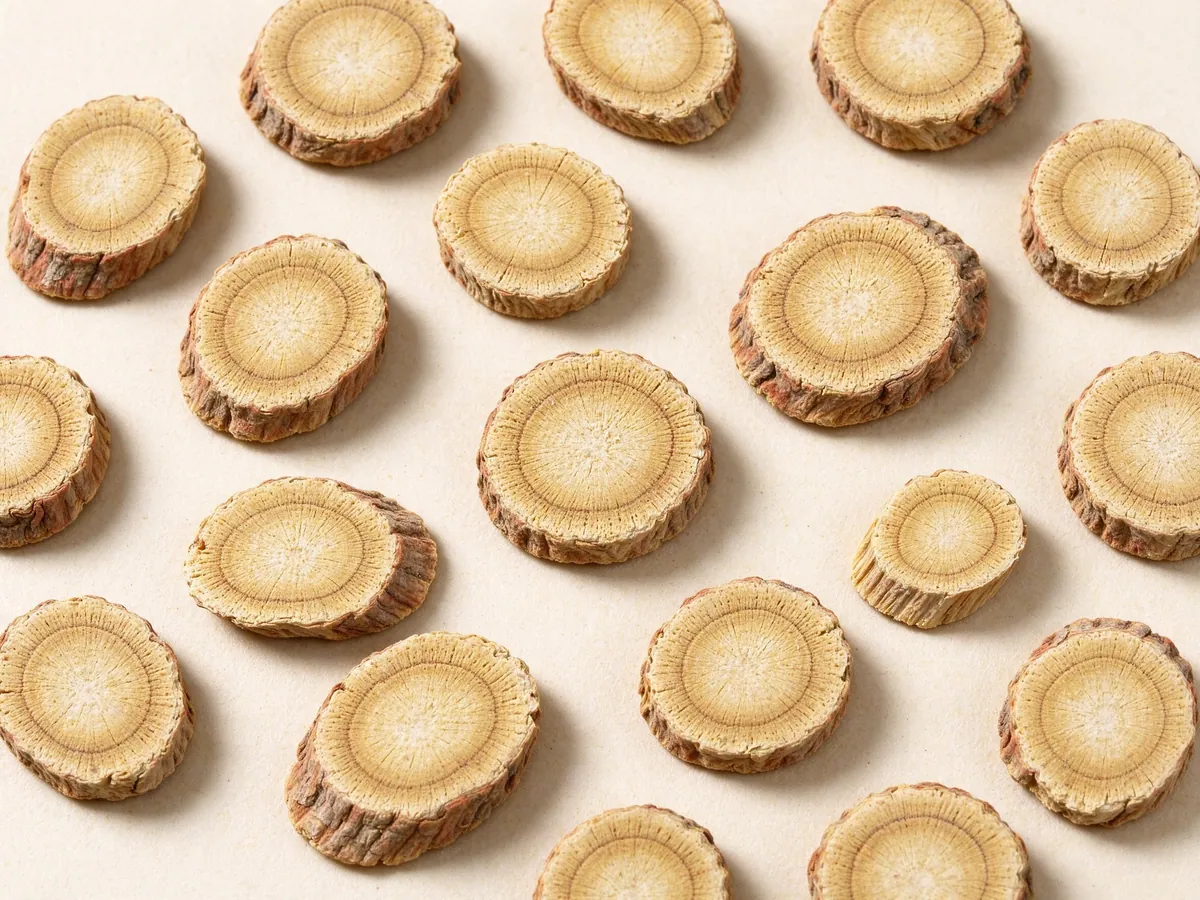
Gan Cao is the dried root and rhizome of three Glycyrrhiza species.1 It is sweet, neutral, and enters the Heart, Lung, Spleen and Stomach.1,2
It tonifies Qi, clears heat and toxicity, resolves Phlegm and stops cough, relieves painful spasm, and harmonises the other ingredients of a prescription.1
The unprepared root is slightly cool and clears heat and toxicity; the honey-fried root is slightly warm and tonifies the middle and restores the pulse.3,1 The prepared form is a component of many classical formulas.4
Identity and sources
The medicinal material is the dried root and rhizome of Glycyrrhiza uralensis, Glycyrrhiza inflata or Glycyrrhiza glabra.1
Honey-frying is what produces Zhi Gan Cao 炙甘草.1
Actions
- Tonifies the Spleen and augments Qi. For the tiredness, poor appetite and loose stools of Spleen Qi deficiency, and for breathlessness on exertion.4,1
- Tonifies the Heart and restores the pulse. The honey-fried form is used for palpitations with an irregular or intermittent pulse.1
- Moistens the Lung and stops cough. For cough of either temperature and either a dry or a productive character, because the root is neutral.4,3
- Moderates spasm and alleviates pain. For cramping pain in the abdomen and spasm of the limbs.4
- Clears heat and resolves fire toxicity. For sores, carbuncles and sore throat.4
- Moderates and harmonises other herbs. It moderates hot and cold herbs and mitigates the harsh properties of other ingredients.4
Clinical applications
Spleen Qi deficiency
For lassitude, poor appetite and loose stools from Spleen and Stomach Qi deficiency.3
Palpitations and irregular pulse
The honey-fried root restores the pulse and is used for palpitations with an irregular or intermittent pulse.1
Cough and wheezing
It is used for cough and wheezing of any duration, of interior or exterior origin, and of either heat or cold; it suits both productive and non-productive coughs.4,3
Painful spasm
For acute abdominal pain from an overactive Liver invading the Spleen, and for limb spasm from Yin and Blood deficiency, it relieves pain by nourishing the Liver Yin.3
Sores, sore throat and toxicity
Used unprepared, it is taken internally or applied topically for carbuncles, sores and sore throat due to fire toxin.4
Key combinations
With Ren Shen 人参, Bai Zhu 白术 and Fu Ling 茯苓 in Si Jun Zi Tang, it supports the treatment of Spleen Qi deficiency with fatigue and loose stools.3
With Ren Shen 人参, E Jiao 阿胶 and Gui Zhi in Zhi Gan Cao Tang, the honey-fried root is used for palpitations with an irregular pulse.3
With Bai Shao 白芍 in Shao Yao Gan Cao Tang, it treats cramping abdominal pain and limb spasm.3
Comparison with similar herbs
| Form | Key difference |
|---|---|
| Unprepared root (Sheng Gan Cao 生甘草) | Neutral by official grading and slightly cool in use. Chosen to clear heat, resolve toxicity and treat sore throat.4,3 |
| Honey-fried root (Zhi Gan Cao 炙甘草) | Warmer and more tonifying. Chosen for Spleen and Heart Qi deficiency and for an irregular pulse.3,4,1 |
| Licorice tips (Gan Cao Shao 甘草梢) | Rather cooling. Used to drain fire and resolve toxicity.4 |
Processing and preparation
For the honey-fried form the slices are stir-fried with prepared honey until yellow to deep yellow and no longer sticky, then cooled.1
The frying significantly increases the ability of the root to tonify the middle.4
External use
The unprepared root is applied topically as well as taken internally for red, swollen sores and sore throat.4
Safety
Contraindications
Distention and fullness of the chest or abdomen, and vomiting from overabundant Dampness.4 It is not to be combined with Sargassum, Jing Da Ji, Hong Da Ji, Gan Sui or Yuan Hua.1 That classical prohibition is no longer applied strictly, and the root has long been combined with Sargassum in practice.4
Use with caution
Dampness accumulation.3 Oedema, hypertension, low potassium and congestive heart failure, where sodium and water retention is dangerous.4
Adverse effects
Long-term use can cause salt retention, hypertension, muscle spasm and numbness, dizziness and headache.4
Toxicity and overdose
Glycyrrhizin inhibits 11beta-hydroxysteroid dehydrogenase type 2, so cortisol activates the mineralocorticoid receptor without restraint.5 This causes pseudoaldosteronism, with low potassium and hypertension.5,6 Severe cases present with refractory low potassium, hypertensive crisis and pulmonary oedema.5
Interactions
It potentiates oral and topical corticosteroids.7 It can interfere with digoxin pharmacodynamics or with digoxin monitoring.8 It can cause hypokalemia when taken with antihypertensives, and it can offset the effect of spironolactone.9,8
Modern research
Glycyrrhizin and its metabolites inhibit 11beta-hydroxysteroid dehydrogenase type 2, the enzyme that protects the mineralocorticoid receptor from cortisol.5,6
In a study of 78 patients taking licorice-containing medicines, the concentrations of 3-epi-GA and 3-epi-GA30G correlated with serum markers of pseudoaldosteronism, and their appearance varied widely between individuals.6
One patient developed severe refractory low potassium with hypertensive crisis and pulmonary oedema from eating an excessive amount of liquorice sweets.5 Another presented with dyspnoea, peripheral oedema and pleural effusion after more than ten years of Shakuyakukanzoto use.10 These are individual cases, not estimates of risk at ordinary doses.
Dose and administration
The official reference dose is 2-10 g.1 Some clinical texts use 3-10 g, or 15-30 g when a larger dose is intended.3 The official dose in Taiwan is 2-11.5 g.2
None of these figures is a safe upper limit.
Common questions
Why does licorice raise blood pressure?
Glycyrrhizin inhibits 11-beta-hydroxysteroid dehydrogenase type 2, so cortisol activates the mineralocorticoid receptor without restraint. This causes pseudoaldosteronism with low potassium.5
What is the difference between Gan Cao and Zhi Gan Cao?
Are the classical incompatibilities still observed?
Can it be taken long term?
Not without supervision. Long-term use can cause salt retention and hypertension, and it is inappropriate for patients with oedema, hypertension, low potassium or congestive heart failure.4
References
- Chinese Pharmacopoeia Commission. Pharmacopoeia of the People's Republic of China, 2020 edition, Volume I. Beijing: China Medical Science Press; 2020. Part I, pp. 88-89.
- Ministry of Health and Welfare. Taiwan Herbal Pharmacopoeia, 4th edition (English edition). Taipei; 2022, with 2025 amendments where cited. p. 195.
- Chang M, Jia M, Bare M, eds. Chinese Materia Medica. Beijing: People's Medical Publishing House; 2014. pp. 563-565.
- Bensky D, Clavey S, Stöger E. Chinese Herbal Medicine: Materia Medica. Portable 3rd edition. Seattle: Eastland Press; 2015. pp. 765-767.
- McHugh J, Nagabathula R, Kyithar MP. A life-threatening case of pseudo-aldosteronism secondary to excessive liquorice ingestion. BMC Endocr Disord. 2021. doi.org/10.1186/s12902-021-00816-4
- Sakoda R, Ishiuchi K, Yoshino T, et al. 3-epi-18beta-glycyrrhetinic acid or its glucuronide, the metabolites of glycyrrhizinic acid with individual differences, correlated with diagnostic marker for licorice-induced pseudoaldosteronism in humans. Drug Metab Dispos. 2024. doi.org/10.1124/dmd.124.001840
- Fugh-Berman A. Herb-drug interactions. Lancet. 2000;355(9198):134-138. doi:10.1016/S0140-6736(99)06457-0 pubmed.ncbi.nlm.nih.gov/10675182
- Miller LG. Herbal medicinals: selected clinical considerations focusing on known or potential drug-herb interactions. Arch Intern Med. 1998;158(20):2200-2211. doi:10.1001/archinte.158.20.2200 pubmed.ncbi.nlm.nih.gov/9818800
- Izzo AA, Di Carlo G, Borrelli F, Ernst E. Cardiovascular pharmacotherapy and herbal medicines: the risk of drug interaction. Int J Cardiol. 2005;98(1):1-14. doi:10.1016/j.ijcard.2003.06.039 pubmed.ncbi.nlm.nih.gov/15676159
- Kurisu S, Fujiwara H. Glycyrrhizin-induced pseudoaldosteronism contributing to decompensated heart failure with preserved ejection fraction. Cureus. 2026. doi.org/10.7759/cureus.116676
Educational reference only. Not medical advice or an individual prescription. Consult a qualified practitioner before using any herb or treatment.