Overview
Da Zao is sweet and warm, entering the Spleen, Stomach and Heart.1
It tonifies the middle and augments the Qi, nourishes the Blood and calms the spirit.1
It also generates fluids, harmonises the Spleen and moderates the effects of other herbs.2
Identity and sources
The medicinal material is the dried ripe fruit of Ziziphus jujuba.1
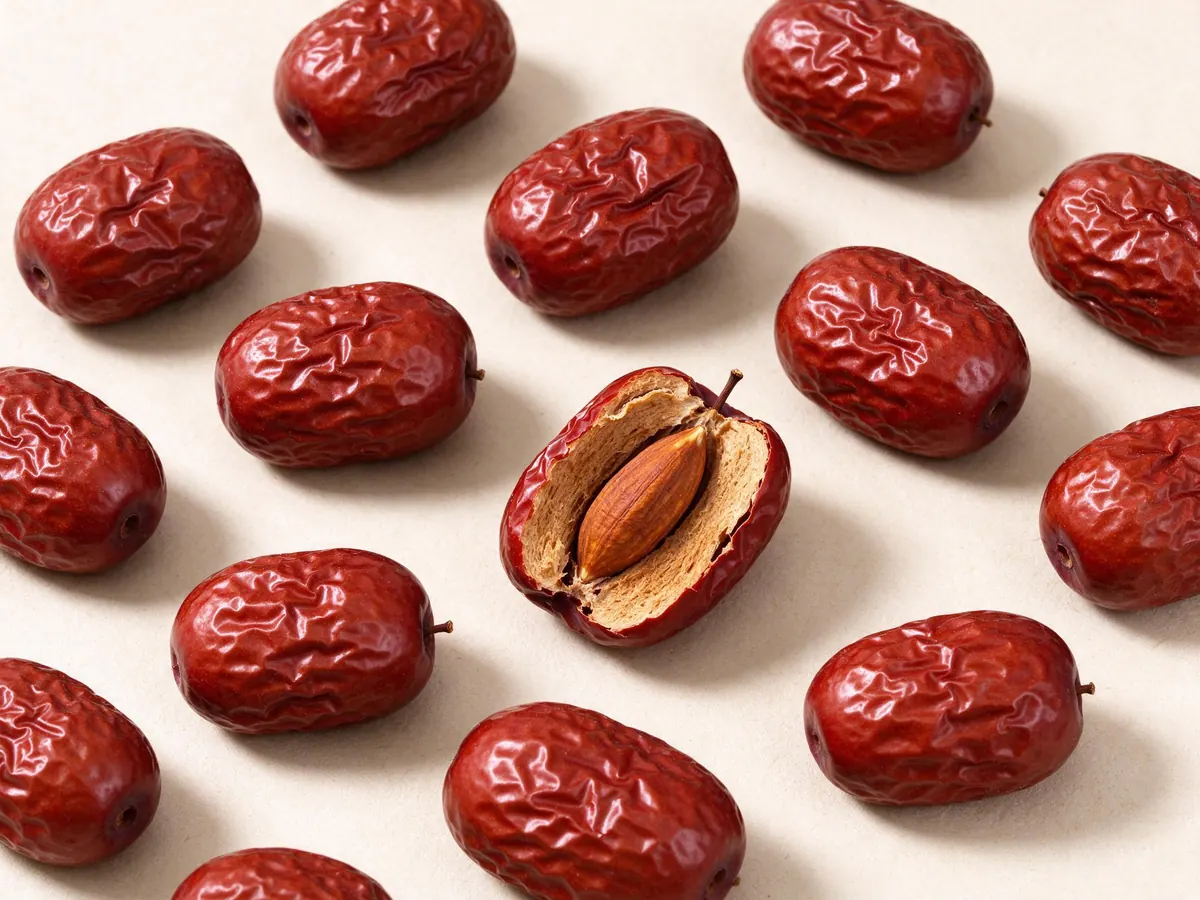
The fruits are oval or spherical, dark red and slightly glossy with irregular wrinkles, and have a short fruit stalk in a sunken base.1
The outer skin is thin, the flesh is brownish-yellow or pale brown, soft, sugary and oily, and the stone is spindle-shaped with sharp ends.1
They are collected when ripe in autumn and dried in the sun.1
Actions
- Tonifies the Spleen and augments the Qi. For weakness, shortness of breath, lassitude, reduced appetite and loose stools from Spleen and Stomach deficiency.2
- Nourishes the Blood and calms the spirit. For the wan appearance, irritability and severe emotional lability of restless organ disorder.2
- Moderates and harmonises the harsh properties of other herbs. It mollifies harsh cathartics and mitigates the harshness of acrid or bitter prescriptions.2
Clinical applications
Spleen and Stomach deficiency
It tonifies the Spleen and augments the Qi, and is used for weakness, shortness of breath, lassitude, reduced appetite and loose stools.2
Prepared with rice or millet gruel it is used for this purpose.2
Restless organ disorder
It nourishes the Blood and calms the spirit, and is used for the wan appearance, irritability and severe emotional lability.2
Spontaneous sweating
With light wheat, Mume and Mulberry leaf for incessant spontaneous sweating in the debilitated.2
Protecting the Stomach
Added to harsh cathartics such as Genkwa and Kansui it mollifies their action and prevents injury to the Spleen and Stomach.2
Key combinations
With Codonopsis and Atractylodes for weakness and lassitude from Spleen and Stomach deficiency.2
With fresh ginger to regulate disharmony between the nutritive and protective Qi and to help other Qi and Blood tonics be digested and absorbed.2
With E Jiao and Dang Gui for nutritive Qi and Blood deficiency.2
With Licorice and wheat for restless organ disorder, as in Licorice, Wheat and Jujube Decoction.2
Comparison with similar herbs
Processing and preparation
The fruits are cleaned of impurities, washed and dried in the sun, and are broken open or pitted when used.1
Large fruit is preferred.2
It is stored in a dry place and protected from insects.1
Safety
Contraindications
Heat from Damp-heat or Phlegm-heat; with abundant Dampness or Qi stagnation it is used with caution.2
Excessive use
Excessive consumption causes distension, diarrhoea, heat and thirst, and it is contraindicated for children, after childbirth, in warm, febrile and summerheat-Damp disorders, in jaundice and in swollen distension.2
Adverse effects
Allergic reactions after taking a decoction have been reported: urticaria, eyelid oedema and dyspnoea, with one severe case of angioneurotic oedema.2
Modern research
A review of Ziziphus jujuba summarises the research on the synthesis mechanisms and pharmacological activities of its phenolic compounds.3
The phenolic compounds of the fruit have antioxidant, anticancer, antibacterial, anti-inflammatory and hypoglycaemic effects.3
Jujube is a functional food with both edible and medicinal properties.3
Dose and administration
The official reference dose is 6-15 g.1 The dose in Taiwan is 6-30 g.4
This is a reference range, not a safe upper limit.
Common questions
Why is it added to harsh formulas?
It moderates and harmonises the harsh properties of other herbs, mollifying harsh cathartics and mitigating acrid or bitter prescriptions.2
What is restless organ disorder?
A pattern with the wan appearance, irritability and severe emotional lability.2
Can it be eaten freely?
No; excessive consumption causes distension, diarrhoea, heat and thirst, and it is contraindicated for children, after childbirth and in febrile and Damp-heat disorders.2
References
- Chinese Pharmacopoeia Commission. Pharmacopoeia of the People's Republic of China, 2020 edition, Volume I. Beijing: China Medical Science Press; 2020. Part I, p. 23.
- Bensky D, Clavey S, Stöger E. Chinese Herbal Medicine: Materia Medica. Portable 3rd edition. Seattle: Eastland Press; 2015. pp. 730-732.
- Hu Y, Du J, Fan Y, Liu F, He W, Li B, Cui X, Wang C. Phenolic Compounds in Ziziphus jujuba Mill.: Advances in Distribution, Biosynthesis, and Pharmacological Activities. Plants (Basel). 2026;15(8). doi:10.3390/plants15081160 pubmed.ncbi.nlm.nih.gov/42075362
- Ministry of Health and Welfare. Taiwan Herbal Pharmacopoeia, 4th edition (English edition). Taipei; 2022, with 2025 amendments where cited. p. 416.
Educational reference only. Not medical advice or an individual prescription. Consult a qualified practitioner before using any herb or treatment.