Overview
Ma Huang is pungent, slightly bitter and warm, entering the Lung and Bladder.1
It induces sweating to disperse cold, disseminates the Lung Qi and calms wheezing, and promotes urination to reduce oedema.1
Because it has a strong effect of inducing sweating and opening up the Lungs, the dose should not be too large.2
Identity and sources
The medicinal material is the dried herbaceous stem of Ephedra sinica, Ephedra intermedia or Ephedra equisetina.1
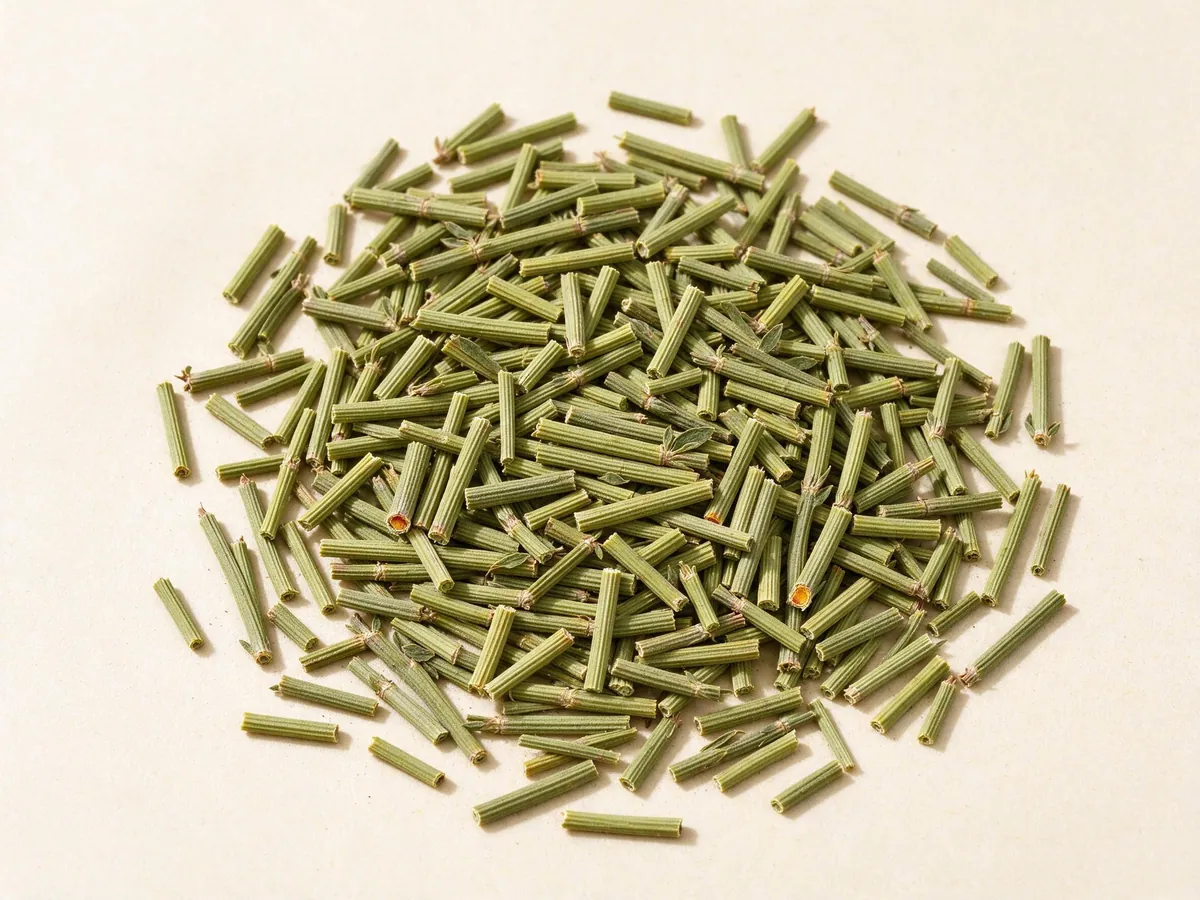
The stems are slender cylinders, little branched, 1-2 mm in diameter, pale green to yellow-green, with fine longitudinal ridges, a slightly rough feel and prominent nodes.1
They are cut in autumn while green and dried in the sun.1
Actions
- Induces sweating and releases the exterior. For exterior wind-cold with chills, fever, headache, absence of sweating and a tight, floating pulse.2
- Disseminates the Lung Qi, calms wheezing and stops coughing. For cough and wheezing from wind-cold obstructing the Lungs.2
- Promotes urination and reduces oedema. Especially for oedema that accompanies an exterior condition.2
- Warms and disperses cold pathogens. For wind-damp painful obstruction and deep-rooted toxic sores without a head.2
Clinical applications
Exterior wind-cold
It induces sweating and releases the exterior, and is used for exterior wind-cold with chills, fever, headache and no sweating.2
Cough and wheezing
It disseminates the Lung Qi, calms wheezing and stops coughing, and is used for cough and wheezing from wind-cold obstructing the Lungs.2
Where heat obstructs the Lungs with wheezing and nasal flaring it is used with Gypsum.2
Oedema
It promotes urination and reduces oedema, especially for oedema that accompanies an exterior condition.2
For acute onset oedema it is used with Atractylodes.2
Painful obstruction and sores
For wind-cold painful obstruction, and for exterior cold with oedema from Yang deficiency, it is used with prepared Aconite.2
It warms and disperses cold pathogens, and is used for painful obstruction and deep-rooted toxic sores without a head.2
Key combinations
With Gui Zhi for exterior wind-cold with fever and chills but no sweating, as in Ephedra Decoction.2,3
With Xing Ren for wind-cold cough and wheezing, as in Ephedra Decoction.2
With Gypsum for cough from heat obstructing the Lungs with wheezing and nasal flaring, as in Ephedra, Apricot Kernel, Gypsum and Licorice Decoction.2
With Atractylodes for acute onset oedema.2
With prepared Aconite for wind-cold painful obstruction, or exterior cold with oedema from Yang deficiency.2
Comparison with similar herbs
Processing and preparation
The stems are cleaned of woody stems, residual roots and impurities and cut into sections.1
The sections are cylindrical, pale yellow-green to yellow-green, rough, with fine longitudinal ridges and small scale leaves at the nodes, and a red-yellow centre in section.1
Stir-frying the sections with water reduces the diaphoretic action but strengthens the effect of calming the Lungs.2
Honey-frying the sections until they no longer stick to the hand gives honey-prepared Ma Huang; 100 kg of the herb uses 20 kg of refined honey.1
Honey-prepared Ma Huang is deep yellow and slightly glossy, with a honey aroma and a sweet taste.1
Honey preparation modifies the diaphoresis, and the intensity of its acrid dispersing qualities is moderated.2
It is stored in a ventilated dry place and protected from moisture.1
Safety
Contraindications
Debilitated patients, spontaneous sweating from exterior deficiency, night sweats from Yin deficiency, and wheezing from the Kidneys failing to accept Qi.2
It should be used with caution in patients with high blood pressure.2
Interactions
It should not be used with cardiac glycosides, as cardiac arrhythmias may occur.2
Adverse effects
It contains central nervous system stimulants and may cause high blood pressure, restlessness and insomnia, and allergic reactions with skin eruptions, slightly elevated temperature and measles-like erythema have been reported.2
Because ephedrine stimulates the sphincter muscle of the bladder, long-term use may cause oliguria or anuresis.2
Toxicity and overdose
The toxic dose is approximately 30-45 g.2 Symptoms of acute toxicity include palpitations, insomnia, chest pain, elevated temperature and tremor, and extreme overdoses can lead to blurred vision, dilated pupils, coma, dyspnoea, dysuria, convulsions, respiratory arrest, cardiac failure, bradycardia and ventricular fibrillation.2
Do not self-treat with this herb.
Modern research
A review of Ephedrae Herba covers its phytochemistry, pharmacology, clinical application and alkaloid toxicity.4
Alkaloids are the main components causing toxicity, so the safety of the herb must be considered.4
More than 100 compounds have been identified in the genus, including alkaloids, flavonoids, tannins, sugars and organic phenolic acids.4
It has been used for asthma, liver disease and skin disease, and has shown efficacy in COVID-19 infection.4
The nonalkaloid components can replace ephedrine extracts for some diseases, and reasonable use can ensure the safety of the herb.4
Dose and administration
The official reference dose is 2-10 g.1 The dose in Taiwan is 1.5-9 g.5
This is a reference range, not a safe upper limit.
Common questions
Why are the nodes and roots removed?
Both are considered to reduce the diaphoretic effect; the nodes can be left when the aim is to disseminate the Lung Qi and calm wheezing rather than to induce sweating.2
What does honey-frying change?
Honey preparation modifies the diaphoresis and moderates the intensity of the acrid dispersing qualities.2
How dangerous is an overdose?
The toxic dose is about 30-45 g, with palpitations, insomnia, chest pain, elevated temperature and tremor; extreme overdoses can lead to convulsions, respiratory arrest and cardiac failure.2
References
- Chinese Pharmacopoeia Commission. Pharmacopoeia of the People's Republic of China, 2020 edition, Volume I. Beijing: China Medical Science Press; 2020. Part I, p. 333.
- Bensky D, Clavey S, Stöger E. Chinese Herbal Medicine: Materia Medica. Portable 3rd edition. Seattle: Eastland Press; 2015. pp. 3-7.
- Chang M, Jia M, Bare M, eds. Chinese Materia Medica. Beijing: People's Medical Publishing House; 2014. p. 58.
- Tang S, Ren J, Kong L, Yan G, Liu C, Han Y, Sun H, Wang XJ. Ephedrae Herba: A Review of Its Phytochemistry, Pharmacology, Clinical Application, and Alkaloid Toxicity. Molecules. 2023;28(2):663. doi:10.3390/molecules28020663 pubmed.ncbi.nlm.nih.gov/36677722
- Ministry of Health and Welfare. Taiwan Herbal Pharmacopoeia, 4th edition (English edition). Taipei; 2022, with 2025 amendments where cited. p. 362.
Educational reference only. Not medical advice or an individual prescription. Consult a qualified practitioner before using any herb or treatment.