Overview
Chai Hu is bitter, acrid and slightly cold, entering the Liver, Gallbladder and Lung.1
It is also associated with the Pericardium and Triple Burner.2
It is light in weight, so it raises and disperses to vent the exterior and drain heat.2
That raising action also lifts the clear Qi of the Stomach and Gallbladder, and with its acrid dispersal it restores the normal movement of Liver Qi.2
Identity and sources
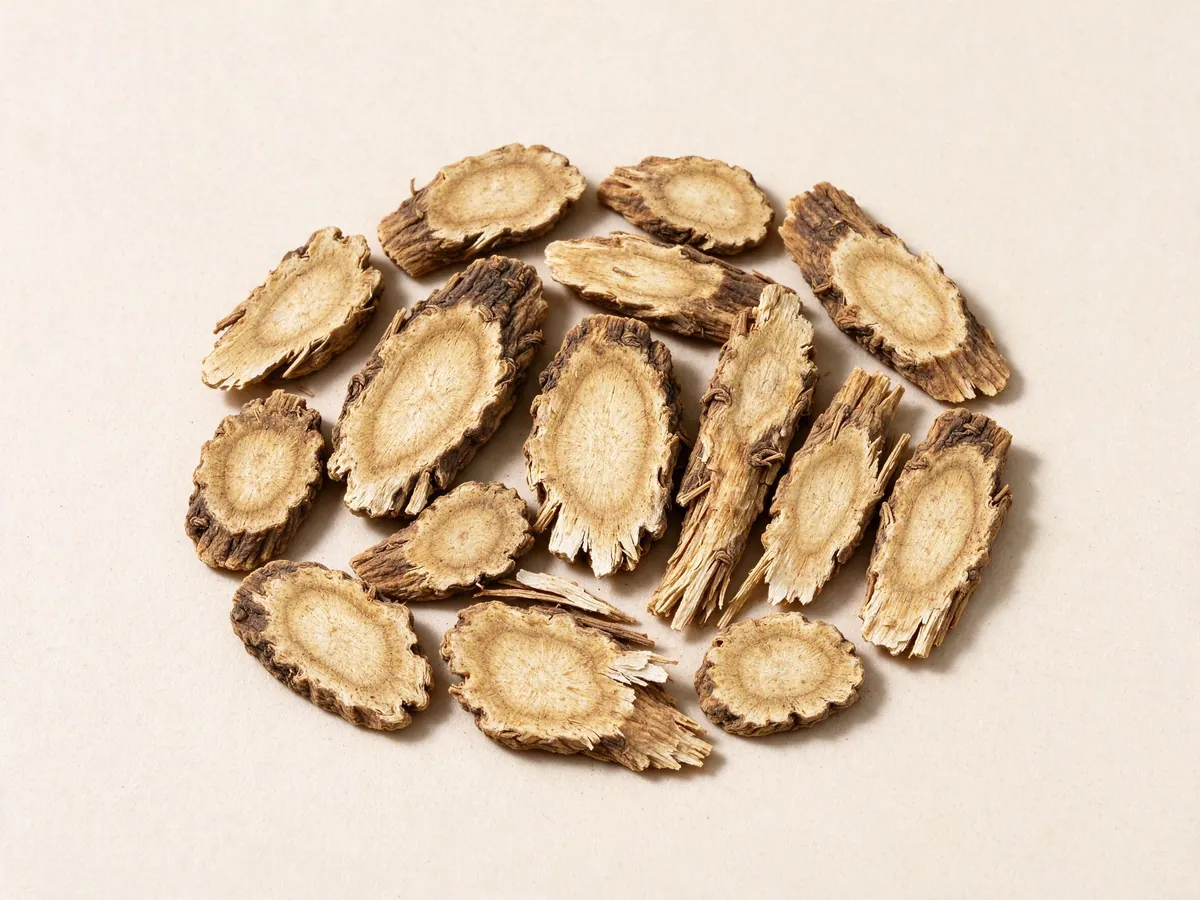
The medicinal material is the dried root of Bupleurum chinense or Bupleurum scorzonerifolium.1,3
It is bitter, acrid and slightly cold, entering the Liver, Gallbladder and Lung.1,2
Actions
- Resolves lesser-yang disorders and reduces fever. For alternating chills and fever with a bitter taste, pain, irritability, vomiting and a stifling chest.2
- Spreads Liver Qi and relieves constraint. For dizziness, vertigo, chest and flank pain, emotional instability and menstrual problems.2
- Raises the Yang and lifts what has sunken. For prolapse, dragging sensations, haemorrhoids and exhaustion.2
Clinical applications
Lesser-yang disorders
For alternating chills and fever with a bitter taste, pain, irritability and vomiting, it harmonises the lesser yang.2
Constrained Liver Qi
For Liver Qi constraint it restores the normal movement of Liver Qi.2
Prolapse
For prolapse, a dragging-down sensation, haemorrhoids and vaginal discharge it lifts the clear Qi.2
Boils and swellings
For boils and furuncles it disperses clumped Qi and Blood in all the channels.2
For dizziness, vertigo, chest and flank pain, emotional instability and menstrual irregularity from constrained Liver Qi, it spreads the Qi.2
For disharmony between the Liver and the Spleen, with epigastric and flank pain, a stifling chest, abdominal bloating, nausea and indigestion.2
For wind-heat constraining the Lungs with a stifling chest and a productive cough, it is used with Peucedanum.2
For deficiency consumption with steaming bones and tidal fever.2
For the stifling chest of lesser-yang disease it is used with Scutellaria and Pinellia, which is the core of Minor Bupleurum Decoction.2
Where cold predominates, Cinnamomi Ramulus and Zingiberis Rhizoma are added.2
Where heat predominates, Gypsum fibrosum and Anemarrhenae Rhizoma are added.2
Key combinations
With Huang Qi 黄芪 to raise the clear Yang when Qi has descended abnormally.2
With Shu Di Huang 熟地黄 and Bai Shao 白芍 for Blood deficiency.2
With Huang Qin 黄芩 and prepared Ban Xia 半夏 in Xiao Chai Hu Tang, it is used for lesser-yang disorders with alternating chills and fever and fullness in the hypochondria and chest.2
With Paeoniae Radix alba in Si Ni San and Bupleurum Powder to Spread the Liver, it is used for vertigo, thoracic and costal pain and menstrual irregularity from Liver Qi obstruction.2
Comparison with similar herbs
| Herb | Key difference |
|---|---|
| Chai Hu 柴胡 | Bitter, acrid and cool, entering the Gallbladder, Liver, Pericardium and Triple Burner. Harmonises lesser yang and relieves Liver Qi constraint.2 |
| Sheng Ma 升麻 | Also light in Qi and flavour with a rising nature, and it leads the lesser yang clear Qi upward from the left.2 |
| Taiwan standard | Mild cold; pungent and bitter; Liver, gallbladder and lung; harmonises and reduces fever, soothes the Liver, releases depression, upraises Yang Qi; 3-10 g.4 |
Both herbs are light in Qi and flavour with a rising nature.2
Processing and preparation
The root is cleaned of impurities and root bases, washed, softened, cut into thick slices and dried.1
The southern form is cleaned, washed, softened, sliced and dried in the same way.1
The vinegar-fried form is made by stir-frying the slices with vinegar until dry.1
Safety
Contraindications
Severely damaged true Yin, and hyperactivity of Liver Yang, because the herb is rising and dispersing.2
Toxicity
The dried rhizome of Bupleurum longiradiatum is toxic and must not be used as Chai Hu.1
Modern research
A review of Bupleuri Radix examined its botany, traditional application, phytochemistry, pharmacology and toxicity.3
The root's functions are evacuation and antipyretic, soothing the Liver and relieving depression.3
Dose and administration
The official reference dose is 3-10 g.1 Some clinical texts use 3-9 g.2
This is a reference range, not a safe upper limit.
Common questions
Why is Chai Hu used for prolapse?
It raises and lifts the Yang, specifically the clear Qi of the Stomach and Gallbladder, which suits prolapse and dragging sensations.2
Who should avoid it?
Anyone with severely damaged true Yin or hyperactivity of Liver Yang, because it rises and disperses.2
References
- Chinese Pharmacopoeia Commission. Pharmacopoeia of the People's Republic of China, 2020 edition, Volume I. Beijing: China Medical Science Press; 2020. Part I, p. 293.
- Bensky D, Clavey S, Stöger E. Chinese Herbal Medicine: Materia Medica. Portable 3rd edition. Seattle: Eastland Press; 2015. pp. 106-111.
- Jiang H, Yang L, Hou A, Zhang J, Wang S, Man W, Zheng S, Yu H, Wang X, Yang B. Botany, traditional uses, phytochemistry, analytical methods, processing, pharmacology and pharmacokinetics of Bupleuri Radix: a systematic review. Biomed Pharmacother. 2020;32858498. doi:10.1016/j.biopha.2020.110679 pubmed.ncbi.nlm.nih.gov/32858498
- Ministry of Health and Welfare. Taiwan Herbal Pharmacopoeia, 4th edition (English edition). Taipei; 2022, with 2025 amendments where cited. p. 279.
Educational reference only. Not medical advice or an individual prescription. Consult a qualified practitioner before using any herb or treatment.