Overview
Fang Feng is acrid, sweet and slightly warm, entering the Bladder, Liver and Spleen.1
It releases the exterior and expels wind, overcomes Dampness and relieves pain, and stops spasms.1
It is moderate, slightly warm and less drying than most wind-expelling herbs; it is used for all wind disorders, treats Dampness, and also treats diarrhoea and pain in the bowels.2
It is known as the most moist of the wind herbs.2
Identity and sources
The medicinal material is the dried root of Saposhnikovia divaricata.1
The roots of plants that have not yet produced a flowering stem are dug in spring and autumn, cleaned of rootlets and soil, and dried in the sun.1
They are long conical or long cylindrical, 15-30 cm long and 0.5-2 cm in diameter, grey-brown or brown and rough, with longitudinal wrinkles, many transversely elongated lenticel-like protrusions and dotted rootlet scars.1
Actions
- Releases the exterior and expels wind. For headache, chills and body aches from externally contracted wind-cold.2
- Expels wind-Dampness and relieves pain. For exterior wind-Damp painful obstruction, especially when wind predominates.2
- Expels wind and relieves spasms. As an auxiliary herb it alleviates trembling of the hands and feet and tetany.2
Clinical applications
Exterior wind
It releases the exterior and expels Wind, and is used for headache, chills and body aches from externally contracted wind-cold.2
Painful obstruction
It expels wind-dampness and alleviates pain, and is used for exterior wind-Damp painful obstruction, especially when wind predominates.2
Spasms
It expels Wind and relieves spasms, and is used as an auxiliary herb for trembling of the hands and feet and for tetany.2
Key combinations
With Schizonepeta for exterior excess patterns or pruritic rash, as in Schizonepeta and Saposhnikovia Powder to Overcome Pathogenic Influences.2
With Qin Jiao, it is used for pain due to wind-Dampness.2
With Cang Zhu for pain from wind-Dampness, or for diarrhoea from wind-cold in Spleen Dampness patterns, as in Important Formula for Painful Diarrhoea.2
With Qiang Huo, Du Huo and Wei Ling Xian, it is used for painful obstruction.2
With prepared Arisaema (Zhi Xing), it is used for headache, generalized body aches and numbness from Wind-Phlegm obstructing the channels.2
With Chuanxiong, prepared Aconite and Shu Di Huang in Major Saposhnikovia Decoction, it is used for legs so painful and weak after dysentery that walking is difficult, and for cranes-knee wind.2
Comparison with similar herbs
| Herb | Key difference |
|---|---|
| Fang Feng 防风 | Acrid, sweet and slightly warm. Moderate and less drying than most Wind herbs; expels Wind, overcomes Dampness and treats intestinal wind and painful diarrhoea.2 |
| Du Huo 独活 and Qiang Huo 羌活 | Fang Feng is lighter and more neutral, less drying and less aromatic than these two, so it is less able to disperse a heavy accumulation of turbid Dampness, but gentler and will not injure the Yin as rapidly. It also treats intestinal wind or painful diarrhoea, which they do not.2 |
| Jing Jie 荆芥 | Both eliminate Wind, release the exterior and disperse Wind-Cold and Wind-Heat, but Jing Jie's action is weaker and more superficial, limited to the skin, muscles and blood. Fang Feng is stronger at expelling Wind deep in the body and also overcomes Dampness; the two are often combined.2 |
Processing and preparation
The root is cleaned of impurities, washed, softened, cut into thick slices and dried.1
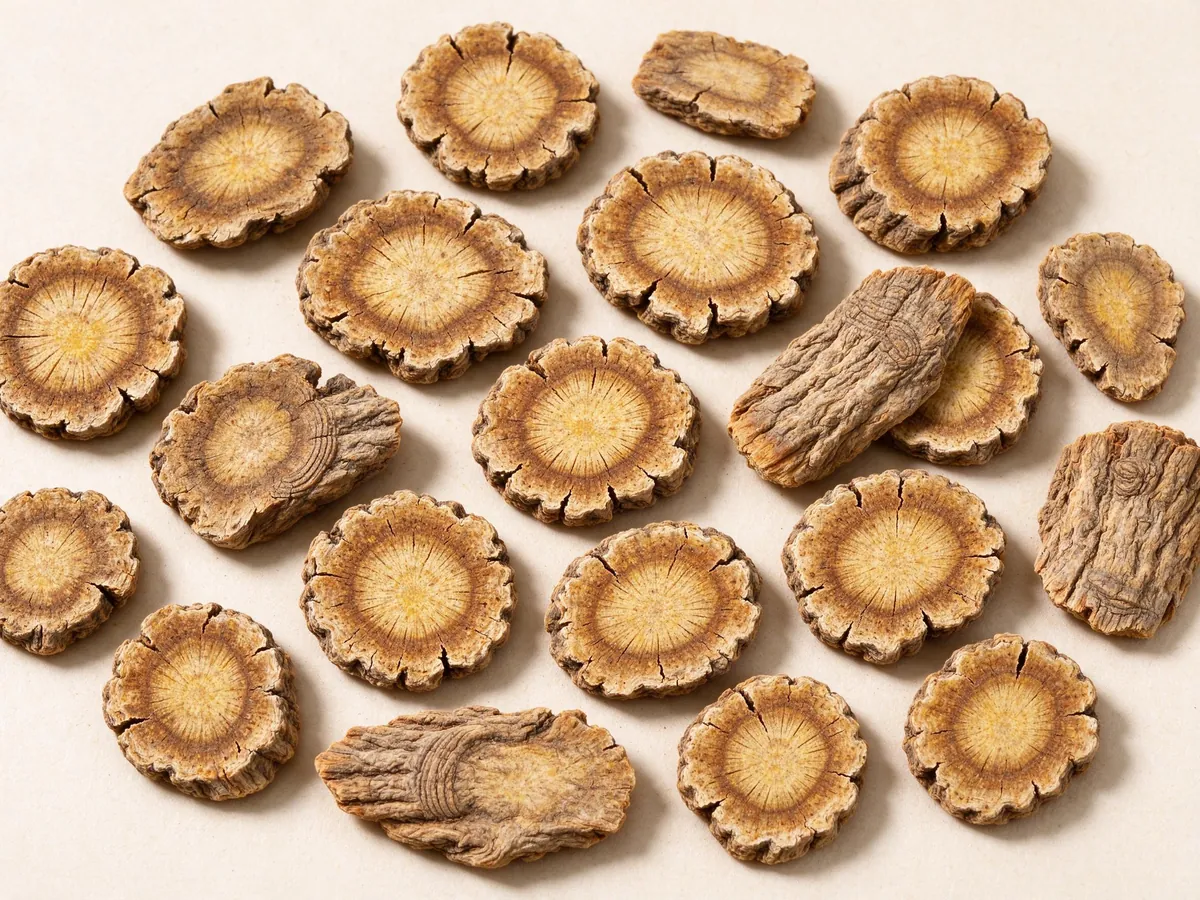
The slices are round or oval thick pieces, grey-brown or brown outside with longitudinal wrinkles and sometimes transversely elongated lenticel-like protrusions.1
The cut face has a brownish-yellow to brown phloem with fissures and yellow xylem with radial striations.1
It is stored in a cool, dry place and protected from insects.1
Safety
Contraindications
It is contraindicated in exuberant fire from Yin deficiency, in spasms from Blood deficiency, and in the absence of pathogenic wind, Dampness or cold.2
Modern research
A review of Saposhnikovia divaricata covers the herb root, used since the Western Han dynasty.3
Chromones and coumarins are its pharmacologically active substances.3
Modern studies show antipyretic, analgesic, anti-inflammatory, antioxidant, antitumour and anticoagulant activity.3
Dose and administration
The official reference dose is 5-10 g.1
This is a reference range, not a safe upper limit.
Common questions
Why is it called the most moist of the wind herbs?
Because it is less drying than most wind-expelling herbs, it is known as the most moist of the wind herbs.2
When is it contraindicated?
In exuberant fire from Yin deficiency, in spasms from Blood deficiency, and in the absence of pathogenic wind, Dampness or cold.2
References
- Chinese Pharmacopoeia Commission. Pharmacopoeia of the People's Republic of China, 2020 edition, Volume I. Beijing: China Medical Science Press; 2020. Part I, p. 156.
- Bensky D, Clavey S, Stöger E. Chinese Herbal Medicine: Materia Medica. Portable 3rd edition. Seattle: Eastland Press; 2015. pp. 16-18.
- Gao JW, Zhan Y, Wang YH, Zhao SJ, Han ZM. Advances in phytochemistry and modern pharmacology of Saposhnikovia divaricata (Turcz.) Schischk. Chin J Integr Med. 2023;29(11):1033-1044. doi:10.1007/s11655-023-3746-5 pubmed.ncbi.nlm.nih.gov/37733271
Educational reference only. Not medical advice or an individual prescription. Consult a qualified practitioner before using any herb or treatment.