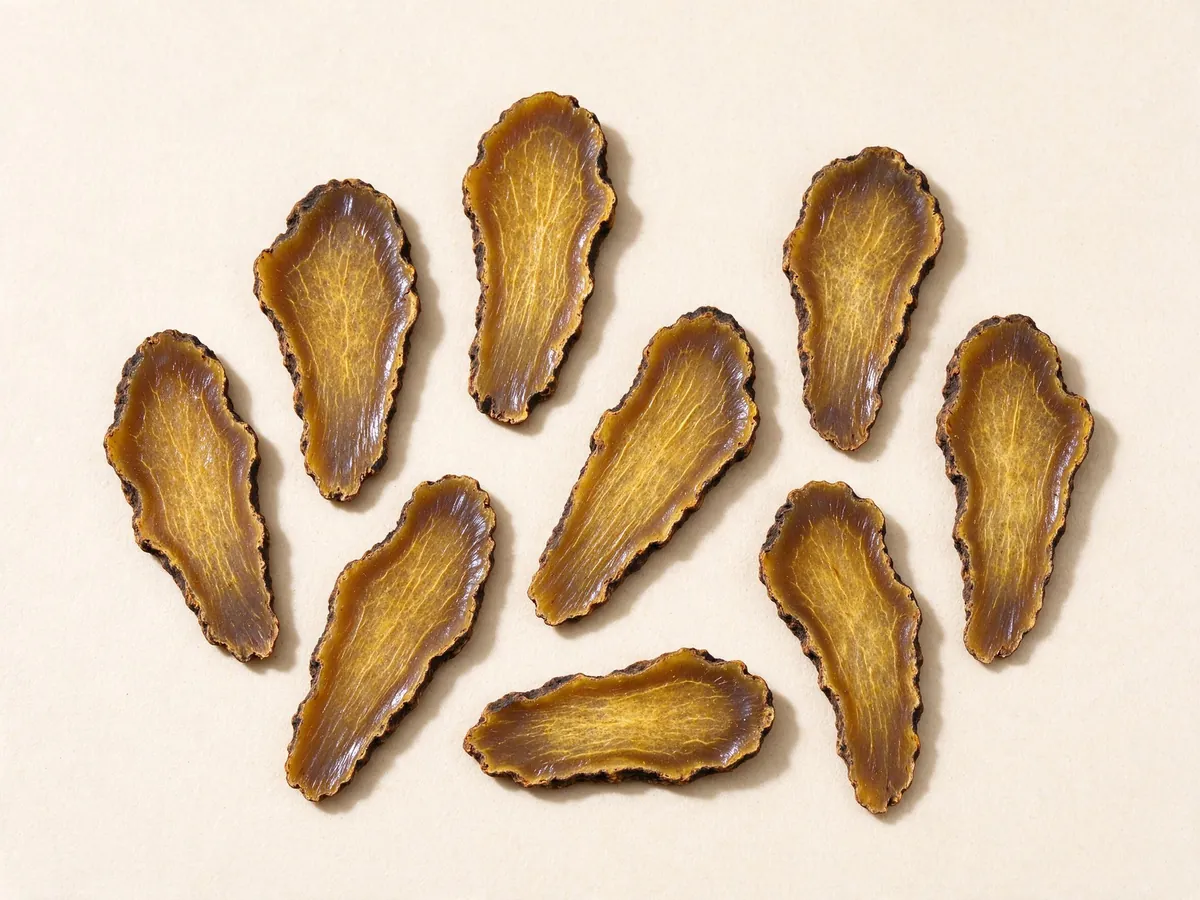
Overview
Fu Zi is acrid, sweet and hot, and toxic, entering the Heart, Kidney and Spleen.1
It restores Yang and rescues collapse, supplements fire and assists Yang, and disperses cold to stop pain.1
It contains aconitine, which causes cardiotoxicity and neurotoxicity if improperly used, and it is decocted first and for a long time.1,2
Identity and sources
The medicinal material is the prepared lateral root of Aconitum carmichaelii.1
The official specifications include salt-processed Fu Zi (Yan Fu Zi), black slices (Hei Shun Pian) and white slices (Bai Fu Pian).1
Further forms are Pao Fu Pian (sand-toasted slices) and Dan Fu Pian (salt-processed slices soaked and boiled with licorice and black beans).1
Actions
- Restores Yang and rescues collapse. For Yang collapse with cold limbs and a faint pulse, and for insufficient Heart Yang with chest pain.1
- Supplements fire and assists Yang. For Kidney Yang decline with impotence and cold uterus, and for Yang deficiency with oedema.1
- Disperses cold and stops pain. For deficiency-cold vomiting and diarrhoea, cold abdominal pain, and cold-Damp painful obstruction.1
Clinical applications
Yang collapse
For Yang collapse with cold limbs and a faint pulse.1
Yang deficiency
For Kidney Yang decline with impotence and cold uterus, and for Yang deficiency with oedema.1
Cold pain
For deficiency-cold vomiting and diarrhoea, cold abdominal pain, and cold-Damp painful obstruction.1
Comparison with similar herbs
| Form | Key difference |
|---|---|
| Yan Fu Zi 盐附子 | The whole root soaked in brine and salt until salt crystals form on the surface; it is the salt-processed specification.1 |
| Hei Shun Pian 黑顺片 | Boiled, sliced and coloured dark tea-brown, then steamed and dried.1 |
| Bai Fu Pian 白附片 | Peeled, sliced thin, steamed and sun-dried. Both Hei Shun Pian and Bai Fu Pian are used directly as medicine.1 |
| Pao Fu Pian 炮附片 | Sand-toasted until swollen and yellow-brown; it is the toasted slice form.1 |
| Dan Fu Pian 淡附片 | Salt-processed Fu Zi soaked in water, boiled with licorice and black beans, then dried.1 |
Processing and preparation
Yan Fu Zi is made by soaking the clean root in brine, adding salt, and drying it repeatedly until salt crystals form.1
Hei Shun Pian is boiled in brine, sliced, coloured, steamed until glossy and dried; Bai Fu Pian is peeled, sliced thin, steamed and sun-dried.1
Pao Fu Pian is sand-toasted, and Dan Fu Pian is soaked and boiled with licorice and black beans.1
Safety
Contraindications
Use with caution in pregnancy.1
Interactions
It is incompatible with Ban Xia, Gua Lou (fruit, seed and peel), Tian Hua Fen, the Bei Mu group, Bai Lian and Bai Ji.1
Toxicity
Improper use of aconitine causes cardiotoxicity and neurotoxicity; animal studies show abnormal heart rate and changed myocardial morphology and function.2
Only the processed root is used, and it is decocted first and for a long time.1
Poisoning begins shortly after ingestion with perioral paraesthesia and nausea, vomiting and abdominal pain, and can progress to refractory ventricular dysrhythmias.3
Do not self-treat with this herb.
Modern research
A meta-analysis of preclinical studies identifies aconitine as the characteristic constituent with anti-inflammatory, analgesic and heart-strengthening effects, but also with cardiotoxicity and neurotoxicity.2
Aconitine alters cardiac myocyte electrophysiology by regulating Na+, Ca2+ and K+ currents.2
Its cardiotoxicity is linked to mitochondrial dysfunction, and overactivation of the NLRP3 inflammasome worsens it.2
Dose and administration
The official reference dose is 3-15 g, decocted first and for a long time.1
This is a reference range, not a safe upper limit.
Common questions
Why must Fu Zi be processed?
How is it decocted?
It is decocted first and for a long time, at 3-15 g.1
What does it treat?
It restores Yang and rescues collapse, supplements fire and assists Yang, and disperses cold to stop pain, for Yang collapse, Yang deficiency, cold pain and oedema.1
What is it incompatible with?
It is incompatible with Ban Xia, Gua Lou, Tian Hua Fen, the Bei Mu group, Bai Lian and Bai Ji.1
References
- Chinese Pharmacopoeia Commission. Pharmacopoeia of the People's Republic of China, 2020 edition, Volume I. Beijing: China Medical Science Press; 2020. Part I, pp. 200-201.
- Jiang H, Zhang Y, Zhang Y, Wang X, Meng X. An updated meta-analysis based on the preclinical evidence of mechanism of aconitine-induced cardiotoxicity. Front Pharmacol. 2022;13:900842. doi:10.3389/fphar.2022.900842 pubmed.ncbi.nlm.nih.gov/35754486
- Kent JT, Sathya A, Juurlink DN, Austin E, Simone D, Fernandes J, Gollob MH, Thompson M. Mass aconite poisoning from a mislabelled spice product. Clin Toxicol (Phila). 2025;63(9):633-639. doi:10.1080/15563650.2025.2526115 pubmed.ncbi.nlm.nih.gov/40637172
Educational reference only. Not medical advice or an individual prescription. Consult a qualified practitioner before using any herb or treatment.