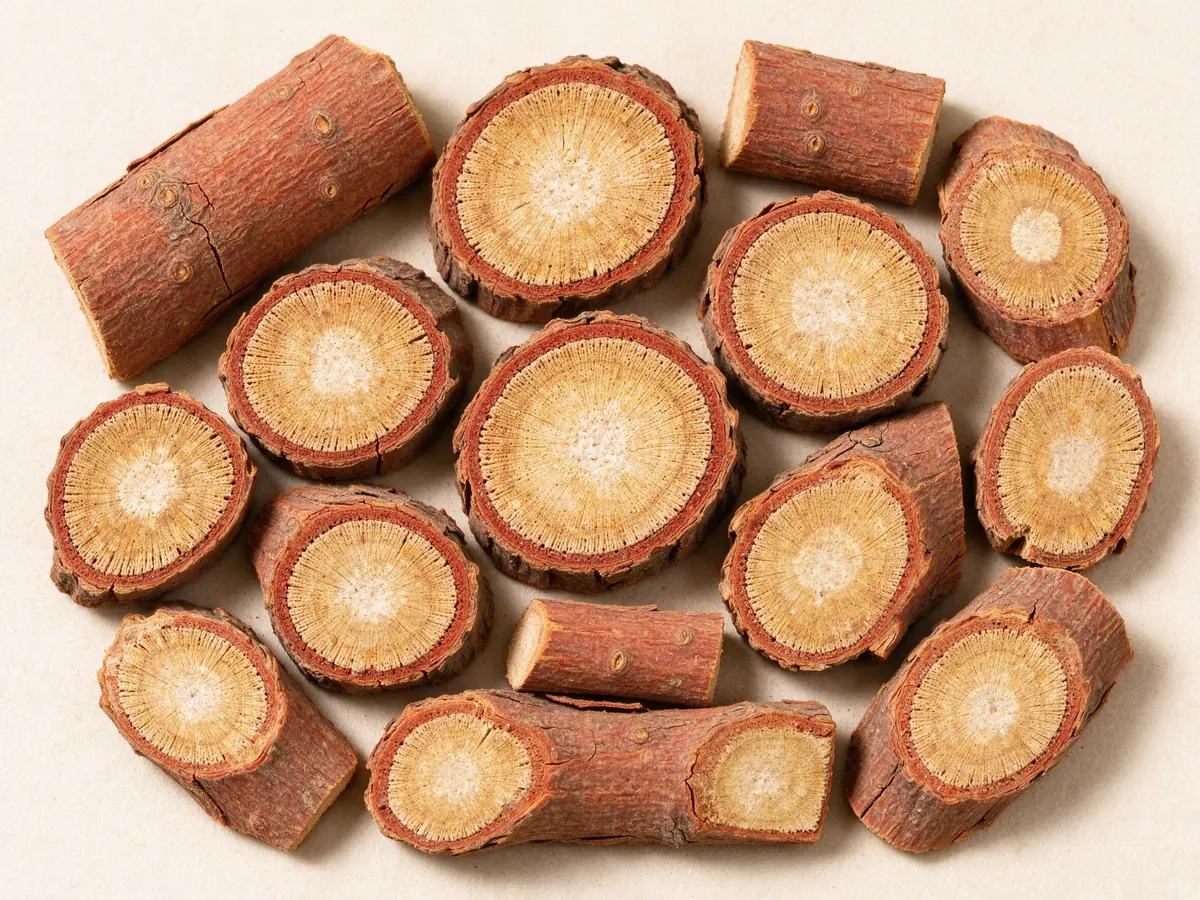
Overview
Gui Zhi is pungent, sweet and warm, entering the Heart, Lung and Bladder.1
It releases the muscle layer, warms and unblocks the channels, assists the Yang to transform Qi, and directs the rebelling Qi downward.1
It is light and warm, unblocks Yang Qi and warms the middle.2
Identity and sources
The medicinal material is the dried young twig of Cinnamomum cassia.1
The twigs are long and cylindrical and much branched, 30-75 cm long, red-brown to brown, with longitudinal ridges, fine wrinkles, leaf, branch and bud scars, and dotted lenticels.1
They are collected in spring and summer, stripped of their leaves and dried in the sun, or sliced and dried.1
Actions
- Releases the exterior and assists the Yang. For exterior wind-cold whether the pattern is relatively deficient or excessive, and for the disharmony of the nutritive and protective Qi with chills and sweating.2
- Warms and unblocks the channels and collaterals. For painful obstruction from wind, cold and Dampness entering the channels and collaterals.2
- Warms the Yang and transforms thin mucus. For fluids that fail to transform from Yang deficiency, with oedema and urinary dysfunction, or dizziness and palpitations.2
- Assists the Heart Yang and unblocks the Yang Qi of the chest. For listless chest Yang with Phlegm and thin mucus, shortness of breath, chest pain and palpitations.2
- Warms the channels, vessels and collaterals. It removes painful obstruction, warms the blood vessels, removes stagnation and regulates the menses.2
Clinical applications
Exterior wind-cold
It releases the exterior and assists the Yang, and is used for exterior wind-cold whether the pattern is relatively deficient or excessive.2
Painful obstruction
With Han Fang Ji it is used for painful obstruction from wind, cold and Dampness entering the channels and collaterals.2
Oedema and thin mucus
It warms the Yang and transforms thin mucus, and is used for oedema with urinary dysfunction, or dizziness and palpitations, from Yang deficiency that fails to transform fluids.2
Chest Yang and palpitations
It assists the Heart Yang and unblocks the Yang Qi of the chest, and is used for shortness of breath, chest pain and palpitations from listless chest Yang.2
Menstrual disorders
For abdominal pain, dysmenorrhoea and menstrual irregularity from cold in the penetrating and Conception vessels.2
Key combinations
With Bai Shao for the disharmony of the nutritive and protective Qi with chills and sweating, and for warming and tonifying the middle burner, as in Cinnamon Twig Decoction.2
With Ma Huang for exterior wind-cold with severe chills, fever and no sweating, as in Ephedra Decoction.2
With Chuanxiong to expel wind and Dampness, warm the channels and collaterals and relieve the discomfort of painful obstruction.2
With Evodia for abdominal pain, dysmenorrhoea and menstrual irregularity from cold in the penetrating and Conception vessels.2
With Persica and Moutan for pain from trauma or gynaecological discomfort from Blood stasis.2
Comparison with similar herbs
| Herb | Key difference |
|---|---|
| Gui Zhi 桂枝 | It does not induce sweating; it releases the muscle layer, unblocks Yang Qi and warms the middle.2 |
| Ma Huang 麻黄 | Acrid, slightly bitter and warm. Induces sweating, calms wheezing and promotes urination.2 |
| Taiwan standard | Warm; pungent and sweet; Heart, lung and bladder; promotes sweating to release the flesh, warms and frees the channels and vessels, assists Yang in transforming Qi and directs Qi downward; 3-10 g.3 |
Processing and preparation
The twigs are cleaned of impurities, washed, softened, cut into thick slices and dried.1
The slices are round or oval thick pieces, red-brown to brown outside, with dotted lenticels or longitudinal ridges.1
The cut face has a red-brown bark, yellowish-white to light yellowish-brown wood and a rounded or squarish pith, and the pieces have a distinctive aroma and a sweet, slightly pungent taste.1
The dry-fried form is fried or baked to a deep golden colour with small scorched spots, which reduces the acrid dispersing action and increases the warm unblocking properties.2
Dry-frying increases its warm, Yang Qi-tonifying action while reducing its acrid dispersing properties.2
Safety
Contraindications
Warm-heat pathogen disease, Yin deficiency with heat signs, and heat in the Blood with vomiting.2
Pregnancy and breastfeeding
The official standard advises caution in pregnancy.1 In pregnancy or with excessive menstruation it is used only in doses of 6 g or less, preferably as the dry-fried twigs.2
Adverse effects
In large overdoses it can cause dizziness, a tense, dry or burning sensation in the eyes, cough, thirst, scanty urine and a burning sensation on urination, and there have been rare allergic reactions of the skin and digestion.2
Modern research
A review of Cinnamomi Ramulus covers its geographical distribution, botany, traditional application, phytochemistry, pharmacology, pharmacokinetics and toxicology.4
The twig is traditionally used for gastrointestinal dysfunction, cancer, arthritis, osteoporosis, Spleen deficiency, Alzheimer's disease and obesity.4
More than 121 compounds have been isolated from the twig, including volatile oil, organic acids, triterpenoid saponins, coumarins, tannins, flavonoids and polysaccharides.4
The review reports antibacterial, anti-inflammatory, antiviral, antitumour, antipyretic, analgesic, antidiabetic and antiplatelet aggregation effects.4
Dose and administration
The official reference dose is 3-10 g.1
This is a reference range, not a safe upper limit.
Common questions
How does it differ from Ma Huang?
Ma Huang induces sweating, while Gui Zhi releases the muscle layer and does not induce sweating.2
Can it be given in pregnancy?
Why would the twigs be dry-fried?
Dry-frying reduces the acrid dispersing action and increases the warm unblocking properties; it may be useful for wind-cold with sweating in older or weaker patients.2
References
- Chinese Pharmacopoeia Commission. Pharmacopoeia of the People's Republic of China, 2020 edition, Volume I. Beijing: China Medical Science Press; 2020. Part I, p. 288.
- Bensky D, Clavey S, Stöger E. Chinese Herbal Medicine: Materia Medica. Portable 3rd edition. Seattle: Eastland Press; 2015. pp. 8-11.
- Ministry of Health and Welfare. Taiwan Herbal Pharmacopoeia, 4th edition (English edition). Taipei; 2022, with 2025 amendments where cited. p. 302.
- Liu J, Zhang Q, Li RL, Wei SJ, Huang CY, Gao YX, Pu XF. The traditional uses, phytochemistry, pharmacology and toxicology of Cinnamomi ramulus: a review. J Pharm Pharmacol. 2020;72(3):319-342. doi:10.1111/jphp.13189 pubmed.ncbi.nlm.nih.gov/31750548
Educational reference only. Not medical advice or an individual prescription. Consult a qualified practitioner before using any herb or treatment.