Overview
Xing Ren is bitter and slightly warm, and it is slightly toxic, entering the Lung and Large Intestine.1
It directs the Qi downward, stops cough and calms wheezing, and moistens the Intestines to unblock the bowels.1
Its bitterness directs downward, its warmth opens, and its moist quality moistens dryness in the Lungs and Large Intestine.2
Identity and sources
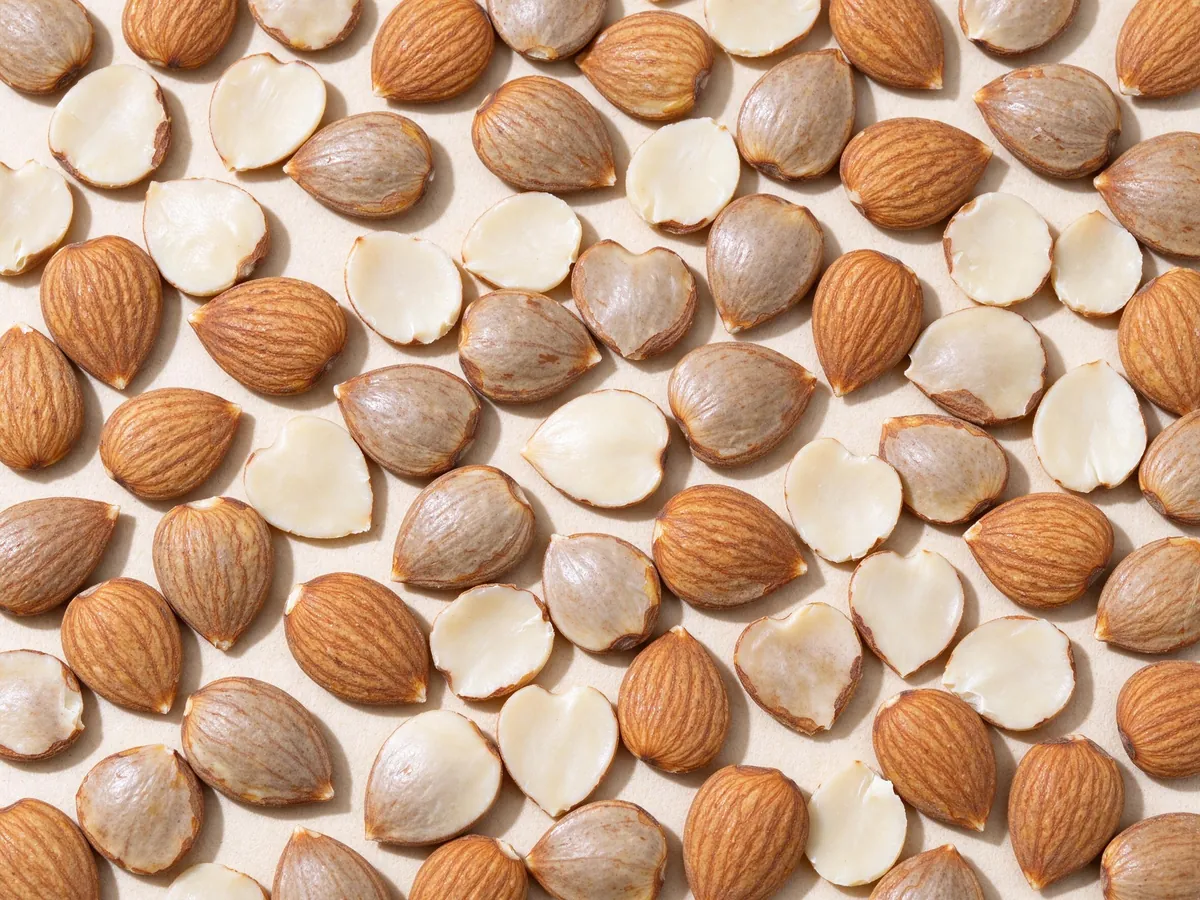
The medicinal material is the dried ripe seed of Prunus armeniaca variety ansu, Prunus sibirica, Prunus mandshurica or Prunus armeniaca.1
The seeds are flat and heart-shaped,, yellow-brown to dark brown, pointed at one end and blunt and thick at the other and asymmetrical.1
There is a short linear hilum on the pointed side, the seed coat is thin, and the two cotyledons are milky white and oily.1
They are collected when the fruit ripens in summer, with the flesh and shell removed and the seeds dried in the sun.1
Actions
Clinical applications
Cough and wheezing
It directs Qi downward, stops cough and calms wheezing, and is used for cough and wheezing with chest fullness and copious Phlegm.1
Besides directing rebellious Qi downward to stop the cough and settle the wheezing, it disperses wind-cold and Phlegm-Dampness in the Lung channel.2
Constipation
It moistens the Intestines and unblocks the bowels, and is used for dry constipation.1
Key combinations
With Cannabis seed and Dang Gui for constipation from Qi deficiency and dry Intestines, as in Five-Seed Pill.2
With Perilla leaf and Pinellia preparata in Apricot Kernel and Perilla Leaf Powder, it is used for dry cough from externally contracted wind-cold.2
With Mori Folium and Chrysanthemi Flos in Mulberry Leaf and Chrysanthemum Drink, it is used for non-productive dry cough from wind-heat.2
With Mori Folium, Fritillaria cirrhosa and Glehnia, it is used for non-productive cough from dry-heat scorching the Lungs.2
With Ophiopogon, it is used for dry cough from dryness and heat injuring the Lungs.2
With Ephedra in Three-Unbinding Decoction, and with Gypsum added in Ephedra, Apricot Kernel, Gypsum and Licorice Decoction, it is used for cough and wheezing from excess, including with significant Lung heat.2
With Amomum rotundum and Coix, it is used in the early stage of Damp-Warmth disorders with heaviness of the head and body and chest stifling.2
Comparison with similar herbs
| Herb | Key difference |
|---|---|
| Xing Ren 苦杏仁 | Bitter, warm and slightly toxic. It moistens the Intestines, and its focus is the upper body.2 |
| Ma Huang 麻黄 | Opens the pores and interstices, while Xing Ren unblocks the collaterals of the Lungs.2 |
| Tao Ren 桃仁 | Another fruit kernel that moistens the Intestines, but its focus is the lower body.2 |
Processing and preparation
The seeds are crushed when used.1
The blanched form is peeled by the scalding method and crushed when used.1
The stir-fried form is made by stir-frying the blanched seeds until yellow, and it is crushed when used.1
They are added near the end of the decocting process.2
Peeled kernels are less toxic than unpeeled ones: brief boiling before peeling reduces the toxicity by about one-half.2
Safety
Contraindications
If the primal Qi is deficient and sinking it is not used, for fear that its descending action directs the Qi downward excessively.2
Toxicity and overdose
It is toxic because of its cyanogenic glycoside content.2 Ten to 20 seeds is the toxic dose for children, and 50-120 seeds can cause death.2 The suspension of powdered kernels is four to five times as toxic as the decoction of the seeds.2
Symptoms appear one to two hours after ingestion and include a bitter and astringent taste, salivation, epigastric discomfort, nausea, vomiting, abdominal pain, diarrhoea, headache, dizziness, weakness, dyspnoea, restlessness, terror and palpitations.2
Severe cases develop coma, cyanosis, dilated pupils and death from respiratory failure.2
Internal use must not exceed the dose, to avoid poisoning.1
Do not self-treat with this herb.
Modern research
Amygdalin, the cyanogenic glycoside found in high concentrations in bitter almonds, is the toxic constituent of the kernel.3,2
The review lists antioxidant, antitumour, anti-fibrotic, anti-inflammatory, immunomodulatory and analgesic effects for amygdalin.3
Studies verified that amygdalin is harmful by mouth only at very high doses.3
Its toxicity depends heavily on the bacteria of the digestive tract.3
Encapsulation in alginate-chitosan nanoparticles is a new area of research.3
Dose and administration
The official reference dose is 5-10 g, with the raw seed added near the end of the decoction.1
This is a reference range, not a safe upper limit.
Common questions
How dangerous is an overdose?
Ten to 20 seeds is the toxic dose for children and 50-120 seeds can cause death; symptoms appear one to two hours after ingestion.2
Are peeled kernels safer?
Peeled kernels are less toxic, because the brief boiling before peeling reduces their cyanogenic glycosides and the toxicity by about one-half.2
References
- Chinese Pharmacopoeia Commission. Pharmacopoeia of the People's Republic of China, 2020 edition, Volume I. Beijing: China Medical Science Press; 2020. Part I, p. 210.
- Bensky D, Clavey S, Stöger E. Chinese Herbal Medicine: Materia Medica. Portable 3rd edition. Seattle: Eastland Press; 2015. pp. 438-440.
- Barakat H, Aljutaily T, Almujaydil MS, Algheshairy RM, Alhomaid RM, Almutairi AS, Alshimali SI, Abdellatif AAH. Amygdalin: A Review on Its Characteristics, Antioxidant Potential, Gastrointestinal Microbiota Intervention, Anticancer Therapeutic and Mechanisms, Toxicity, and Encapsulation. Biomolecules. 2022;12(10). doi:10.3390/biom12101514 pubmed.ncbi.nlm.nih.gov/36291723
Educational reference only. Not medical advice or an individual prescription. Consult a qualified practitioner before using any herb or treatment.