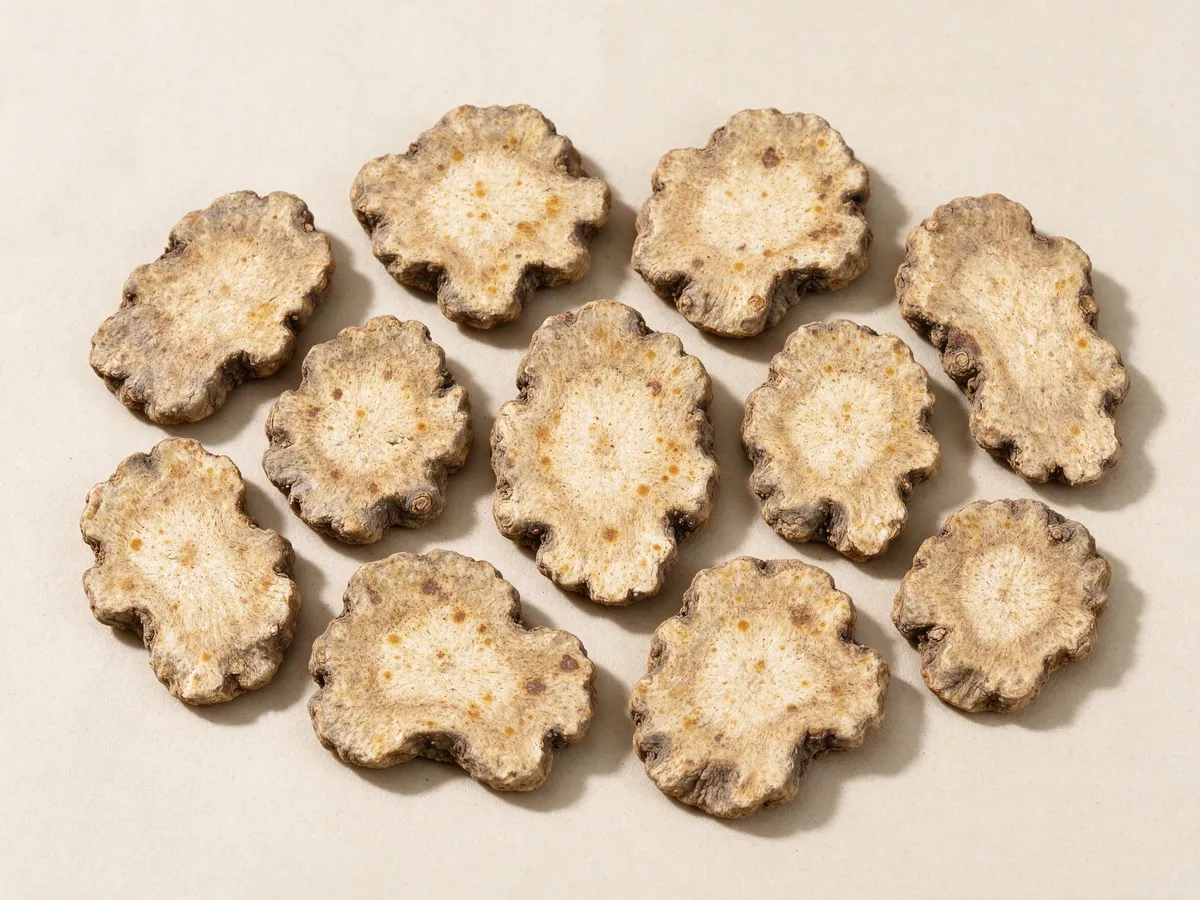
Overview
Bai Zhu is bitter, sweet and warm, entering the Spleen and Stomach.1,2
It tonifies the Spleen Qi, dries Dampness, stops sweating and quiets the fetus.1,2
Its sweetness tonifies the Spleen earth, its bitterness dries Dampness, and its aroma supports the Spleen's transportive work.2
It is therefore an essential herb for tonifying the Spleen and Stomach when Dampness obstructs the middle burner.2
Identity and sources
The medicinal material is Atractylodes macrocephala.1
Actions
- Tonifies the Spleen and augments the Qi. For diarrhoea, fatigue, a sallow complexion and lack of appetite.2
- Dries Dampness and promotes water metabolism. For accumulation of fluids affecting digestion, oedema and reduced urination when the Spleen fails to transform and transport, and as an auxiliary herb for Damp painful obstruction.2
- Stabilises the exterior and stops sweating. For spontaneous sweating from Qi deficiency.2
- Calms the fetus. For restless fetus, especially from Spleen deficiency.2
Clinical applications
Spleen deficiency
For diarrhoea, fatigue, a sallow complexion and lack of appetite from Spleen or Stomach deficiency, it tonifies the Spleen and augments the Qi.2
Dampness and oedema
For accumulation of fluids affecting digestion, oedema and reduced urination when the Spleen fails to transform and transport, it dries Dampness and promotes water metabolism, and it is an auxiliary herb for Damp painful obstruction.2
Sweating
For spontaneous sweating from Qi deficiency it stabilises the exterior, and with appropriate partners it is used for other kinds of sweating.2
Threatened miscarriage
For restless fetus, especially from Spleen deficiency, it calms the fetus; with appropriate partners it is used for other types.2
Fetal Qi is linked to the Spleen; if the Spleen is deficient the Girdle vessel has no support, and miscarriage follows readily.2
Key combinations
With Poria in Ginseng, Poria and White Atractylodes Powder for loose, watery stools from Spleen deficiency.2
With prepared Rehmannia and Bai Shao for restless fetus from Blood deficiency with palpitations.2
With Codonopsis and Zingiberis Rhizoma in Regulate the Middle Pill, it is used for abdominal pain, distention, vomiting and diarrhoea from cold from deficiency of the middle burner.2
With Aurantii Fructus Immaturus (Zhi Shi) in Unripe Bitter Orange and Atractylodes Pill, it is used for reduced appetite with epigastric focal distention and fullness from Spleen deficiency with Qi stagnation.2
With Poria and Coicis Semen in Ginseng, Poria and White Atractylodes Powder, it is used for Spleen and Stomach Qi deficiency with Dampness.2
With Plantaginis Semen, it is used for diarrhoea due to Dampness.2
With Cang Zhu in End Discharge Decoction, it is used for Damp-cold painful obstruction or vaginal discharge.2
With Poria and Cinnamomi Ramulus, as in Poria, Cinnamon Twig, Atractylodes and Licorice Decoction and Five-Ingredient Powder with Poria, it is used for thin mucus with distention of the chest and oedema from Spleen deficiency.2
With Polyporus and Alismatis Rhizoma in Four-Ingredient Powder with Poria, it is used for oedema from water and Dampness lingering internally.2
With prepared Aconite and Poria in True Warrior Decoction, it is used for oedema from Spleen and Kidney Yang deficiency with retention of pathogenic water.2
With prepared Pinellia and Gastrodia, it is used for Phlegm generated by Spleen Dampness with internal stirring of Liver Wind.2
With Huang Qi and Tritici Fructus Levis, it is used for unrelenting spontaneous sweating.2
With Huang Qi and Saposhnikovia in Jade Windscreen Powder, it is used for spontaneous sweating with aversion to drafts.2
With Dendrobium and Ostreae Concha, it is used for night sweats from Yin deficiency.2
With Scutellaria, it is used for restless fetus with internal heat.2
With Ginseng and Huang Qi, it is used for restless fetus from Qi deficiency.2
With Taxillus and Eucommia, it is used for restless fetus from Kidney deficiency.2
Comparison with similar herbs
| Form | Key difference |
|---|---|
| Bai Zhu 白术 | Bitter, sweet and warm. It more powerfully tonifies the Spleen Qi, stops sweating and calms the fetus.1,2 |
| Fu Chao Bai Zhu 麸炒白术 | Stir-fried with honey-fried bran until the surface is yellowish-brown with scorch marks.1 |
| Cang Zhu 苍术 | It more powerfully dries Dampness and induces sweating. It is used for externally contracted cold-Dampness with headache, heaviness of the body, lethargy, aching limbs and joints, and chills and fever without sweating, and for wind-Dampness painful obstruction when Dampness predominates.2 |
Processing and preparation
The rhizome is cleaned, moistened until softened, cut into thick slices and dried.1
For the bran-fried form, honey-fried bran is scattered into a hot wok and the Bai Zhu slices are added once it smokes, using 10 kg of bran per 100 kg of slices.1
The finished slices look like the raw ones but are yellowish-brown on the surface, with occasional scorch marks.1
Safety
Contraindications
Internal heat from Yin deficiency, and thirst from exhausted fluids.2
Use with caution
In the absence of pathogenic Dampness, drying Dampness can injure the Spleen Yin.2
Adverse effects
Overdosage or inappropriate use can cause vomiting of blood, nosebleed, bloody stools, raised temperature and agitation.2
Modern research
A review of Atractylodes macrocephala calls it a tonic long used in East Asian medicine.3
It lists gastrointestinal dysfunction, cancer, osteoporosis, obesity and fetal irritability among the traditional uses.3
More than 79 chemical compounds have been isolated from A. macrocephala.3
Dose and administration
The official reference dose is 6-12 g.1
Some clinical texts use 6-15 g.2
The dosage for this purpose is 60-120 g.2
This is a reference range, not a safe upper limit.
Common questions
How is the bran-fried form made?
Honey-fried bran is scattered into a hot wok and the slices are added once it smokes, using 10 kg of bran per 100 kg of slices.1
Who should avoid it?
Anyone with internal heat from Yin deficiency or thirst from exhausted fluids.2
References
- Chinese Pharmacopoeia Commission. Pharmacopoeia of the People's Republic of China, 2020 edition, Volume I. Beijing: China Medical Science Press; 2020. Part I, p. 107.
- Bensky D, Clavey S, Stöger E. Chinese Herbal Medicine: Materia Medica. Portable 3rd edition. Seattle: Eastland Press; 2015. pp. 759-762.
- Zhu B, Zhang QL, Hua JW, Cheng WL, Qin LP. The traditional uses, phytochemistry, and pharmacology of Atractylodes macrocephala Koidz.: a review. J Ethnopharmacol. 2018;30130541. doi:10.1016/j.jep.2018.08.023 pubmed.ncbi.nlm.nih.gov/30130541
Educational reference only. Not medical advice or an individual prescription. Consult a qualified practitioner before using any herb or treatment.