Overview
Huang Qi is sweet and slightly warm, entering the Spleen and Lung.1,2,3 It tonifies the Qi of the middle burner and raises the Yang to reach the muscle layer and the exterior.4
It stabilises the protective Qi and stops abnormal sweating, promotes urination and reduces oedema, generates Blood and fluids, and brings chronic sores to discharge pus and grow new flesh.4
It is used for ulcers and sores that form pus poorly, or that have formed pus but do not drain or heal well, in a depleted patient.4
Identity and sources
The medicinal material is the dried root of Astragalus membranaceus variety mongholicus or of A. membranaceus.1 The Taiwan monograph gives Astragalus membranaceus and Astragalus mongholicus.3
Honey-frying produces Zhi Huang Qi 炙黄芪, which is sweet and warm and is used to tonify the middle and augment Qi.1
The raw root tends to travel in the exterior, where it stabilises the protective Qi and brings sores to a head; the honey-prepared root tends to travel internally, where it tonifies and raises the clear Qi of the middle burner.4
Actions
- Tonifies the Qi and raises the Yang. For the fatigue, poor appetite and diarrhoea of Spleen deficiency, and for prolapse where the clear Qi has sunk.4,1
- Augments the protective Qi and stabilises the exterior. For spontaneous sweating from Qi deficiency, and for the frequent colds and breathlessness that go with weak protective Qi.4
- Promotes urination and reduces oedema. For swelling from deficiency with reduced urine output, and it can be used alone for this.4
- Generates Blood and fluids. For the fever, irritability and thirst that follow severe blood loss, and for postpartum fever from deficiency of Qi and Blood.4
- Promotes the discharge of pus and generates flesh. For chronic ulcers and sores that will not form pus, or have formed it but will not drain or heal.4
Clinical applications
Spleen and Lung Qi deficiency
For lack of appetite, fatigue and diarrhoea, and for sinking and collapse of the middle Qi with prolapse.4
Spontaneous sweating
It stabilises the protective Qi, so it is used where sweating occurs without exertion and the patient catches cold easily.4 It may be used to produce a therapeutic sweat when diaphoretics do not.4
Oedema
For superficial oedema with reduced urination from deficiency; it can be used alone for this.4
Chronic sores and ulcers
For ulcers that are pale and flat, that do not form pus, or that discharge thin fluid and will not close, it supports suppuration and the growth of new tissue.4
Numbness, weakness and obstruction
For numbness and painful obstruction from deficiency of Qi and Blood, and for the aftermath of stroke with Qi deficiency and Blood stasis, it is combined with Dang Gui, peach kernel and safflower.4
Key combinations
With Ren Shen 人参 for general debility, poor appetite, fatigue and spontaneous sweating, the two primal Qi tonics reinforce each other.4
With Bai Zhu 白术 for weakness, lassitude and loose stools associated with Spleen Qi deficiency.4
With Cimicifuga and Chai Hu 柴胡 for weak and sunken Spleen Qi, as in Bu Zhong Yi Qi Tang, used for rectal and uterine prolapse.4,2
With Fang Feng and Bai Zhu 白术 in Yu Ping Feng San, it stabilises the exterior for spontaneous sweating from weak protective Qi.4
With Han Fang Ji 汉防己 and Bai Zhu 白术 in Fang Ji Huang Qi Tang, it is used for oedema with sweating and aversion to drafts.4
With Dang Gui 当归 for Blood deficiency after severe bleeding, and for chronic non-healing sores, numbness and painful obstruction.4
With Dang Gui 当归, Persicae Semen and Carthami Flos for the aftermath of stroke with Qi deficiency and Blood stasis.4
With Mu Li 牡蛎 and Ma Huang Gen 麻黄根 in Mu Li San, it is used for sweating from exterior deficiency.2
Comparison with similar herbs
| Herb | Key difference |
|---|---|
| Ren Shen 人参 | Both are primal Qi tonics. Ren Shen its tonic effect is stronger and longer lasting. It does not itself stop sweating, discharge pus, generate flesh or promote urination.4 |
| Huang Qi 黄芪 | Sweet and warm. It supports the Yang with a quick ascending quality and is most appropriate for disorders of the Qi dynamic involving sinking of the clear Qi. It also stops sweating, promotes the discharge of pus, generates flesh and facilitates urination, which Ren Shen does not do directly.4 |
| Zhi Huang Qi 炙黄芪 | It is somewhat moistening and is more appropriate when the pattern involves Blood deficiency or dryness of the Spleen.4 |
The honey-prepared root is also somewhat moistening, which makes it the better choice when the pattern includes Blood deficiency or dryness of the Spleen.4
Processing and preparation
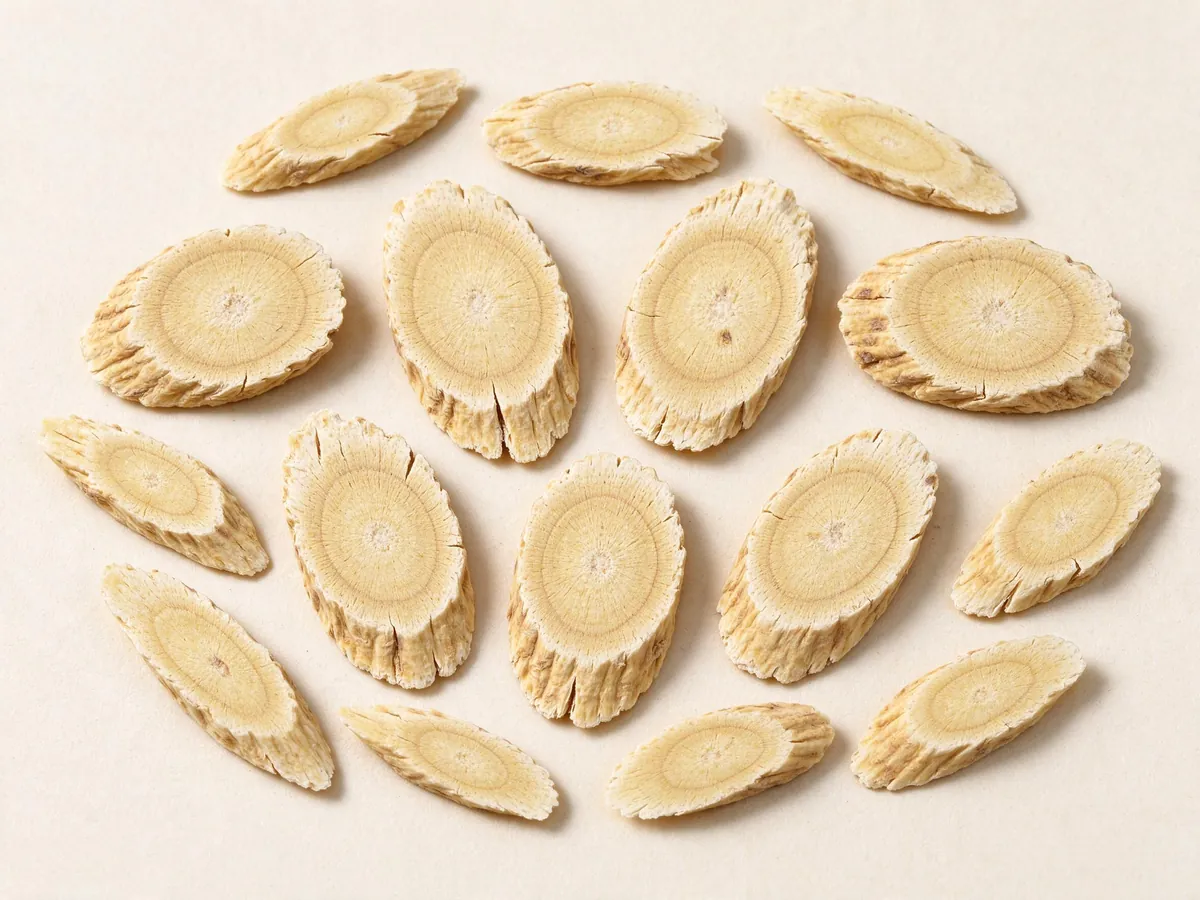
The root is cleaned, graded by size, moistened, cut into thick slices and dried.1 For the honey-fried form the slices are stir-fried with prepared honey until no longer sticky.1
Dry-frying with bran enhances its warming and tonifying properties toward the Spleen and Stomach.4 Wine-frying enhances its ability to reach the exterior and allows it to tonify without being cloying.4
Clear-preparation, spraying the slices with a little water before frying or baking, helps it tonify without being cloying.4
External use
For chronic ulceration where a depleted patient cannot form pus or fill the defect, it promotes the discharge of pus and generates flesh.4
Safety
Contraindications
Sores in their early stage, or sores with significant heat toxin.4 Yang excess with Yin deficiency, and upper burner heat with lower burner deficiency cold, because it tonifies the Yang.4
Use with caution
High doses in patients with allergies, because significant allergic reactions have been reported at 30 g or more and after injections.4
Adverse effects
Overdose can cause headache, tightness in the chest, insomnia, dizziness, flushing and raised blood pressure.4 Skin eruptions and itching have been reported, and anaphylactic shock has followed injections.4
Modern research
An updated systematic review and meta-analysis included sixty-six studies with 4,785 participants and found that additional Astragalus injection reduced albuminuria, proteinuria and serum creatinine in diabetic kidney disease.5
A meta-analysis of 32 papers with 2,462 patients from randomised controlled trials found that Astragalus added to RAAS blockers significantly reduced urinary protein excretion and serum creatinine in stage III diabetic nephropathy.6
Dose and administration
The official reference dose is 9-30 g.1 Some clinical texts use 9-15 g.4 The official dose in Taiwan is 9-30 g.3
The honey-fried form is used at the same range.1 These are reference ranges, not safe upper limits.
Common questions
Can Huang Qi be used on a leg ulcer?
It is used for chronic ulcers and sores due to deficiency that form pus poorly, or have formed pus but do not drain or heal well.4
How does it differ from Ren Shen?
Both are primal Qi tonics. Ren Shen is the stronger and longer-lasting tonic. Huang Qi raises the Yang and also stops sweating, promotes the discharge of pus, generates flesh and facilitates urination.4
Why is it used for both sweating and oedema?
It stabilises the exterior to stop spontaneous sweating, and it promotes urination to reduce oedema.4
When should it not be used?
In Yang excess with Yin deficiency, and on sores that are in their early stage or carry significant heat toxin.4
References
- Chinese Pharmacopoeia Commission. Pharmacopoeia of the People's Republic of China, 2020 edition, Volume I. Beijing: China Medical Science Press; 2020. Part I, pp. 315-316.
- Chang M, Jia M, Bare M, eds. Chinese Materia Medica. Beijing: People's Medical Publishing House; 2014. pp. 555-557.
- Ministry of Health and Welfare. Taiwan Herbal Pharmacopoeia, 4th edition (English edition). Taipei; 2022, with 2025 amendments where cited. p. 57.
- Bensky D, Clavey S, Stöger E. Chinese Herbal Medicine: Materia Medica. Portable 3rd edition. Seattle: Eastland Press; 2015. pp. 751-755.
- Zhang L, Shergis JL, Yang L, et al. Astragalus membranaceus (Huang Qi) as adjunctive therapy for diabetic kidney disease: an updated systematic review and meta-analysis. J Ethnopharmacol. 2019. doi.org/10.1016/j.jep.2019.111921
- Lin YQ, Yu F, Chen HJ, et al. Efficacy of astragalus combined with renin-angiotensin-aldosterone system blockers in the treatment of stage III diabetic nephropathy: a systematic review and meta-analysis. Ren Fail. 2024. doi.org/10.1080/0886022X.2024.2359033
Educational reference only. Not medical advice or an individual prescription. Consult a qualified practitioner before using any herb or treatment.