Overview
Sheng Jiang is acrid and slightly warm, entering the Lung, Spleen and Stomach.1
It releases the exterior and disperses cold, warms the middle and stops vomiting, transforms Phlegm and stops coughing, and resolves the toxicity of fish and crab.1
Identity and sources
The medicinal material is the fresh rhizome of Zingiber officinale.1
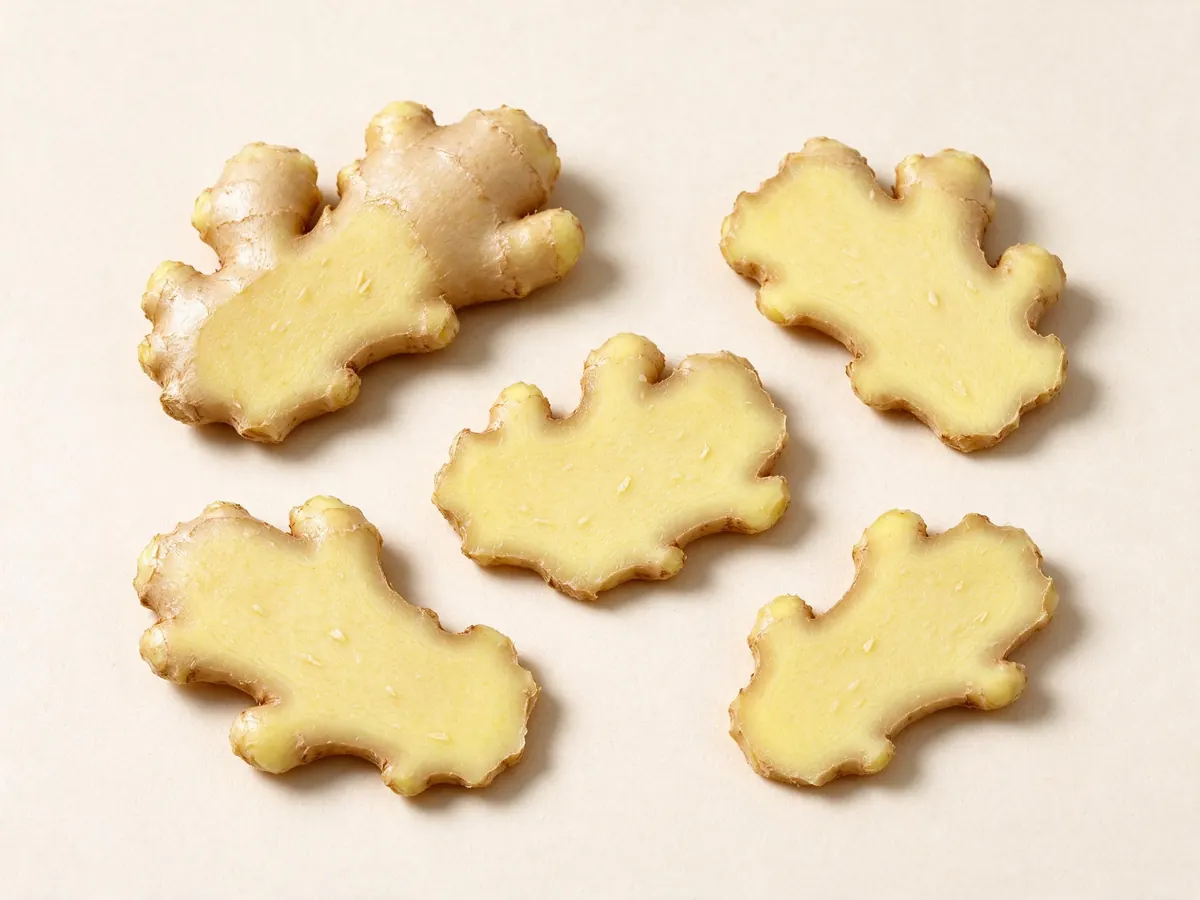
The rhizomes are irregular, slightly flattened blocks with finger-like branches, 4-18 cm long and 1-3 cm thick, yellow-brown or grey-brown with rings, and stem scars or buds at the branch tips.1
They are dug in autumn and winter, with the rootlets and soil removed.1
Actions
- Releases the exterior and disperses cold. For exterior cold patterns.2
- Warms the middle and stops vomiting. For cold in the Stomach, especially when there is vomiting.2
- Warms the Lungs and stops coughing. For cough from acute wind-cold and from chronic Lung disorders with Phlegm.2
- Resolves toxicity. For the toxicity or overdose of other herbs, such as Aconite or Pinellia, and for seafood poisoning.2
Clinical applications
Exterior cold
For exterior cold patterns it is used with Da Zao, as in Cinnamon Twig Decoction.2
Vomiting
For vomiting from cold in the Stomach it is used with prepared Pinellia.2
For vomiting from heat in patients with Stomach Qi deficiency it is used with bamboo shavings.2
Cough
For cough from wind-cold it is used with Perilla leaf, Xing Ren and Aster.2
For cough and headache from heat-induced Phlegm, or aphonia and numbness from wind-stroke, it is used with bamboo juice.2
Poisoning
For vomiting and diarrhoea from seafood poisoning it is used with Perilla leaf.2
Key combinations
With Da Zao for exterior wind-cold, epigastric pain, nausea and vomiting, and to protect the Stomach Qi from the irritation of other herbs.2
With prepared Pinellia for vomiting from many causes and for productive cough from Phlegm-Dampness.2
With bamboo shavings for vomiting from heat in Stomach Qi deficiency.2
With Perilla leaf for vomiting and diarrhoea from seafood poisoning.2
Comparison with similar herbs
| Form | Key difference |
|---|---|
| Sheng Jiang 生姜 (fresh) | Acrid and warm, with a mild aroma. It induces sweating and expels pathogenic influences; its effect is rapid but does not last long.2 |
| Gan Jiang 干姜 (dried) | Acrid and hot, with a strong aroma and a compact texture. It is internally mobile while warming the middle and dispersing internal cold; mobile and does conserve.2 |
| Pao Jiang 炮姜 (prepared) | No longer acrid but bitter, warm and harmonious. It warms the middle and stops diarrhoea and bleeding.2 |
Processing and preparation
Fresh ginger is stored in a cool, moist place or buried in wet sand, protected from freezing.1
Ginger peel is obtained by shaving the outer skin from clean fresh ginger.1
Safety
Contraindications
Spontaneous sweating from exterior deficiency, heat from Yin deficiency, and any pattern with abundant heat.2
Adverse effects
Belching was identified as a potential side effect in pregnant women.3
Modern research
A systematic review evaluated meta-analyses of ginger's pharmacological effects in inflammation, type 2 diabetes, oxidative stress and pregnancy-associated nausea and vomiting.3
The meta-analyses associated ginger supplementation with lower circulating C-reactive protein, high-sensitivity C-reactive protein and tumour necrosis factor-alpha.3
In patients with T2DM, it lowered glycosylated haemoglobin 1c and fasting blood glucose, and antioxidant effects were seen as lower malondialdehyde and higher glutathione peroxidase activity.3
In pregnant women it alleviated nausea but had no significant effect on vomiting frequency.3
Daily doses of 1-3 g were used for anti-inflammatory, antioxidant and antidiabetic purposes, and 500-1,500 mg daily in divided doses for pregnancy nausea.3
Dose and administration
The official reference dose is 3-10 g.1
This is a reference range, not a safe upper limit.
Common questions
How does fresh ginger differ from dried ginger?
Fresh ginger is acrid and warm with a mild aroma; it induces sweating and expels pathogens quickly but briefly. Dried ginger is acrid and hot with a strong aroma; it warms the middle and disperses internal cold, and its effect lasts longer.2
What is ginger peel?
It is the outer skin shaved from clean fresh ginger.1
Is it used for seafood poisoning?
Yes; with Perilla leaf it is used for vomiting and diarrhoea from seafood poisoning.2
References
- Chinese Pharmacopoeia Commission. Pharmacopoeia of the People's Republic of China, 2020 edition, Volume I. Beijing: China Medical Science Press; 2020. Part I, p. 104.
- Bensky D, Clavey S, Stöger E. Chinese Herbal Medicine: Materia Medica. Portable 3rd edition. Seattle: Eastland Press; 2015. pp. 30-33.
- Paudel KR, Orent J, Penela OG. Pharmacological properties of ginger (Zingiber officinale): what do meta-analyses say? a systematic review. Front Pharmacol. 2025;16:1619655. doi:10.3389/fphar.2025.1619655 pubmed.ncbi.nlm.nih.gov/40808693
Educational reference only. Not medical advice or an individual prescription. Consult a qualified practitioner before using any herb or treatment.