Overview
Ren Shen is sweet, slightly bitter and slightly warm, entering the Spleen, Lung, Heart and Kidney.1,2,3,4 It powerfully tonifies the primal Qi of the five organs, nourishes the Yin, revives from collapse and stops heavy bleeding.2,3
It acts more powerfully and quickly than Codonopsis and Pseudostellaria.2 It is used for collapse of Qi with cold limbs and a minute pulse, and for Spleen and Lung deficiency.1,2
It aids fire and can hold a pathogen in, so it is used carefully where an exterior pathogen is present and avoided in ascendant Liver Yang and in conditions from fire.2
Identity and sources
The medicinal material is the dried root and rhizome of Panax ginseng.1 Taiwan's official monograph has the same flavour, a slightly different channel list, and a different dose range.4
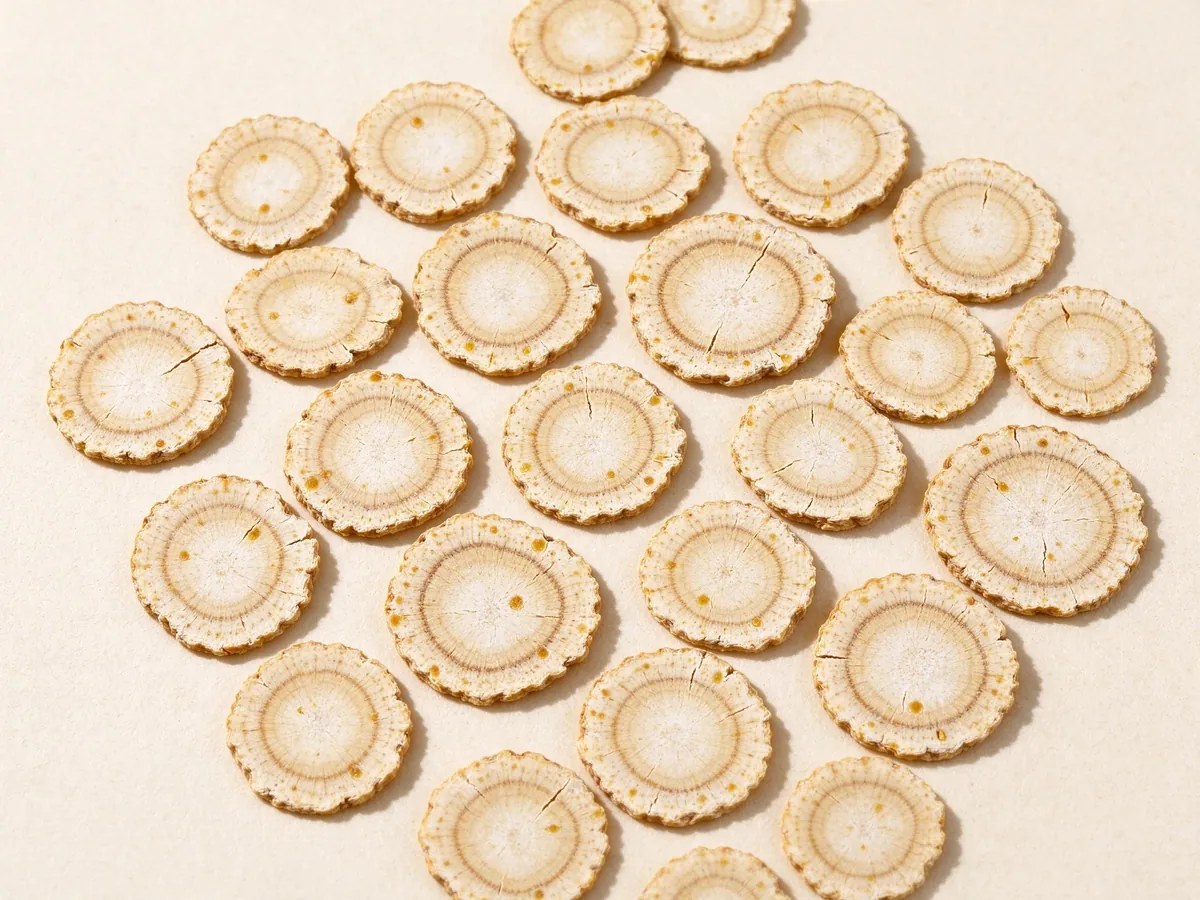
It is prepared by moistening the root, cutting it into thin slices and drying them, or by powdering it when used.1
Actions
- Powerfully tonifies the primal Qi. For collapse with shallow breathing, cold limbs, profuse sweating and a pulse that is barely perceptible, after blood loss, heavy sweating or severe fluid loss.2
- Strengthens the Spleen and tonifies the Stomach. For lethargy, poor appetite, abdominal distention, chronic diarrhoea and, in severe cases, prolapse.2
- Tonifies the Lungs and augments the Qi. For wheezing, breathlessness and laboured breathing on exertion from Lung Qi deficiency.2
- Generates fluids and stops thirst. For wasting and thirsting disorder, and for Qi and fluids injured by high fever and sweating.2
- Benefits the Heart Qi and calms the spirit. For palpitations with anxiety, insomnia, forgetfulness and restlessness from Qi and Blood deficiency.2
- Restores the pulse and stops bleeding. For collapse and for heavy bleeding.1,2
Clinical applications
Collapse of Qi
For a patient who is deeply depleted, with cold limbs, shallow breathing, profuse sweating and a pulse that is almost imperceptible, it restores the pulse and secures the collapse.2,1 In this setting it can be used alone.2
Spleen and Stomach deficiency
For lethargy, poor appetite, abdominal distention, chronic diarrhoea and prolapse.2
Lung Qi deficiency
For wheezing and breathlessness on exertion from Lung Qi deficiency, where the Kidney also fails to grasp the Qi.2
Thirst and fluid depletion
For intense thirst with fever, irritability and sweating, and for wasting and thirsting disorder with an intense, unquenchable thirst.2
Heart Qi deficiency
For palpitations, insomnia, forgetfulness and restlessness from deficiency of Qi and Blood.2,1
Key combinations
With Fu Zi 附子 in Shen Fu Tang (Ginseng and Aconite Decoction), it is used for collapsed Qi and Yang with icy extremities and profuse sweating.2,3
With Wu Wei Zi 五味子 and Mai Dong 麦冬 in Sheng Mai San (Generate the Pulse Powder), it is used for breathlessness and spontaneous sweating from Qi and Yin deficiency after heat injury.2
With Bai Zhu 白术 and Fu Ling 茯苓 in Si Jun Zi Tang (Four-Gentlemen Decoction), it is used for Spleen and Stomach Qi deficiency with anorexia, diarrhoea and fatigue.2
With Huang Qi 黄芪 and Chai Hu 柴胡 in Bu Zhong Yi Qi Tang (Tonify the Middle to Augment the Qi Decoction), it tonifies Qi and raises the clear Yang for prolapse.2,3
With Gypsum and Zhi Mu 知母 in White Tiger plus Ginseng Decoction, it is used where heat has injured both the Qi and the fluids, with fever, irritability and intense thirst.2
With Dang Gui 当归, Longan and Polygala in Gui Pi Tang (Restore the Spleen Decoction), it is used for palpitations, poor appetite and insomnia from Heart and Spleen deficiency.2
With Rehmannia and Platycladi Semen in Tian Wang Bu Xin Dan (Emperor of Heaven's Special Pill), it is used for insomnia from Heart and Kidney insufficiency.2
Comparison with similar herbs
| Herb | Key difference |
|---|---|
| Ren Shen 人参 | Also nourishes the Yin, and its tonic effect is stronger and longer lasting.2 |
| Huang Qi 黄芪 | Sweet and warm with a quick ascending quality. It raises the Yang, stops sweating, promotes the discharge of pus, generates flesh and promotes urination.2 |
Both Ren Shen and Huang Qi are primal Qi tonics, and Ren Shen revives from collapse.2
Processing and preparation
The root is usually cooked separately in a double boiler and the liquid added to the strained decoction of the other herbs.2
Safety
Contraindications
It is not to be combined with Veratrum (Li Lu) or with flying squirrel faeces (Wu Ling Zhi).1 Steaming bone disorder, bleeding from heat in the Blood, ascendant Liver Yang, and any condition from fire due to constraint.2
It cannot be taken where heat from excess affects the Spleen and Stomach, where Lung fire causes wheezing with copious phlegm, in the early stages of bleeding disorders, or with hiccough, constipation or parasitic accumulation.2
Use with caution
It is used with caution where an external pathogen is clearly present, because it aids fire and can help retain the pathogen.2
Interactions
It should not be taken with high doses of caffeine or other stimulants.2
Modern research
A randomised, double-blind, placebo-controlled trial gave a Panax ginseng extract, 250 mg a day for four weeks, to 65 survivors with moderate to severe fatigue, and reported a significant reduction in fatigue with excellent tolerability.5
Dose and administration
The official reference dose is 3-9 g.1 As a powder the official dose is 2 g twice a day.1 The official dose in Taiwan is 3-11.5 g.4 In emergencies 15-30 g is used, divided into several doses.3
These are reference ranges, not safe upper limits.
Common questions
What must it never be combined with?
Veratrum (Li Lu) and flying squirrel faeces (Wu Ling Zhi).1
References
- Chinese Pharmacopoeia Commission. Pharmacopoeia of the People's Republic of China, 2020 edition, Volume I. Beijing: China Medical Science Press; 2020. Part I, pp. 8-9.
- Bensky D, Clavey S, Stöger E. Chinese Herbal Medicine: Materia Medica. Portable 3rd edition. Seattle: Eastland Press; 2015. pp. 743-745.
- Chang M, Jia M, Bare M, eds. Chinese Materia Medica. Beijing: People's Medical Publishing House; 2014. pp. 547-549.
- Ministry of Health and Welfare. Taiwan Herbal Pharmacopoeia, 4th edition (English edition). Taipei; 2022, with 2025 amendments where cited. pp. 187-188.
- Rahmani A, Sanaat Z, Hajivalizadeh H, Shamsi A, Ghaderi M. The effect of ginseng extract on fatigue in cancer survivors: a randomized double-blind clinical trial. Support Care Cancer. 2026. doi.org/10.1007/s00520-026-10398-3
Educational reference only. Not medical advice or an individual prescription. Consult a qualified practitioner before using any herb or treatment.