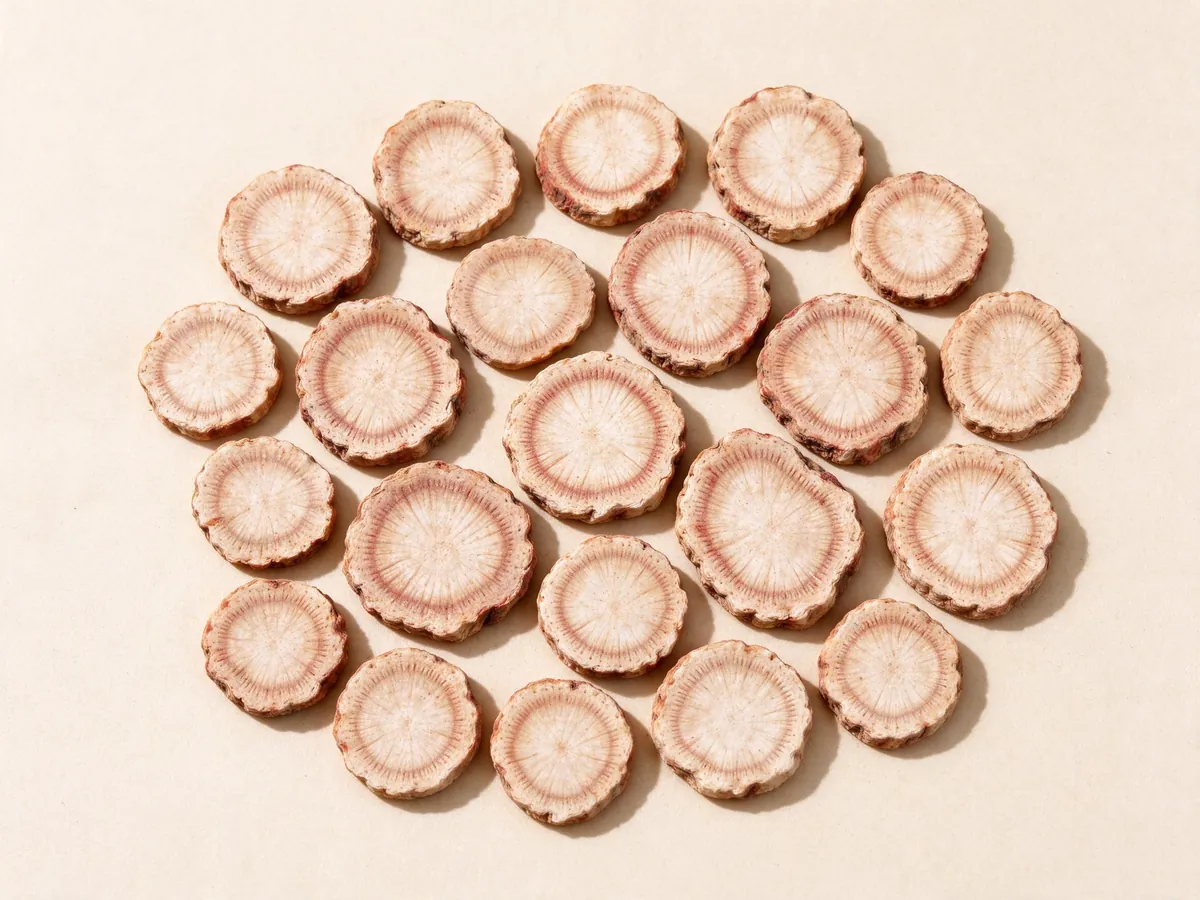
Overview
Bai Shao is bitter, sour and slightly cold, entering the Liver and Spleen.1,2,3,4 It nourishes the Blood, restrains Yin, softens the Liver and settles rising Yang.2,1
Its slight sourness restrains and inhibits, while its slight bitterness tonifies Yin.2
It is also used for a pale complexion, for spontaneous sweating that does not resolve, and for cramping pain.2
It is very commonly used in the treatment of women's disorders, particularly where menstrual dysfunction, discharge or uterine bleeding accompanies a pale, lusterless complexion.2,1
The Liver governs the sinews, and sinews cramp and spasm when the Liver Blood does not support them.2 It tonifies the Liver Blood and thereby relieves pain from acutely cramped sinews.2
Identity and sources
The medicinal material is the dried root of Paeonia lactiflora.1 In Taiwan the nature is graded mild cold, bitter and sour, and it enters the Liver and Spleen.4 The official dose in Taiwan is 6-15 g.4
Chi Shao, Paeoniae Radix rubra, comes from the same species but is wild-crafted and generally retains its bark, while Bai Shao is cultivated and peeled.2
Actions
- Nourishes the Blood and regulates the menses. For Blood deficiency with menstrual dysfunction, discharge and uterine bleeding, a pale complexion and lusterless nails.2
- Calms and curbs Liver Yang and alleviates pain. For flank, chest and abdominal pain from constrained Liver Qi, for cramping of the hands and feet, and for headache and dizziness from ascendant Yang.2
- Preserves Yin and adjusts the nutritive and protective levels. For spontaneous sweating, night sweats, discharge and spermatorrhoea.1,2
Clinical applications
Blood deficiency and menstrual disorders
For a pale, lusterless complexion, dull nails, dizziness, blurred vision and irregular or painful periods.2,1
Cramping and colicky pain
For cramping pain or spasm in the hands and feet, painful spasms in the abdomen, cramp of the calf, and pain from acutely cramped sinews, it softens and relieves.2
Painful diarrhoea
It is used for diarrhoea with abdominal pain from Spleen deficiency or from disharmony between Spleen and Liver.2
Sweating
For spontaneous sweating from disharmony between the nutritive and protective levels, and for night sweats from Yin deficiency.3
Headache and dizziness
Key combinations
With Gan Cao 甘草 in Shao Yao Gan Cao Tang, it relieves abdominal pain from Liver and Stomach disharmony, and spasm of the calf from Blood deficiency.2
With Dang Gui 当归, Shu Di Huang 熟地黄 and Chuan Xiong 川芎 in Si Wu Tang, it is used for dizziness, blurred vision and dysmenorrhoea from Blood deficiency or stasis.3,2
With Chai Hu 柴胡 for flank pain from constrained Liver Qi, it softens the Liver and relieves the pain.2
With Wu Wei Zi 五味子 and light wheat for night sweats, it preserves the Yin and checks the sweating.2
Comparison with similar herbs
| Herb or form | Key difference |
|---|---|
| Chi Shao 赤芍 | The same species, wild-crafted and generally unpeeled.2 |
| Bai Shao 白芍 (unprepared) | Bitter, sour and slightly cold. Nourishes Blood, cultivates Yin, calms the Liver and checks sweating.2,3 |
| Wine-fried Bai Shao 酒白芍 | Moderates the cold nature and sour flavour and gives a mild ability to invigorate the blood, and is used where Blood deficiency is coupled with stasis or cold.2 |
Processing and preparation
The root is cleaned, moistened, cut into thin slices and dried.1 Dry-frying reduces the cold property and enhances the Blood-nourishing action.2
Wine-frying moderates the cold nature and sour flavour and gives a mild ability to invigorate the blood.2
Stir-frying to a slightly yellow colour (Chao Bai Shao) and wine-frying (Jiu Bai Shao) are the two forms in the official monograph.1 Earth-frying leads it directly into the Spleen and Stomach.2 Vinegar-frying enhances its ability to relax and soften the Liver, relieve pain and inhibit bleeding.2 The charred form is used to stop bleeding and helps reduce diarrhoea in dysenteric disorders.2
Safety
Contraindications
It is not to be combined with Veratrum (Li Lu).1
It is forbidden when a weak Stomach is attacked by cold, with diarrhoea and cold pain in the abdomen.2
Use with caution
It is not suitable for patients with abdominal distension, Dampness, Phlegm, poor appetite or loose stools, because it may affect appetite and digestion.3
It is not suitable in Yang deficiency or cold attack, because it is cold in nature.3
Adverse effects
Allergic reactions have been reported, including measles-like eruptions, pruritus, papular rashes over the whole body, a red and swollen face and restlessness.2
Modern research
A narrative review of Paeonia radix alba formulas and their bioactive metabolites examined hepatoprotection in chronic liver disease.5 The review found hepatoprotective, anti-inflammatory and immunomodulatory effects, and it can attenuate the hepatotoxicity of other botanical drugs.5
A second review examined total glucosides of peony, an extract rich in paeoniflorin, in cirrhosis and the mechanisms by which they modulate the gut-liver axis.6
Dose and administration
The official reference dose is 6-15 g.1 Some clinical texts use 10-30 g in decoction.3
These are reference ranges, not safe upper limits.
Common questions
Is Bai Shao the same as Chi Shao?
Why does it help cramps?
The Liver governs the sinews, and they cramp when Liver Blood does not support them. Bai Shao tonifies the Liver Blood and thereby relieves pain from acutely cramped sinews.2
References
- Chinese Pharmacopoeia Commission. Pharmacopoeia of the People's Republic of China, 2020 edition, Volume I. Beijing: China Medical Science Press; 2020. Part I, pp. 108-109.
- Bensky D, Clavey S, Stöger E. Chinese Herbal Medicine: Materia Medica. Portable 3rd edition. Seattle: Eastland Press; 2015. pp. 787-790.
- Chang M, Jia M, Bare M, eds. Chinese Materia Medica. Beijing: People's Medical Publishing House; 2014. pp. 597-599.
- Ministry of Health and Welfare. Taiwan Herbal Pharmacopoeia, 4th edition (English edition). Taipei; 2022, with 2025 amendments where cited. pp. 283-284.
- Li Y, Shen J, He X, et al. Traditional Paeonia radix alba formulas and their bioactive metabolites: a narrative review focusing on hepatoprotection in chronic liver diseases. Front Pharmacol. 2026. doi.org/10.3389/fphar.2026.1958930
- Chen S, Zheng Q. Total glucosides of paeony in cirrhosis: mechanisms of action via the gut-liver axis, a review. Front Gastroenterol (Lausanne). 2026. doi.org/10.3389/fgstr.2026.1981682
Educational reference only. Not medical advice or an individual prescription. Consult a qualified practitioner before using any herb or treatment.