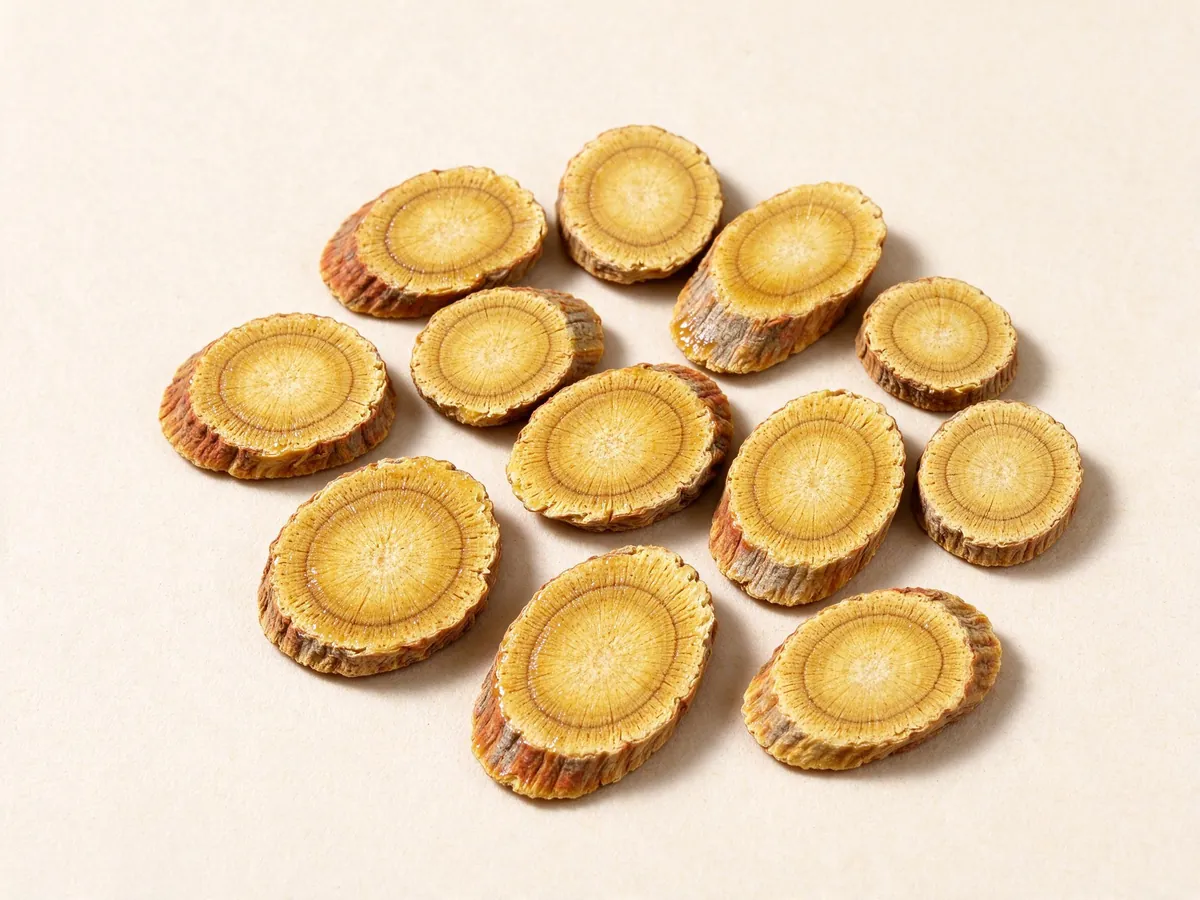
Overview
Zhi Gan Cao is licorice root prepared by stir-frying the slices with honey.1 It has its own official monograph, separate from Gan Cao.1
The frying shifts the emphasis of the root toward tonifying.2 It is sweet and neutral, entering the Heart, Lung, Spleen and Stomach, and it is used for Spleen and Stomach weakness with tiredness and for palpitations with an irregular or intermittent pulse.1
The prepared form is a component of many classical formulas.2
Identity and sources
The medicinal material is prepared licorice, made from the dried root and rhizome of the three accepted Glycyrrhiza species.1 Honey is brought to a boil, thinned with water, poured over the slices, and the slices are then fried at a low temperature until deep yellow and no longer sticky.2
Actions
- Tonifies the Spleen and harmonises the Stomach. For Spleen and Stomach weakness with tiredness and lack of strength.1
- Augments Qi and restores the pulse. For palpitations with an irregular or intermittent pulse from Heart Qi deficiency.1,3
- Harmonises the properties of other herbs. This method of preparation increases the root's ability to tonify the middle, augment the Heart and Spleen Qi and harmonise the properties of other herbs.2
Clinical applications
Palpitations with an irregular pulse
For palpitations with an intermittent pulse from Heart Qi deficiency, the honey-fried herb is used.3
As a harmonising ingredient
In a formula it harmonises the properties of the other herbs.2
Key combinations
With Ren Shen 人参, E Jiao 阿胶 and Gui Zhi in Zhi Gan Cao Tang, it is used for palpitations with an irregular pulse.3
With Bai Shao 白芍 in Shao Yao Gan Cao Tang, it is used for cramping abdominal pain and limb spasm.3
Comparison with similar herbs
Processing and preparation
Licorice slices are stir-fried with honey until yellow to deep yellow and no longer sticky, then cooled.1
The prepared slices are slightly sticky, yellow to deep yellow in cross-section, and have a burnt-sweet smell.1
Safety
Contraindications
The same incompatibilities apply as for the unprepared root: not with Sargassum, Jing Da Ji, Hong Da Ji, Gan Sui or Yuan Hua.1 Distention and fullness of the chest or abdomen, and vomiting from overabundant Dampness.2
Use with caution
Dampness accumulation.3 Oedema, hypertension, low potassium and congestive heart failure.2
Adverse effects
Long-term use can cause salt retention, hypertension, oedema and low potassium.2
Toxicity and overdose
Glycyrrhizin inhibits 11beta-hydroxysteroid dehydrogenase type 2, so cortisol activates the mineralocorticoid receptor without restraint.4 Decompensated heart failure has been reported after more than ten years of a licorice-containing formula.5
Modern research
Pseudoaldosteronism has been reported after excessive liquorice consumption and after more than ten years of a licorice-containing formula.4,5
Glycyrrhizin is the compound responsible for that effect.4
Dose and administration
The dose, caution and storage are the same as for the unprepared root.1 The reference dose is 2-10 g.1 Some clinical texts use 3-10 g3 or up to 30 g when a larger dose is intended.3
This is a reference range, not a safe upper limit.
Common questions
Can Zhi Gan Cao be used instead of Gan Cao?
Does it carry the same safety risks as Gan Cao?
Why is it used in the tonifying formulas rather than the raw root?
Frying increases its ability to tonify the middle and to harmonise the other herbs.2
References
- Chinese Pharmacopoeia Commission. Pharmacopoeia of the People's Republic of China, 2020 edition, Volume I. Beijing: China Medical Science Press; 2020. Part I, p. 89.
- Bensky D, Clavey S, Stöger E. Chinese Herbal Medicine: Materia Medica. Portable 3rd edition. Seattle: Eastland Press; 2015. pp. 765-767.
- Chang M, Jia M, Bare M, eds. Chinese Materia Medica. Beijing: People's Medical Publishing House; 2014. pp. 563-565.
- McHugh J, Nagabathula R, Kyithar MP. A life-threatening case of pseudo-aldosteronism secondary to excessive liquorice ingestion. BMC Endocr Disord. 2021. doi.org/10.1186/s12902-021-00816-4
- Kurisu S, Fujiwara H. Glycyrrhizin-induced pseudoaldosteronism contributing to decompensated heart failure with preserved ejection fraction. Cureus. 2026. doi.org/10.7759/cureus.116676
Educational reference only. Not medical advice or an individual prescription. Consult a qualified practitioner before using any herb or treatment.