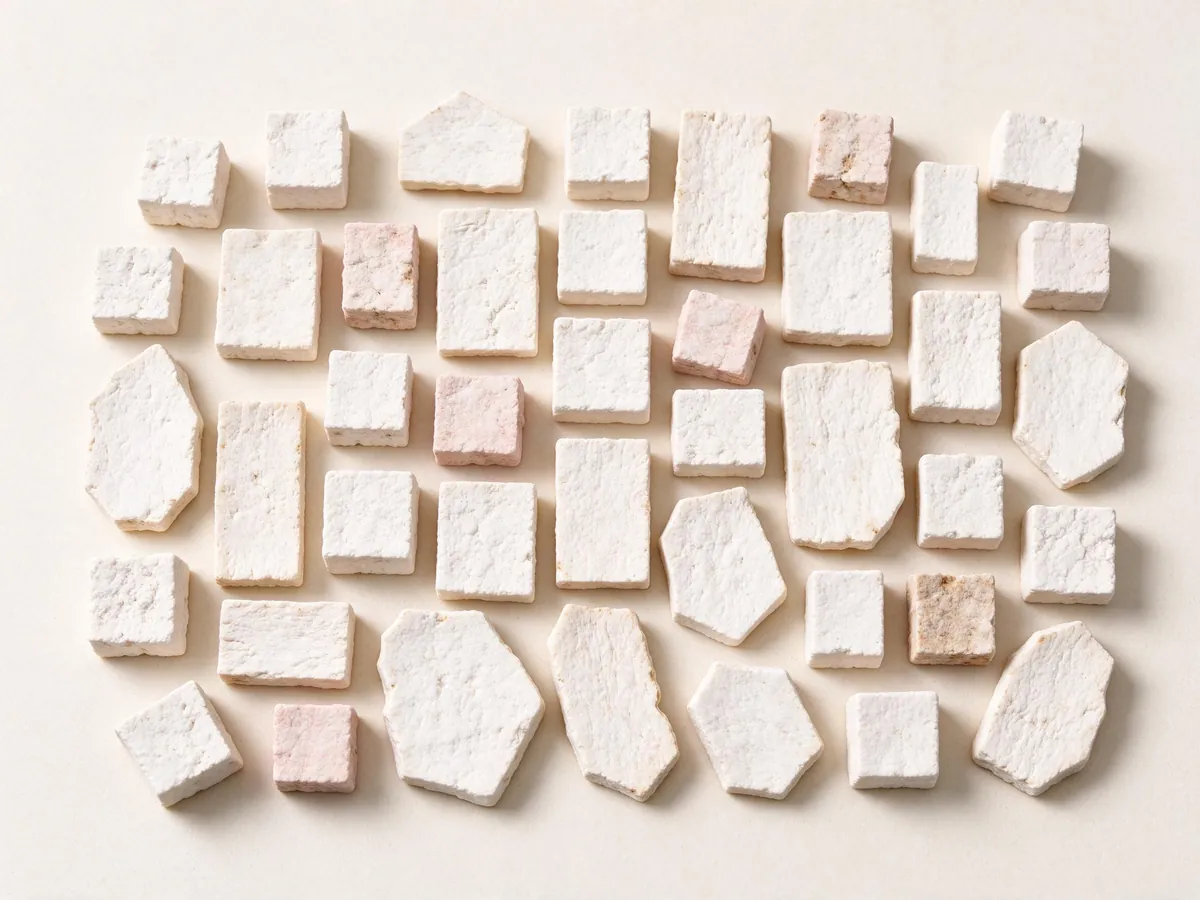
Overview
Fu Ling is sweet, bland and neutral, entering the Heart, Spleen, Kidney and Lung.1,2 It drains Dampness, strengthens the Spleen and quiets the Heart spirit.1,2
Sweetness tonifies the middle while blandness leaches out Dampness, so it tonifies and drains at the same time.2 That is why it suits patterns where the Spleen is deficient and Dampness is also in excess.2
It promotes urination without injuring the Qi.2
Identity and sources
It is sweet, bland and neutral, entering the Heart, Lung, Spleen and Kidney.1,2
It is a fungus, and the part used is the dried sclerotium.1
Actions
- Promotes urination and leaches out Dampness. For urinary difficulty, diarrhoea and oedema.2
- Strengthens the Spleen and harmonises the middle burner. For Spleen deficiency with Dampness, with poor appetite and diarrhoea.2
- Strengthens the Spleen and transforms Phlegm. For thin mucus that moves upward, with palpitations, headache and dizziness.2
- Quiets the Heart and calms the spirit. For palpitations, insomnia or forgetfulness from Spleen and Heart insufficiency or from turbid Phlegm.2
Clinical applications
Oedema and urinary difficulty
For oedema and difficult urination it is used with Alismatis Rhizoma and Polyporus to strengthen its ability to promote urination.2
Spleen deficiency with Dampness
For poor appetite and loose stools where the Spleen is deficient and Dampness has accumulated, it tonifies and drains together.2
Thin mucus
For thin mucus rising with dizziness, headache and palpitations, it is used with Pinellia and with Chen Pi.2
Palpitations and insomnia
For palpitations and insomnia from Spleen and Heart insufficiency, or from turbid Phlegm obstructing the orifices, it quiets the spirit.2
For oedema from Spleen and Kidney Yang deficiency it is used with Aconiti Radix lateralis praeparata and Atractylodis macrocephalae Rhizoma.2
For thin mucus with vomiting, fullness and distension of the chest, nausea and reduced appetite, it is used with Chen Pi.2
Key combinations
With Ze Xie 泽泻 and Polyporus (Zhu Ling 猪苓), it is used to strengthen the promotion of urination and the leaching out of Dampness.2
With Cinnamomi Ramulus and Atractylodis macrocephalae Rhizoma for oedema, a feeling of heaviness throughout the body, painful urinary dribbling and irritability from internal Dampness.2
With Ginseng Radix and Atractylodis macrocephalae Rhizoma for deficient and weak Spleen Qi with fatigue, weakness, loss of appetite and loose stools.2
With Aucklandia it is used for diarrhoea from Dampness with Spleen deficiency.2
With Pinellia it is used to expel Phlegm and stop vomiting and nausea.2
With Citri reticulatae Pericarpium for thin mucus with vomiting, fullness and distension of the chest, nausea and reduced appetite.2
With Aconite and Bai Zhu in Zhen Wu Tang, it is used for oedema from Spleen and Kidney Yang deficiency.2
With Codonopsis, Ziziphus seed and Longan in Gui Pi Tang, it is used for insomnia from Spleen and Heart insufficiency.2
Comparison with similar herbs
| Herb | Key difference |
|---|---|
| Fu Ling 茯苓 | Sweet, bland and neutral. Tonifies the Spleen, eliminates Dampness and quiets the Heart spirit.2 |
| Zhu Ling 猪苓 | Sweet, bland and slightly cool, entering the Spleen, Kidney and Bladder. Its described actions are to promote urination and leach out Dampness.2 |
Fu Ling both tonifies and drains, while Zhu Ling's listed actions are draining only, so Fu Ling is chosen where the Spleen is also deficient.2
Processing and preparation
The sclerotia are dug from July to September, cleaned of mud, piled to sweat, then spread out and dried until the surface is dry.1
Safety
Use with caution
Yin deficiency, sunken Spleen Qi, or cold from deficiency with spermatorrhoea.2
General caution for this group
Dampness-draining herbs must be used with caution where Yin is deficient or fluids are depleted.2
Modern research
A review of Poria cocos notes documented use spanning more than 2500 years.3
Pharmacological studies cited in the review report diuretic activity, and the review also raises problems of quality standardisation and sustainability.3
Dose and administration
The official reference dose is 10-15 g.1
This is a reference range, not a safe upper limit.
Common questions
Is Fu Ling a mushroom?
It is the dried sclerotium of the fungus Poria cocos.1
Why is it used for both diarrhoea and oedema?
It strengthens the Spleen and harmonises the middle burner, and it leaches out Dampness.2
When is it most appropriate?
When the Spleen is deficient and there is a simultaneous over-abundance of Dampness.2
References
- Chinese Pharmacopoeia Commission. Pharmacopoeia of the People's Republic of China, 2020 edition, Volume I. Beijing: China Medical Science Press; 2020. Part I, p. 251.
- Bensky D, Clavey S, Stöger E. Chinese Herbal Medicine: Materia Medica. Portable 3rd edition. Seattle: Eastland Press; 2015. pp. 300-303.
- Lei J, Gong D, Duan L, Tang R, Gu W, Zhang F, Zhao Y, Zhang M, Yang X, Yu J. A multidimensional perspective on Poria cocos, an ancient fungal traditional Chinese medicine. J Ethnopharmacol. 2025;40280371. doi:10.1016/j.jep.2025.119869 pubmed.ncbi.nlm.nih.gov/40280371
Educational reference only. Not medical advice or an individual prescription. Consult a qualified practitioner before using any herb or treatment.