Overview
Jie Geng is bitter, acrid and neutral, entering the Lung.1
It opens the Lungs, benefits the throat, transforms Phlegm and expels pus.1
It has an ascending and dispersing nature which raises and opens the Lung Qi, releases the exterior, benefits the throat, transforms Phlegm and expels pus.2
It also causes the Qi and the actions of other herbs to rise, and it soothes the throat.2
Identity and sources
The medicinal material is the dried root of Platycodon grandiflorum.1
The roots are dug in spring and autumn, washed, stripped of rootlets, and either peeled while fresh or left unpeeled before drying.1
They are cylindrical or slightly spindle-shaped,, pale yellowish-white to yellow, with longitudinal twisted furrows and lenticel-like scars, and several half-moon stem scars at the top.1
Actions
Clinical applications
Cough
It disseminates the Lung Qi and dispels Phlegm, and is used for cough with copious Phlegm and a stifling sensation in the chest.1
Throat
It benefits the throat, and is used for sore throat and loss of voice.1
Lung abscess
For Lung abscess with coughing of pus.1
Key combinations
With Gan Cao, it disseminates Lung Qi, expels Phlegm, resolves toxicity and expels pus; the pair is used for productive cough with swelling and pain of the throat, Lung abscess with pus, and chest and flank pain.2
With Perilla stem for cough, wheezing or a stifling sensation in the chest and diaphragm from Lung Qi constraint.2
With Aurantii Fructus and Trichosanthes peel for discomfort and a stifling sensation in the chest from Phlegm obstruction and Qi stagnation.2
With Mentha, Arctium and cicada moult for hoarseness and sore throat from wind-heat.2
With Perilla leaf and Armeniacae Semen in Apricot Kernel and Perilla Leaf Powder, it is used for wind-cold cough with watery sputum, nasal congestion, chills and headache.2
With Mori Folium and Chrysanthemi Flos in Mulberry Leaf and Chrysanthemum Drink, it is used for wind-heat cough with mild fever and thirst.2
With Pinellia preparata, it is used for cough from externally contracted wind-cold or from a longstanding Phlegm-Dampness disorder.2
With Trichosanthes seed, Houttuynia and Coix.2
With Angelica dahurica, it is used for an ulcerated abscess that is discharging slowly.2
With Fritillaria and Croton, it is used to enhance the discharge of pus.2
Comparison with similar herbs
Processing and preparation
The root is cleaned of impurities, washed, softened, cut into thick slices and dried.1
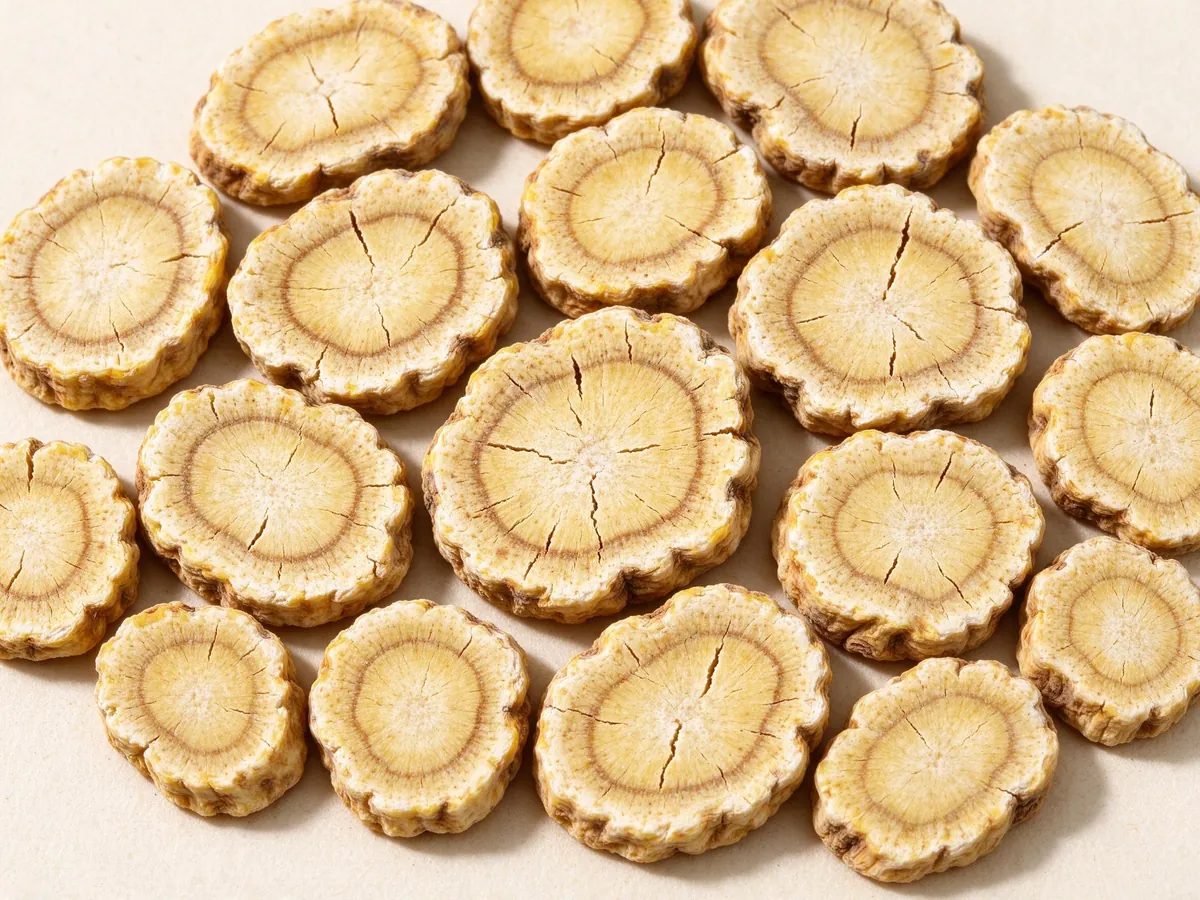
The slices are oval or irregular thick pieces, with the outer bark mostly removed, a yellowish-white narrow phloem, a distinct brown cambium ring and a broad, deeply fissured xylem; they smell faintly and taste slightly sweet then bitter.1
It is stored in a ventilated dry place and protected from insects.1
Safety
Contraindications
It is an herb that raises, so it is not used when pathogenic Qi rushes rebelliously upward and cannot descend.2
It should also not be used with herbs intended to purge or to tonify the lower burner.2
Adverse effects
Within the allowed oral dose range no toxic effects are expected, but overdosage readily causes nausea and vomiting, and in severe cases sweating of the limbs, exhaustion and restlessness have been reported.2
Modern research
A review of platycodin D from Platycodon grandiflorus covers one of the main active compounds extracted from the root.3
The plant has been traditionally used in China for sore throats, hoarseness and coughs with Phlegm.3
Platycodin D has anti-inflammatory, antitumour, antioxidant, metabolic, antiviral, hepatoprotective and spermatogenic effects.3
It can also serve as a vaccine adjuvant to increase the efficacy of vaccines.3
Dose and administration
The official reference dose is 3-10 g.1 The dose in Taiwan is also 3-10 g.4
This is a reference range, not a safe upper limit.
Common questions
What does it treat in the throat?
It benefits the throat and is used for sore throat and loss of voice.1
Can it be used when Qi rebels upward?
No; it is an herb that raises and is not used when pathogenic Qi rushes rebelliously upward and cannot descend.2
What does it do to other herbs in a formula?
It causes the Qi and the actions of other herbs to rise, and it soothes the throat.2
References
- Chinese Pharmacopoeia Commission. Pharmacopoeia of the People's Republic of China, 2020 edition, Volume I. Beijing: China Medical Science Press; 2020. Part I, p. 289.
- Bensky D, Clavey S, Stöger E. Chinese Herbal Medicine: Materia Medica. Portable 3rd edition. Seattle: Eastland Press; 2015. pp. 429-431.
- Song Y, Lv X, Ding C, Liu X, Han Y, Chen S, Li M, Zhao T. Research progress on the bioactivity of platycodin D from Platycodon grandifloras. Naunyn Schmiedebergs Arch Pharmacol. 2025;398(8):9673-9701. doi:10.1007/s00210-025-03875-9 pubmed.ncbi.nlm.nih.gov/40064661
- Ministry of Health and Welfare. Taiwan Herbal Pharmacopoeia, 4th edition (English edition). Taipei; 2022, with 2025 amendments where cited. p. 511.
Educational reference only. Not medical advice or an individual prescription. Consult a qualified practitioner before using any herb or treatment.