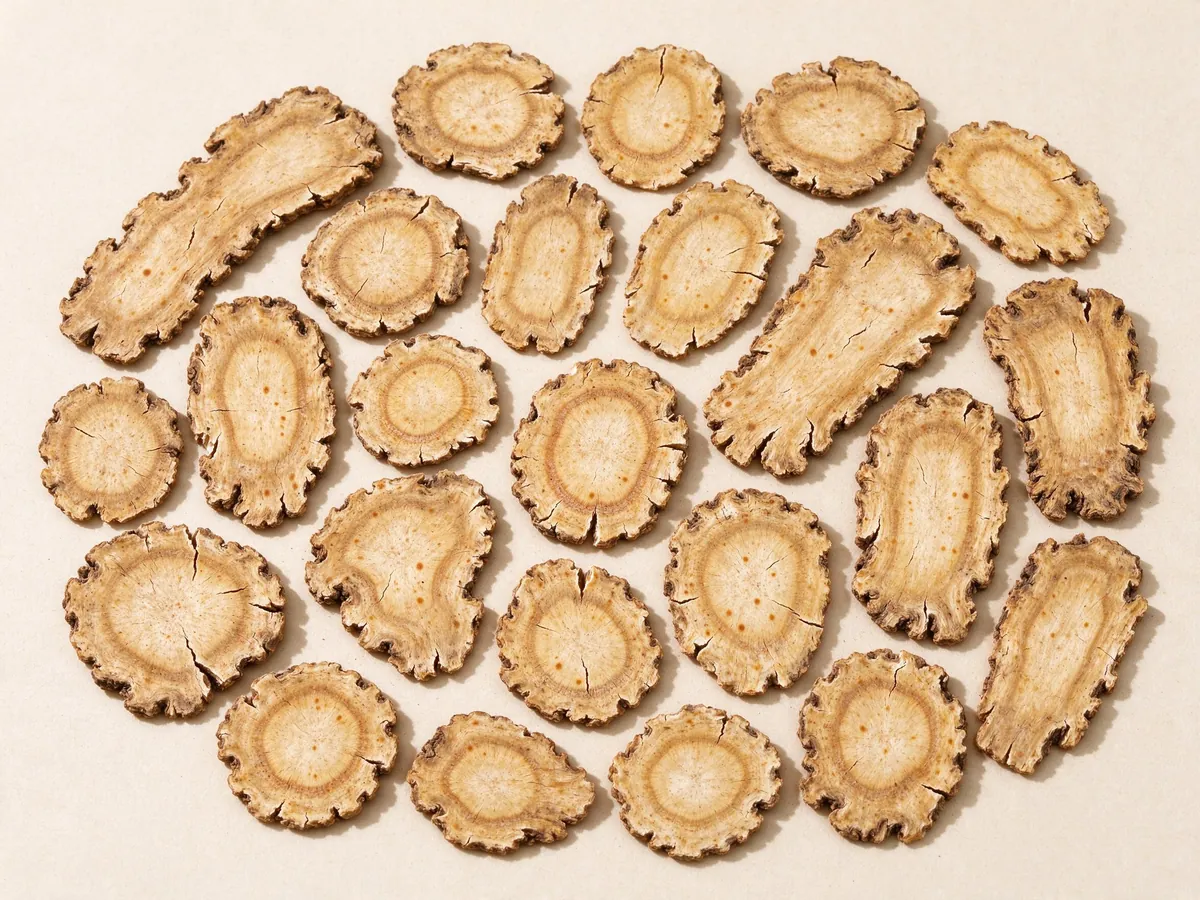
Overview
Dang Gui is sweet, pungent and warm, entering the Liver, Heart and Spleen.1,2,3 It tonifies the Blood, invigorates it, regulates menstruation and alleviates pain.1,4
It both tonifies and invigorates the Blood.4
It is the premier herb in gynaecology: its warmth is harmonious rather than drying, its tonification is not cloying, and its invigoration of the Blood is gentle rather than forceful.4
It is used for the pallid, ashen complexion and lusterless nails of Blood deficiency, for irregular, painful and absent periods, for pain after injury, for dry Intestines, and for abscesses and sores that drain poorly.1,4
Identity and sources
The medicinal material is the dried root of Angelica sinensis.1 Taiwan's official monograph has the same nature, flavour and channels, with a dose range of its own.3
Actions
- Tonifies the Blood and regulates the menses. For Blood deficiency affecting the Heart, with pallor, tinnitus, blurred vision and palpitations, and for irregular, absent or painful periods.4
- Invigorates and harmonises the Blood and disperses cold. For pain from Blood stasis in the abdomen, after injury, and in carbuncles, particularly where deficiency cold is also present.4
- Moistens the Intestines and unblocks the bowels. For dry Intestines due to deficiency.4
- Reduces swelling, expels pus and generates flesh. For sores and abscesses, where its ability to both tonify and invigorate the Blood promotes drainage and healing.4
Clinical applications
Blood deficiency
For a pallid, ashen complexion, lusterless nails, dizziness, tinnitus, blurred vision and palpitations.4,1
Menstrual disorders
For irregular cycles, dysmenorrhoea and amenorrhoea from Blood deficiency, Blood stasis or both.4 The wine-fried form is used to quicken the Blood and unblock the menses.1
Pain from Blood stasis
For abdominal pain, pain after injury, and carbuncles with stasis, especially with deficiency cold, it moves the Blood and relieves pain.4,1
Dry stool
For constipation from dry Intestines due to deficiency, it moistens the Intestines and unblocks the bowels.4
Sores and abscesses
For ulcerated abscesses that drain poorly or discharge only thin fluid, and for chronic sores, it supports drainage and the generation of flesh.4,1
Key combinations
With Shu Di Huang 熟地黄, Bai Shao 白芍 and Chuan Xiong 川芎 in Si Wu Tang, it nourishes and regulates the Blood for menstrual irregularity, amenorrhoea and dysmenorrhoea.4
With Peach Kernel and Safflower in Tao Hong Si Wu Tang, it is used for amenorrhoea and for pain and swelling from Blood stasis.4
With Huang Qi 黄芪, it is used for the pallor, debility, fatigue and low-grade fever that follow excessive blood loss, and for ulcerated abscesses with insufficient drainage.4
With Bai Shao 白芍 and Fu Ling 茯苓, it is used for mild abdominal pain and diarrhoea during pregnancy.4
With Chuan Xiong 川芎, the moisture of Dang Gui moderates the dryness of Chuan Xiong, and Chuan Xiong in turn reduces the cloying quality of Dang Gui.4
Comparison with similar herbs
Processing and preparation
The wine-fried form, Jiu Dang Gui, is defined as quickening the Blood and unblocking the menses.1
The root is cleaned, moistened, cut into thin slices and dried.1 The slices are stir-fried with rice wine until dry to make the wine-fried form.1
External use
It is applied topically as well as taken internally for sores and abscesses, on the strength of the same action of reducing swelling, expelling pus and generating flesh.4
Safety
Contraindications
Diarrhoea or abdominal fullness from abundant Dampness.4
Use with caution
Dampness inside or loose stools.2 Pregnancy, where it should be used only with considerable caution.4
Pregnancy and breastfeeding
It is used in pregnancy for mild abdominal pain and diarrhoea in one classical combination, but the caution above still applies.4
Modern research
A review of Angelica sinensis examined how its use translates from Chinese practice to European patients, and identified identity and quality, processing, and the ethnicity of users as the aspects most easily lost.5
Its main traditional use is for women's reproductive problems, including dysmenorrhoea and amenorrhoea.5
Dose and administration
The official reference dose is 6-12 g.1 Some clinical texts use 4.5-15 g.4 The official dose in Taiwan is 5-15 g.3
These are reference ranges, not safe upper limits.
Common questions
Is Dang Gui safe during pregnancy?
It is used in pregnancy in at least one classical combination, but only with considerable caution.4
What is Jiu Dang Gui?
It is the root stir-fried with rice wine until dry, used to quicken the Blood and unblock the menses.1
Why is it used for both anaemia and painful periods?
It tonifies the Blood, invigorates it, regulates menstruation and alleviates pain at the same time.4
Can it be used on a slow-healing sore?
It is used for ulcerated abscesses, and it can be applied topically for this purpose.4
References
- Chinese Pharmacopoeia Commission. Pharmacopoeia of the People's Republic of China, 2020 edition, Volume I. Beijing: China Medical Science Press; 2020. Part I, p. 139.
- Chang M, Jia M, Bare M, eds. Chinese Materia Medica. Beijing: People's Medical Publishing House; 2014. pp. 593-595.
- Ministry of Health and Welfare. Taiwan Herbal Pharmacopoeia, 4th edition (English edition). Taipei; 2022, with 2025 amendments where cited. pp. 37-38.
- Bensky D, Clavey S, Stöger E. Chinese Herbal Medicine: Materia Medica. Portable 3rd edition. Seattle: Eastland Press; 2015. pp. 783-786.
- Hook IL. Danggui to Angelica sinensis root: are potential benefits to European women lost in translation? A review. J Ethnopharmacol. 2014. doi.org/10.1016/j.jep.2013.12.018
Educational reference only. Not medical advice or an individual prescription. Consult a qualified practitioner before using any herb or treatment.