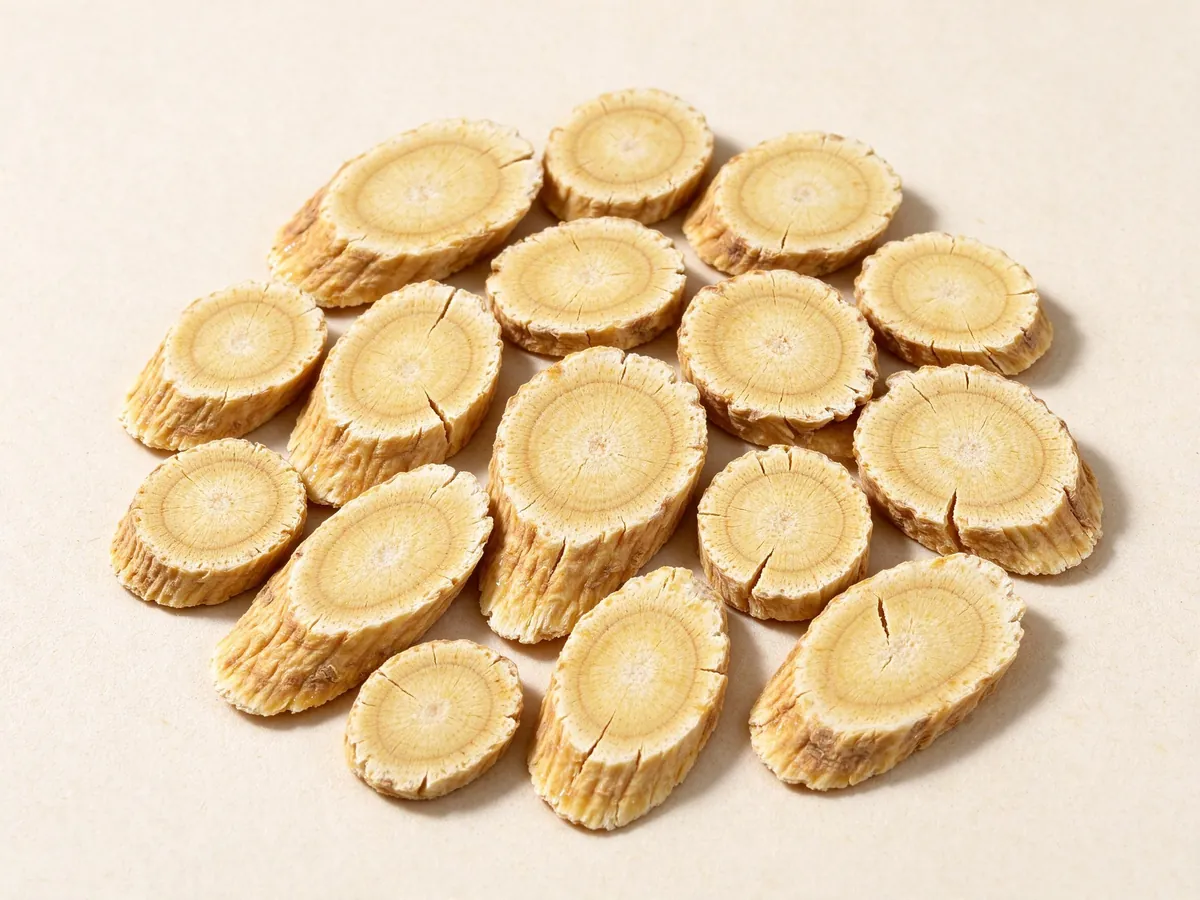
Overview
Zhi Huang Qi is astragalus root prepared by stir-frying the slices with honey.1,2 As a prepared product of the root it has its own standard, separate from Huang Qi 黄芪.1
It is sweet and warm, entering the Lung and Spleen, and it augments Qi and tonifies the middle.1 It is used for fatigue and poor appetite with loose stools.1
Honey-preparation directs the root inward, to tonify and raise the clear Qi of the middle burner.3
Identity and sources
The medicinal material is the prepared product of astragalus root, made from the dried root of Astragalus membranaceus variety mongholicus or A. membranaceus.1 The root is cleaned, separated by size, moistened, cut into thick slices, dried, and then stir-fried with honey.2
Actions
Clinical applications
Spleen Qi deficiency
For tiredness, poor appetite and loose stools.1
Sinking of middle Qi
The prepared root travels internally and raises the clear Qi, and with its strong ascending nature it raises prolapse and relieves dragging sensations.3
Where Blood is also deficient
Honey-preparation leaves the root somewhat moistening, which makes it the better choice when the pattern includes Blood deficiency or dryness of the Spleen.3
Key combinations
With Ren Shen 人参 for general debility, and with Bai Zhu 白术 for weakness, lassitude and loose stools from Spleen Qi deficiency, the prepared root reinforces the Qi-tonifying formulas.3
With Cimicifuga and Chai Hu 柴胡 in Bu Zhong Yi Qi Tang, it tonifies the middle and raises the clear Qi for prolapse.3,2
Comparison with similar herbs
Processing and preparation
Astragalus slices are honey-fried until deep yellow and no longer sticky to the touch.1,3 Before that the root is cleaned, graded by size, moistened and cut into slices.2
This method of preparation directs the root inward to tonify and raise the clear Qi of the middle burner.3
Safety
Contraindications
Sores in their early stage, or sores with significant heat toxin.3 Yang excess with Yin deficiency, because the root tonifies the Yang.3
Modern research
The trials of Astragalus in diabetic kidney disease tested its preparations as an adjunct to conventional treatment.4 Some used an injectable form, and others an oral preparation.4
Dose and administration
The official reference dose is 9-30 g.1 Some clinical texts use 9-15 g, with up to 30 g when a high dose is required.3
This is a reference range, not a safe upper limit.
Common questions
Can Zhi Huang Qi be used instead of Huang Qi?
The prepared form tonifies the middle and raises the clear Qi; the raw root is used for the exterior and for bringing sores to a head.3
Why is it warmer than the raw root?
When is the prepared form preferred over the raw root?
When the aim is to raise the clear Qi, or when the pattern also includes Blood deficiency or dryness of the Spleen.3
References
- Chinese Pharmacopoeia Commission. Pharmacopoeia of the People's Republic of China, 2020 edition, Volume I. Beijing: China Medical Science Press; 2020. Part I, p. 316.
- Chang M, Jia M, Bare M, eds. Chinese Materia Medica. Beijing: People's Medical Publishing House; 2014. p. 556.
- Bensky D, Clavey S, Stöger E. Chinese Herbal Medicine: Materia Medica. Portable 3rd edition. Seattle: Eastland Press; 2015. pp. 752-755.
- Zhang L, Shergis JL, Yang L, et al. Astragalus membranaceus (Huang Qi) as adjunctive therapy for diabetic kidney disease: an updated systematic review and meta-analysis. J Ethnopharmacol. 2019. doi.org/10.1016/j.jep.2019.111921
Educational reference only. Not medical advice or an individual prescription. Consult a qualified practitioner before using any herb or treatment.