Overview
Zhi Mu is bitter, sweet and cold, entering the Lung, Stomach and Kidney.1,2,3
It clears heat and drains fire, enriches Yin and moistens dryness.1,2,3
Its bitterness drains fire while its sweetness and moisture enrich Yin, so it is used where heat has dried the fluids, in both excess and deficiency.2
It is used for high fever and thirst, steaming bone and night sweats, and wasting and thirsting disorder.2
Identity and sources
The medicinal material is the dried rhizome of Anemarrhena asphodeloides.1
The unpeeled rhizome is called Mao Zhi Mu; the peeled rhizome is also used.1
Taiwan grades it cold, bitter and sweet, entering the Lung, Stomach and Kidney, with a 6-12 g dose.3
Actions
- Clears heat and drains fire. For high fever, irritability, thirst and a rapid, flooding pulse from excess heat in the Lungs and Stomach, and for cough with thick, yellow sputum.2
- Enriches Yin and moistens dryness. For night sweats, steaming bone disorder, irritability, afternoon or low-grade fever, heat in the five centres and bleeding gums.2
- Clears Kidney heat. For spermatorrhoea, nocturnal emissions and abnormally elevated sex drive.2
- Generates fluids and clears heat. For oral ulcers and inflammation from Yin deficiency, and for wasting and thirsting disorder.2
- Ameliorates the dryness of tonifying or warming herbs. It is added when Huang Qi, Gui Zhi or Fu Zi are used but there is concern that they be too drying.2
Clinical applications
High fever and excess heat
For high fever, irritability, thirst and a rapid, flooding pulse from excess heat in the Lungs and Stomach.2
It is often combined with Gypsum for Lung and Stomach heat with thirst or cough.2
Lung heat cough
For cough from Lung heat with thick, yellow sputum.2
Yin deficiency with heat
For night sweats, steaming bone disorder, irritability, afternoon or low-grade fever, heat in the five centres and bleeding gums from Lung and Kidney Yin deficiency.2
Kidney heat
For spermatorrhoea, nocturnal emissions and abnormally elevated sex drive.2
Wasting and thirsting
For wasting and thirsting disorder.2
Oral ulcers
For oral ulcers and inflammation from Yin deficiency.2
Protecting fluids in drying formulas
It is added to tonifying or warming formulas when there is concern that they be too drying.2
Key combinations
With Huang Bai, as in Anemarrhena, Phellodendron and Rehmannia Pill and Great Tonify the Yin, it clears heat and drains fire, and is used for steaming bone disorder from Yin deficiency with night sweats, dizziness and vertigo.2
With Cinnamomi Cortex added to that pair, it is used for Damp-heat smoldering in the lower burner with urinary retention and afternoon fever.2
With Coptis, it is used for blazing Stomach fire with intense hunger and thirst, dry stools, a dry yellow tongue coating and a slippery, rapid pulse.2
With Fritillaria thunbergii in Fritillaria and Anemarrhena Powder, it is used for cough from Lung heat with thick, yellow sputum.2
With Scrophularia and Rehmannia, it is used for ulcers of the oral cavity.2
With Trionycis Carapax, it is used for steaming bone.2
With Trichosanthes and Ophiopogon, it is used for thirst and irritability from Lung and Stomach dryness.2
With Dioscorea, Huang Qi and Schisandra it is used for wasting and thirsting disorder.2
Comparison with similar herbs
| Herb | Key difference |
|---|---|
| Zhi Mu 知母 | Bitter, sweet and cold. Clears heat and drains fire, enriches Yin and moistens dryness.1,2 |
| Shi Gao 石膏 | Both cool the Lungs and Stomach and clear Yang brightness Qi-level heat, and are often combined for Lung and Stomach heat with thirst or cough. Zhi Mu clears heat and moistens, cools the Kidneys and nourishes Yin; Shi Gao clears and disperses, reaches the exterior and protects fluids by draining fire, while Zhi Mu benefits Yin by generating fluids.2 |
Processing and preparation
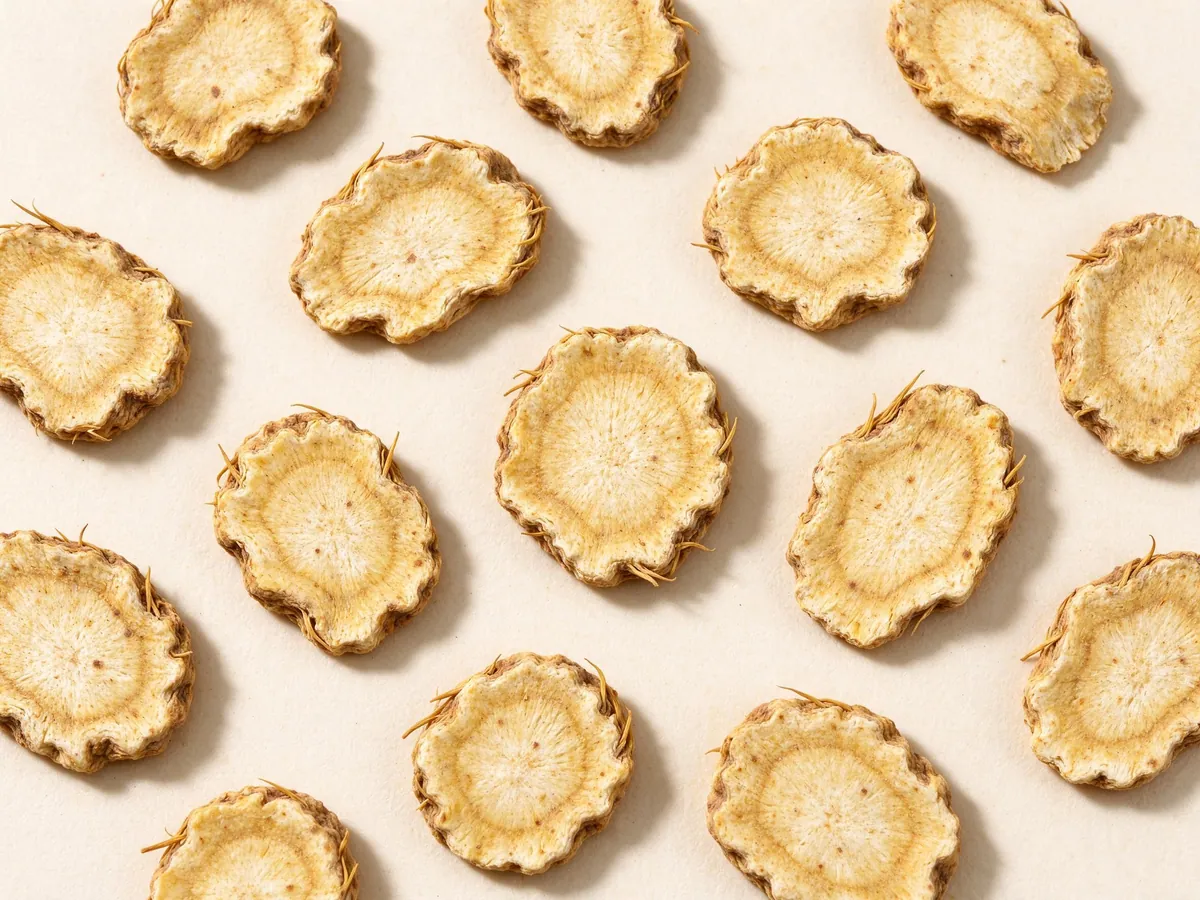
The rhizome is cleaned, moistened, cut into thick slices and dried.1
Salt-frying (Yan Zhi Mu), stir-fried with salt water until dry, is the prepared form in the official monograph; the slices are yellow or slightly scorched and taste slightly salty.1
Dry-frying reduces its cooling nature and moderates its fire-draining effect.2
Honey-preparation protects the Spleen and Stomach by moderating its bitter, draining, cooling nature and adding sweetness to tonify the middle.2
Vinegar-frying focuses its action on the Lungs.2
Salt-frying promotes its affinity for the Kidneys and increases its downward-directing action.2 Wine-frying guides it upward and lessens its cold draining.2
Safety
Contraindications
Cold from deficiency of the Spleen and Stomach, and diarrhoea.2
The traditional texts add weak Spleen with inability to digest food, no thought of eating, and Kidney deficiency diarrhoea.2
Use with caution
It lubricates the Intestines, so it should not be used if the stools are loose.2
Because it is bitter and cold, it is inappropriate for long-term use.2
Modern research
Two hundred sixty-nine compounds have been identified from Anemarrhena asphodeloides, including steroidal saponins, flavonoids, phenylpropanoids, alkaloids, steroids, organic acids and polysaccharides.4
The review lists antitumour, anti-inflammatory, antidiabetic, antiosteoporotic, neuroprotective and antiviral activity for its extracts and compounds.4
A review of sarsasapogenin, a steroidal sapogenin obtained mainly from the herb, reports anti-inflammatory, anticancer, antidiabetic, anti-osteoclastogenic and neuroprotective activity.5
Dose and administration
The official reference dose is 6-12 g.1
Some clinical texts use 6-12 g, and the official dose in Taiwan is 6-12 g.2,3
This is a reference range, not a safe upper limit.
Common questions
Why is it used with Huang Bai?
The pair clears heat and drains fire, and is used for steaming bone disorder from Yin deficiency with night sweats, dizziness and vertigo.2
Can it be used for a dry cough?
It is used for cough from Lung heat with thick, yellow sputum, and with Trichosanthes and Ophiopogon for thirst and irritability from Lung and Stomach dryness.2
Is it safe with weak digestion?
No. It is contraindicated in cold from deficiency of the Spleen and Stomach and in diarrhoea, and it lubricates the Intestines, so it should not be used if the stools are loose.2
Can it be taken long term?
It is bitter and cold, and the traditional texts say this is inappropriate for long-term use.2
References
- Chinese Pharmacopoeia Commission. Pharmacopoeia of the People's Republic of China, 2020 edition, Volume I. Beijing: China Medical Science Press; 2020. Part I, pp. 222-223.
- Bensky D, Clavey S, Stöger E. Chinese Herbal Medicine: Materia Medica. Portable 3rd edition. Seattle: Eastland Press; 2015. pp. 92-94.
- Ministry of Health and Welfare. Taiwan Herbal Pharmacopoeia, 4th edition (English edition). Taipei; 2022, with 2025 amendments where cited. pp. 33-34.
- Liu C, Cong Z, Wang S, Zhang X, Song H, Xu T, Kong H, Gao P, Liu X. A review of the botany, ethnopharmacology, phytochemistry, pharmacology, toxicology and quality of Anemarrhena asphodeloides Bunge. J Ethnopharmacol. 2023;302(Pt A):115857. doi:10.1016/j.jep.2022.115857 pubmed.ncbi.nlm.nih.gov/36330891
- Mustafa NH, Sekar M, Fuloria S, et al. Chemistry, biosynthesis and pharmacology of sarsasapogenin: a potential natural steroid molecule for new drug design, development and therapy. Molecules. 2022;27(6):2032. doi:10.3390/molecules27062032 pubmed.ncbi.nlm.nih.gov/35335393
Educational reference only. Not medical advice or an individual prescription. Consult a qualified practitioner before using any herb or treatment.