Overview
Mai Dong is sweet, slightly bitter and slightly cold, entering the Heart, Lung and Stomach.1,2 It nourishes Yin, generates fluids, moistens the Lungs and clears the Heart.1
It nourishes the Yin of the Stomach, Spleen, Heart and Lungs, clears heat and quiets irritability.2
Identity and sources
The medicinal material is Ophiopogon japonicus.1
It is sweet, slightly bitter and slightly cold, entering the Heart, Lung and Stomach.1,2
Actions
- Moistens the Lungs and nourishes Lung Yin. For a hacking dry cough, a cough with thick sputum, or coughing up blood.2
- Nourishes Stomach Yin and generates fluids.2,1
- Clears the Heart and quiets irritability.1,2
- Moistens the Intestines. For constipation, dry mouth and irritability, as after a febrile disease or in Yin deficiency.2
Clinical applications
Dry cough
For a hacking dry cough or a cough with thick sputum it moistens the Lungs.2
Dryness that has become fire
For pathogenic dryness that has transformed to fire, with thick, viscous, yellow sputum, chest pain and coughing up blood, it is combined with Anemarrhena and Trichosanthes.2
Lung and Kidney Yin deficiency
For consumptive cough with occasional coughing up of blood from Lung and Kidney Yin deficiency.2
Warm-dryness injuring the Lungs
For warm-dryness injuring the Lungs with fever, cough, wheezing and fullness and pain in the chest and lower ribs.2
Thirst and constipation
It is used for thirst from fluid damage, wasting-thirst from interior heat, and constipation from intestinal dryness.1
Irritability and insomnia
It clears heat and quiets irritability, and it is used for irritability and insomnia.2,1
Key combinations
With Gypsum, Mulberry leaf and Loquat leaf in Clear Dryness and Rescue the Lungs Decoction for warm-dryness injuring the Lungs with fever, cough and chest pain.2
With Anemarrhenae Rhizoma and Trichosanthes for dryness transformed into fire with thick, viscous, yellow sputum and chest pain.2
With Asparagus for Lung and Kidney Yin deficiency with consumptive cough.2
With Scrophulariae Radix, Platycodi Radix and Glycyrrhizae Radix as a tea, it is used for an itchy, dry throat, thirst and a non-productive cough from insufficient Lung Yin.2
With Scrophulariae Radix and Moutan Cortex in Nourish the Yin and Clear the Lungs Decoction, it is used for a swollen, painful diphtheritic disorder in a Yin-deficient constitution after epidemic toxin.2
With Glehniae/Adenophorae Radix and Polygonati odorati Rhizoma in Benefit the Stomach Decoction, it is used for insufficient Stomach Yin.2
With Zhi Ban Xia and Codonopsis in Ophiopogonis Decoction, it is used for Stomach Yin deficiency with nausea and vomiting from rebellious Qi, and for chronic dry cough from Lung Yin deficiency.2
With Mume Fructus, it is used for upper or middle burner wasting and thirsting disorder with intense dryness of the throat and unquenchable thirst.2
With Rehmanniae Radix and Scrophulariae Radix in Increase the Fluids Decoction, it is used for constipation after a febrile disease.2
With Rehmanniae Radix and Scrophulariae Radix in Clear the Nutritive Level Decoction, it is used for thirst, constipation, irritability and low-grade fever from severely injured fluids in the late stages of a warm pathogen disease.2
With Ziziphi spinosae Semen and Rehmanniae Radix in Emperor of Heaven's Special Pill to Tonify the Heart, it is used for irritability and insomnia from Yin deficiency.2
With Astragali Radix, Angelicae sinensis Radix and Schisandrae Fructus, it is used for irritability from severe loss of fluids through sweating.2
With Ginseng Radix and Schisandrae Fructus in Generate the Pulse Powder, it is used for profuse sweating, wheezing, a rapid heart rate and exhaustion from severe Heart and Lung deficiency, including fluid loss in summerheat disorders.2
Comparison with similar herbs
| Form | Key difference |
|---|---|
| Mai Dong 麦冬 (raw tuber) | Slightly cold. Moistens the Lungs and nourishes Yin, clears heat and quiets irritability.2 |
| Zhi Mai Dong 炙麦冬 (prepared) | Dry-fried or baked until dark yellow. Its cooling nature is moderated and it is less cloying.2 |
| Sha Shen 沙参 | Similar in nourishing Yin, moistening dryness, augmenting the Stomach and generating fluids, nourishing Lung Yin and clearing Lung heat, and often combined with Mai Dong. Mai Dong is heavier and more moist and better at generating Stomach fluids in the middle burner; Sha Shen is lighter and clears Lung heat more strongly, but cannot clear the Heart or relieve irritability.2 |
It is particularly appropriate for Yin deficiency of the Lungs or Stomach with few heat signs but easily upset digestion.2
Processing and preparation
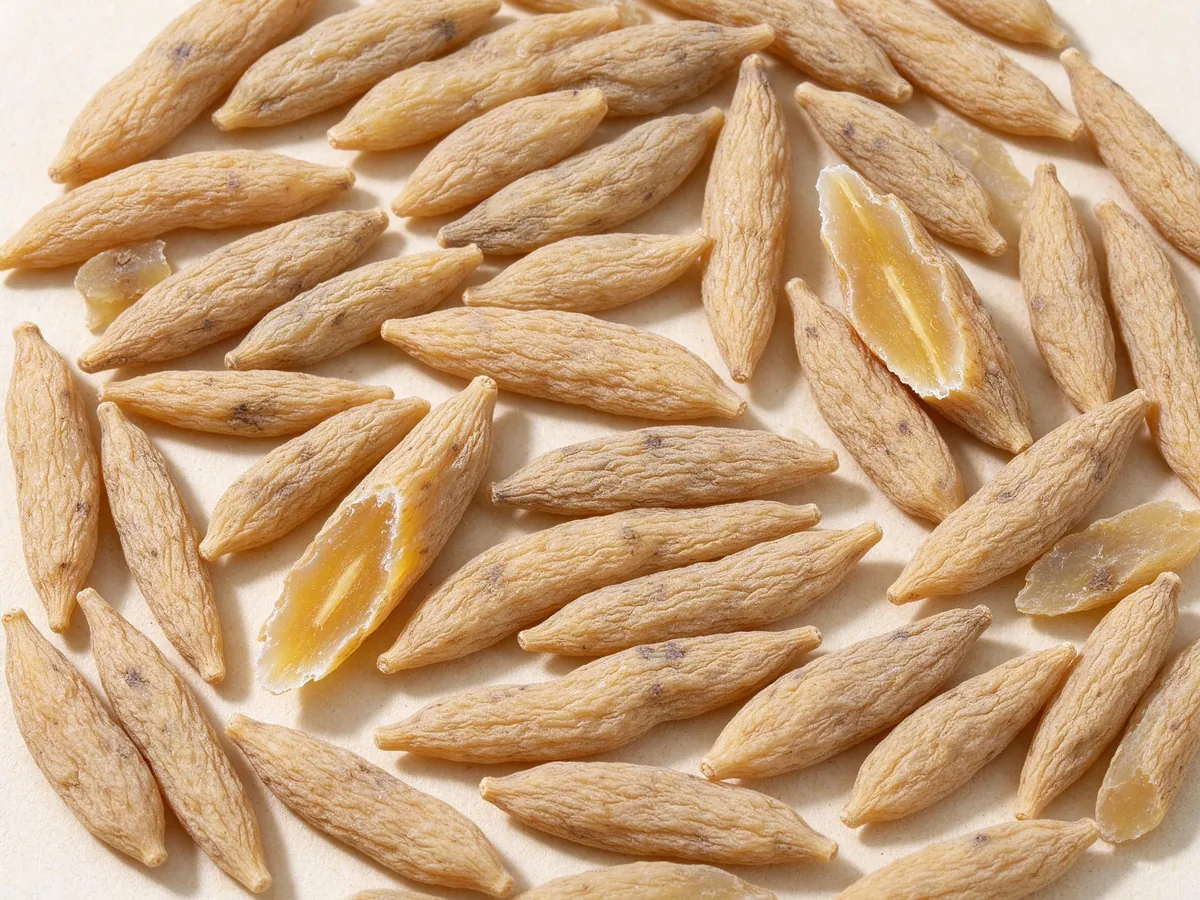
The tubers are sold whole or pressed into flattened spindle-shaped pieces, resembling the whole tuber.1
Prepared Mai Dong is dry-fried or baked at a low temperature until dark yellow, which moderates the cooling nature and reduces the tendency to be cloying.2
Safety
Contraindications
Loose stools from Spleen deficiency, turbid Phlegm or thin mucus in the Lungs or Stomach, and the early stages of a wind-cold cough.2
Use with caution
It is forbidden in those with much cold, and is not given with weak Qi or Stomach cold.2
Adverse effects
Allergic reactions have been reported, with nausea, vomiting, nervousness, agitation, generalised erythema, tingling abdominal pain and pruritus; severe cases have had delirium and loss of consciousness.2
Modern research
A review of Ophiopogon japonicus gives the root's traditional actions as nourishing Yin, promoting body fluids, moistening the Lung, easing the mind and clearing Heart fire.3
It identifies steroidal saponins, homoisoflavonoids and polysaccharides as the main components, with cardiovascular, anti-inflammatory, antioxidant, cough-relieving and glucose-lowering activity reported.3
Dose and administration
The official reference dose is 6-12 g.1
Some clinical texts use 6-15 g, and the official dose in Taiwan is 6-15 g.2,4
This is a reference range, not a safe upper limit.
Common questions
Why is Mai Dong fried for weak digestion?
Dry-frying or baking moderates its cooling nature and reduces its tendency to be cloying.2
Who should avoid it?
Anyone with loose stools from Spleen deficiency, turbid Phlegm in the Lungs or Stomach, or an early wind-cold cough.2
References
- Chinese Pharmacopoeia Commission. Pharmacopoeia of the People's Republic of China, 2020 edition, Volume I. Beijing: China Medical Science Press; 2020. Part I, pp. 162-163.
- Bensky D, Clavey S, Stöger E. Chinese Herbal Medicine: Materia Medica. Portable 3rd edition. Seattle: Eastland Press; 2015. pp. 858-861.
- Chen MH, Chen XJ, Wang M, Lin LG, Wang YT. Ophiopogon japonicus - a phytochemical, ethnomedicinal and pharmacological review. J Ethnopharmacol. 2016;26826325. doi:10.1016/j.jep.2016.01.037 pubmed.ncbi.nlm.nih.gov/26826325
- Ministry of Health and Welfare. Taiwan Herbal Pharmacopoeia, 4th edition (English edition). Taipei; 2022, with 2025 amendments where cited. p. 480.
Educational reference only. Not medical advice or an individual prescription. Consult a qualified practitioner before using any herb or treatment.