Overview
Shan Yao is sweet and neutral, entering the Spleen, Lung and Kidney.1 It strengthens the Spleen and Stomach, generates fluids and benefits the Lungs, and stabilises the Kidneys.1
Taken over a long period, its effects accumulate gently rather than quickly.2
The classic texts make it the herb that governs injury to the middle, tonifies deficiency, eliminates cold and hot pathogenic Qi, and augments the power of Qi.2
It is a medicinal and edible plant.3
Identity and sources
The medicinal material is Dioscorea opposita.1
It is sweet and neutral, entering the Spleen, Lung and Kidney.1
Actions
- Strengthens the Spleen and Stomach. For deficiency with diarrhoea, fatigue, spontaneous sweating and poor appetite.2
- Benefits the Lungs. For chronic cough or wheezing due to Lung deficiency.2
- Tonifies the Kidney and astringes the essence. For wasting and thirsting.1,2
- Tonifies Qi and Yin together. It is used where both are depleted at once.4
Clinical applications
Spleen deficiency
For loose, watery stools with fatigue and poor appetite, it is used with Poria and Bai Zhu.2
Lung deficiency
For chronic cough or wheezing from deficient Lung Qi it is used.2
Wasting and thirsting
It is often used for wasting and thirsting disorder.2
Loss of essence
It secures the Kidneys.2
It is used for injury to the middle with deficiency, and for the cold and hot pathogenic Qi that settle there.2
It also strengthens the Spleen and Stomach, stops diarrhoea and dysenteric disorders, transforms Phlegm and thick saliva, and moistens the skin.2
For all deficiency patterns it enriches the essence and secures the Kidneys.2
Long-term consumption sharpens the hearing, brightens the eyes and lightens the body.2
Key combinations
With Poria and Atractylodis macrocephalae Rhizoma for loose, watery stools due to Spleen deficiency.2
With Codonopsis Radix for fatigue, weakness, reduced appetite and watery stools.2
With dry-fried Hordei Fructus germinatus and Gigeriae galli Endothelium corneum, it is used for a weak Spleen and Stomach with food stagnation.2
With Aurantii Fructus Immaturus (Zhi Shi) and Amomi Fructus (Sha Ren), it is used for a weak Spleen and Stomach with Qi stagnation.2
With Polygonati odorati Rhizoma and Dendrobium, it is used for a weak Spleen and Stomach from Stomach Yin deficiency.2
With Sepiae Endoconcha and Ostreae Concha in Clear Discharge Decoction, it is used for Spleen deficiency with profuse, thin, continuous, clear or red vaginal discharge.2
With Phellodendri Cortex and Che Qian Zi in Change Yellow Decoction, it is used for Spleen deficiency with Damp-heat leading to a thick, yellow, foul-smelling vaginal discharge.2
With Bupleuri Radix and Paeoniae Radix alba in End Discharge Decoction, it is used for vaginal discharge from Spleen deficiency with Liver Qi constraint.2
With Ophiopogonis Radix and Schisandrae Fructus, it is used for cough from Lung deficiency.2
With Scrophulariae Radix and Arctii Fructus, it is used for cough and wheezing with no sputum or scanty, sticky sputum.2
With Rehmanniae Radix praeparata and Corni Fructus, it is used for spermatorrhoea and night sweats from Kidney deficiency.2
With Euryales Semen, it is used for diarrhoea, spermatorrhoea and vaginal discharge from Kidney deficiency; Shan Zhu Yu and Tu Si Zi are often added.2
With Trichosanthis Radix and Puerariae Radix, it is used for irritability and thirst with fluids injured by a warm pathogen disease.2
With Astragali Radix and Anemarrhenae Rhizoma in Jade Fluid Decoction, it is used for irritability and thirst from wasting and thirsting disorder.2
Comparison with similar herbs
Processing and preparation
The rhizome is dug after the leaves wither, the root head is cut off, and it is washed, peeled and dried to give the form called Mao Shan Yao.1
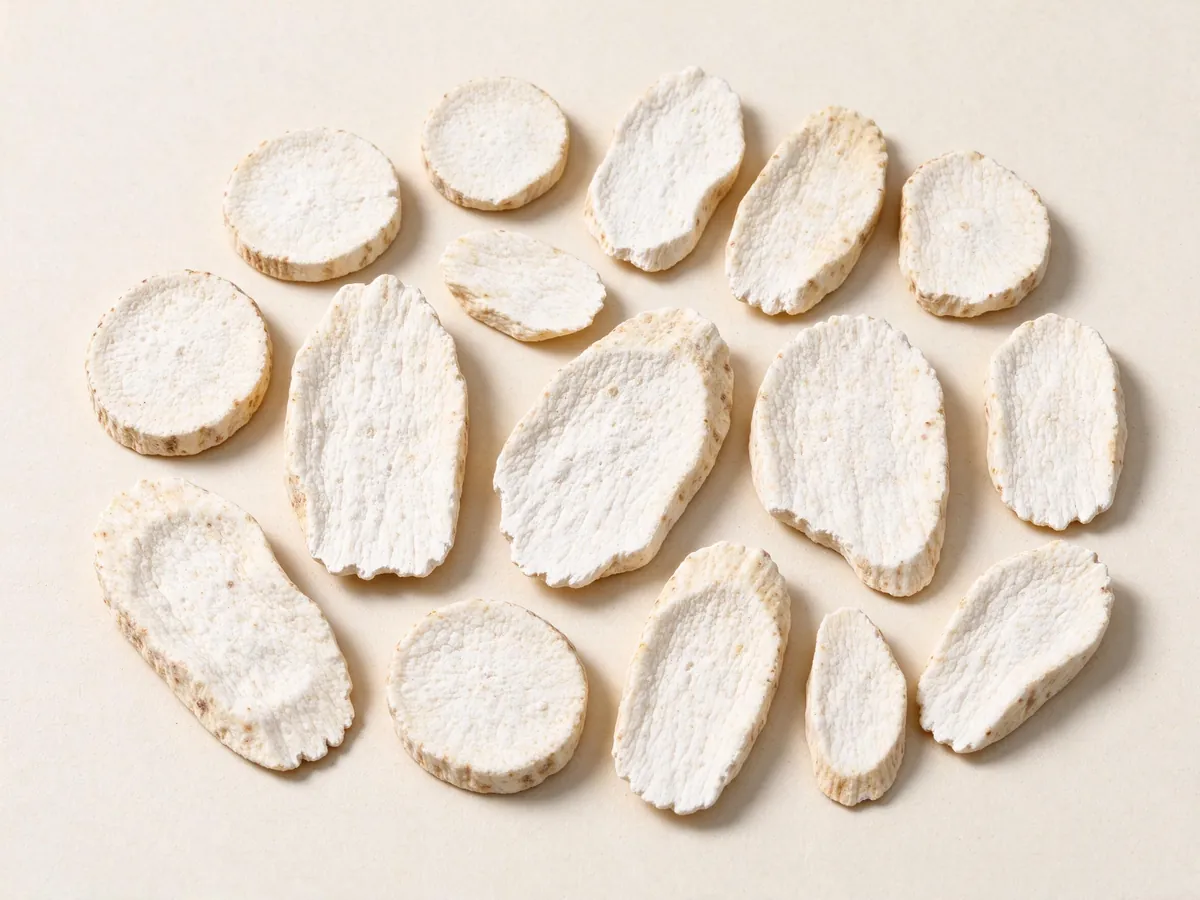
Or it is peeled, cut into thick slices while fresh and dried, which is called Shan Yao Pian.1
The slices are irregular and wrinkled, white to yellowish-white on the cut face.1
Dry-frying or baking, often with bran, until golden brown more strongly augments the Spleen, harmonises the Stomach and tonifies the Kidneys to secure the essence; it is used for diarrhoea, loose stools, vaginal discharge or spermatorrhoea.2 Earth-frying is especially good for tonifying the Spleen and harmonising the Stomach, and is used for a weak Spleen with poor appetite, fatigue and diarrhoea, and for vaginal discharge.2
Safety
Contraindications
It should not be used by itself when there is an accumulation of Dampness marked by fullness in the abdomen.2
Adverse effects
Allergic reactions have been reported after ingestion and after topical application, including maculopapular rashes over the whole body, an itchy throat and a sensation of oppression in the chest.2
Modern research
A review of Chinese yam treats it as a traditional medicinal and edible plant whose polysaccharides are the main bioactive fraction, notably for immunomodulation.3
Dose and administration
The official reference dose is 15-30 g of the dried rhizome.1
Some clinical texts use 9-30 g, and the official dose in Taiwan is 10-30 g.2,4
Common questions
Who should avoid it?
It should not be used by itself where Dampness has accumulated with fullness in the abdomen.2
How quickly does it work?
Taken over a long period its effects accumulate gently.2
How was it used traditionally?
The classics describe it as tonifying the middle and augmenting the power of Qi, and say long-term use sharpens the hearing and brightens the eyes.2
References
- Chinese Pharmacopoeia Commission. Pharmacopoeia of the People's Republic of China, 2020 edition, Volume I. Beijing: China Medical Science Press; 2020. Part I, pp. 30-31.
- Bensky D, Clavey S, Stöger E. Chinese Herbal Medicine: Materia Medica. Portable 3rd edition. Seattle: Eastland Press; 2015. pp. 756-758.
- Ding X, Wang B, Ma X, He S, Noundara, Zhou X. From structural code to immunomodulation: the structure-activity relationship, molecular mechanisms, and translational medicine challenges of yam (Dioscorea opposita Thunb) polysaccharides. Front Immunol. 2026;42220517. doi:10.3389/fimmu.2026.1821913 pubmed.ncbi.nlm.nih.gov/42220517
- Ministry of Health and Welfare. Taiwan Herbal Pharmacopoeia, 4th edition (English edition). Taipei; 2022, with 2025 amendments where cited. p. 353.
Educational reference only. Not medical advice or an individual prescription. Consult a qualified practitioner before using any herb or treatment.