Overview
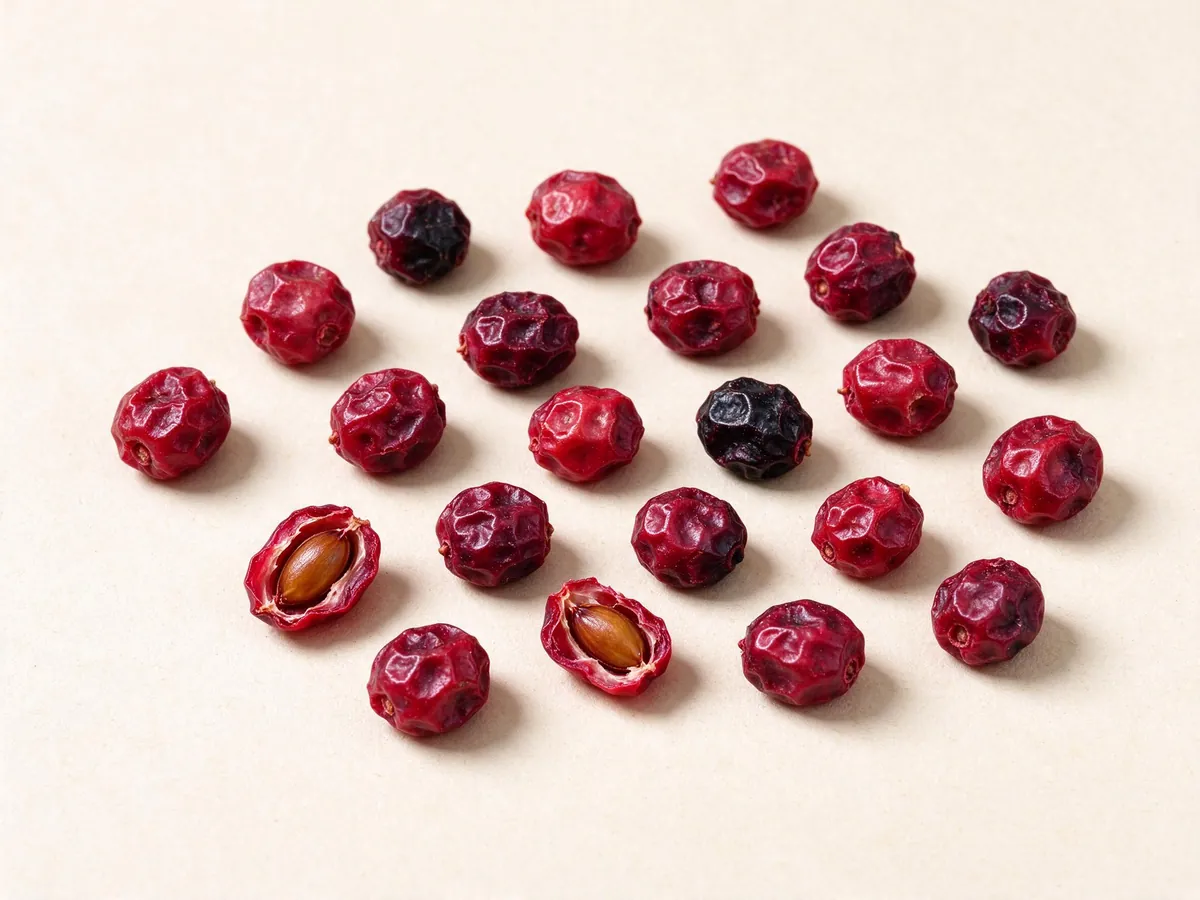
Wu Wei Zi is sour, sweet and warm, entering the Lung, Heart and Kidney.1,2 It astringes and binds, augments Qi, generates fluids, tonifies the Kidneys and quiets the Heart.1
Although it has five flavours, it is primarily sour and restraining, so it tonifies the Yin of the five Yin organs, with emphasis on containing the Kidneys and grasping the Qi.2
That is why it generates fluids and stops thirst.2
It is used both for a leaking Lung and for diarrhoea.2
Identity and sources
The medicinal material is the dried ripe fruit of Schisandra chinensis, known as Bei Wu Wei Zi.1
It is sour, sweet and warm, entering the Lung, Heart and Kidney.1
Actions
- Contains the leakage of Lung Qi and stops cough. For chronic cough and wheezing from Lung deficiency or from Lung and Kidney deficiency together.2
- Tonifies the Kidneys and binds up the essence.2
- Stops diarrhoea. For daybreak diarrhoea from lower-burner deficiency.2
- Quiets the spirit and generates fluids.2
It also nourishes the Liver and quiets the spirit, so it is not only an astringent.2
Clinical applications
Chronic cough
For chronic cough and wheezing from deficiency it inhibits the leakage of Lung Qi above while enriching the Kidney Yin below.2
Sweating
It astringes and binds.1
Daybreak diarrhoea
For diarrhoea before dawn, its sour restraining power acts on the transformation of lower-burner Qi.2
Thirst and fluid loss
It generates fluids and stops thirst, moistening the Lungs and Stomach while augmenting Kidney Yin.2
For cough and wheezing from cold with thin mucus it is used with acrid, warming Ephedra.2
For wheezing that comes from both Lungs and Kidneys failing to hold the Qi, it is combined with herbs that tonify both organs.2
For the cough of deficiency it is combined with Ginseng and Aster, which tonify the Lungs while the fruit holds them.2
For urinary frequency it secures the lower burner.2
For the thirst of fluid depletion it generates fluids.2
For chronic cough and wheezing from Lung deficiency it holds the Lungs.2
Key combinations
With Ren Shen 人参, Ginger and Aster in Tonify the Lungs Decoction, it is used for chronic cough and wheezing from Lung deficiency.2
With prepared Rehmannia, Dioscorea and Cornus in Capital Qi Pill, it is used for cough and wheezing from Lung and Kidney deficiency.2
With Ephedra in Minor Bluegreen Dragon Decoction, it is used for cough and wheezing from cold with thin mucus.2
Comparison with similar herbs
| Fruit | Key difference |
|---|---|
| Bei Wu Wei Zi 北五味子 | The dried ripe fruit of Schisandra chinensis, known as Bei Wu Wei Zi.1 |
| Nan Wu Wei Zi 南五味子 | The dried ripe fruit of Schisandra sphenanthera.1 |
| Taiwan standard | Warm; sour and sweet; Lung, heart and kidney; astringes the Lung and suppresses cough, tonifies the Kidney and astringes essence, stops diarrhoea, calms the mind, tonifies Qi to engender fluid, checks sweating; 1.5-7.5 g.3 |
Processing and preparation
The fruit is harvested when ripe in autumn, dried in the sun or steamed and then sun-dried, and cleared of stalks and impurities.1
Before use it is cleaned of impurities and crushed.1
The vinegar-prepared form is steamed with vinegar until black, and is crushed when used.1
Safety
Contraindications
An exterior disorder that has not cleared, excess heat in the interior, and the early stages of a cough or a rash.2
Adverse effects
It may occasionally cause heartburn.2
Modern research
A review examines gomisin A, a dibenzocyclooctadiene lignan derived from Schisandra chinensis.4
The fruit is traditionally used for its adaptogenic, hepatoprotective and detoxifying properties, particularly for fatigue, chronic cough and liver disorders.4
Dose and administration
The official reference dose is 2-6 g.1
This is a reference range, not a safe upper limit.
Common questions
Why is it called the five-flavour seed?
Because it carries all five flavours, though it is primarily sour and restraining.2
Who should not take it?
Anyone with an exterior disorder that has not cleared, excess heat in the interior, or the early stage of a cough or rash.2
Can it cause indigestion?
It may occasionally cause heartburn.2
References
- Chinese Pharmacopoeia Commission. Pharmacopoeia of the People's Republic of China, 2020 edition, Volume I. Beijing: China Medical Science Press; 2020. Part I, p. 68.
- Bensky D, Clavey S, Stöger E. Chinese Herbal Medicine: Materia Medica. Portable 3rd edition. Seattle: Eastland Press; 2015. pp. 893-896.
- Ministry of Health and Welfare. Taiwan Herbal Pharmacopoeia, 4th edition (English edition). Taipei; 2022, with 2025 amendments where cited. p. 562.
- Xu J, Shi S, Zhu C, Sui Q, Zhu S, Zhang J, Zhang Y, Chen P. Gomisin A as a multi-target therapeutic agent: pharmacological mechanisms, pharmacokinetics and network pharmacology (Review). Int J Mol Med. 2026;42885297. doi:10.3892/ijmm.2026.6011 pubmed.ncbi.nlm.nih.gov/42885297
Educational reference only. Not medical advice or an individual prescription. Consult a qualified practitioner before using any herb or treatment.