Overview
Ma Huang Gen is sweet and neutral, entering the Heart and Lung.1,2
It inhibits the exterior and stops sweating.1,2
Ephedrae Herba induces sweating, while its root specifically stops sweating.2
Identity and sources
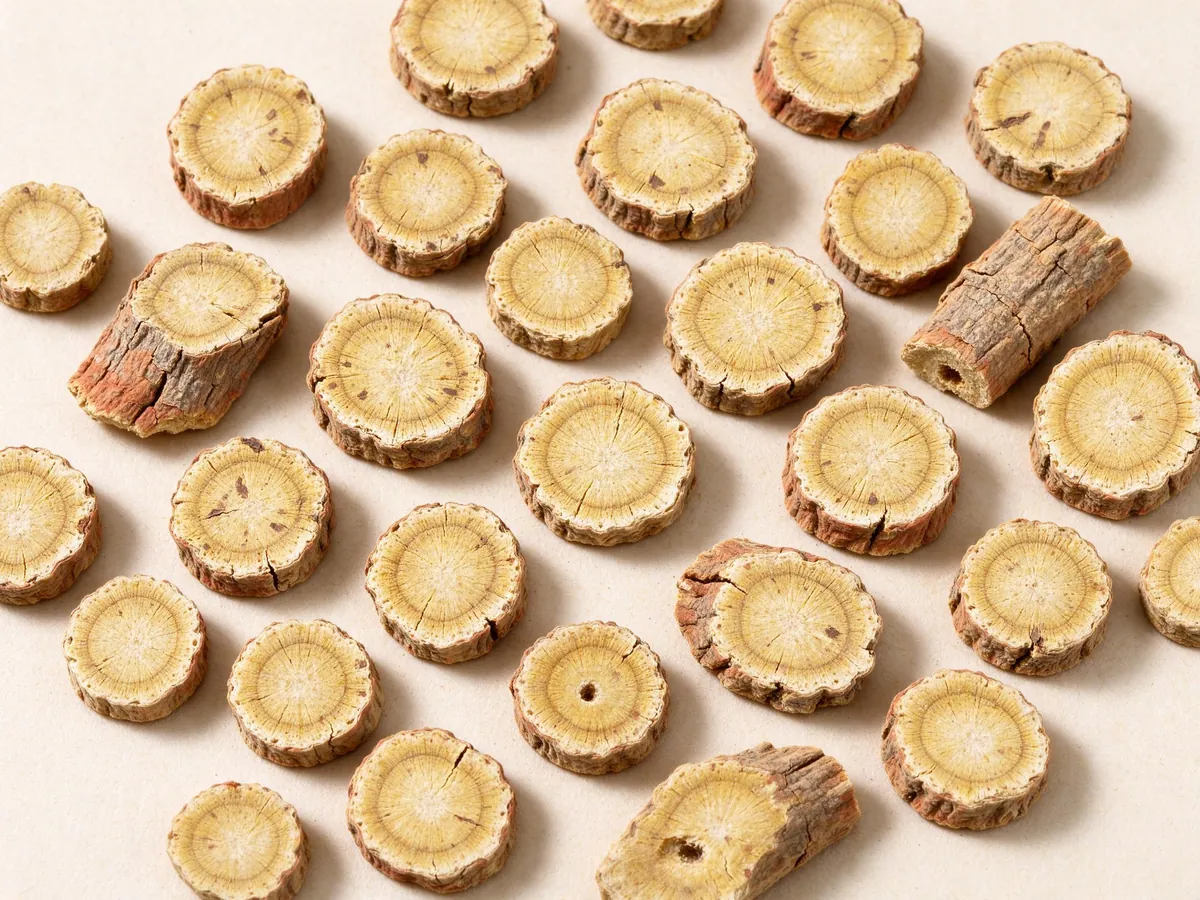
The medicinal material is the dried root and rhizome of Ephedra sinica or Ephedra intermedia.1
It is cleaned, washed, moistened, cut into thick slices and dried.1
Actions
- Stops sweating. For many kinds of sweating from deficiency, including spontaneous sweating from Qi deficiency, night sweats from Yin deficiency, and postpartum sweating.2
Clinical applications
Spontaneous sweating
For spontaneous sweating from Qi deficiency.2
Night sweats
For night sweats from Yin deficiency.2
Postpartum sweating
For postpartum sweating.2
Key combinations
With Huang Qi and Angelica sinensis, it is used for incessant spontaneous sweating.2
With Platycladi Semen and Rehmannia, it is used for night sweats.2
With Ostreae Concha and Huang Qi in Oyster Shell Powder, it is used for spontaneous sweating that worsens at night.2
Ground with Ostreae Concha and applied to the abdomen, it is used for incessant postpartum sweating.2
With calcined Fossilia Ossis Mastodi, the pair strongly restrains the Yin and Yang fluids in the exterior and quickly stops pathological sweating from deficiency.2
Comparison with similar herbs
| Herb | Key difference |
|---|---|
| Ma Huang Gen 麻黄根 | Sweet and neutral. Restrains the outward discharge of sweat; its action is limited to stopping sweating.2 |
| Mu Li 牡蛎 | Both restrain sweating in deficiency. Ma Huang Gen restrains the outward discharge, while the heavy weight of Ostreae Concha inhibits Yin and anchors Yang, so it is especially used for Yin-deficiency night sweats; it also secures, binds and quiets the spirit.2 |
Processing and preparation
The root is used without any special preparation.2
Safety
Contraindications
It is contraindicated for exterior conditions, because pathogenic influences should be discharged, not restrained.2
Modern research
A study comparing Ephedra Herba and Ephedra Radix found that their opposite effects on sweating come from different active ingredients: the aerial part contains ephedrine-type alkaloids, while the root contains flavonoid derivatives.3
Mahuannin B from the root reduces sweating by inhibiting adenylate cyclase and lowering cAMP through the beta-2-adrenoceptor/cAMP pathway.3
Dose and administration
The official reference dose is 3-9 g.1
Some clinical texts give 3-9 g.2
This is a reference range, not a safe upper limit.
Common questions
Does Ma Huang Gen cause sweating?
No. Its root specifically stops sweating, while the aerial herb induces sweating.2
What sweating does it treat?
Spontaneous sweating from Qi deficiency, night sweats from Yin deficiency, and postpartum sweating.2
When should it be avoided?
Avoid it in exterior conditions; pathogenic influences should be discharged, not restrained.2
References
- Chinese Pharmacopoeia Commission. Pharmacopoeia of the People's Republic of China, 2020 edition, Volume I. Beijing: China Medical Science Press; 2020. Part I, p. 333.
- Bensky D, Clavey S, Stöger E. Chinese Herbal Medicine: Materia Medica. Portable 3rd edition. Seattle: Eastland Press; 2015. pp. 898-899.
- Wang Z, Cui Y, Ding G, Zhou M, Ma X, Hou Y, Jiang M, Liu D, Bai G. Mahuannin B an adenylate cyclase inhibitor attenuates hyperhidrosis via suppressing beta(2)-adrenoceptor/cAMP signaling pathway. Phytomedicine. 2017;30:18-27. doi:10.1016/j.phymed.2017.03.002 pubmed.ncbi.nlm.nih.gov/28545666
Educational reference only. Not medical advice or an individual prescription. Consult a qualified practitioner before using any herb or treatment.