Overview
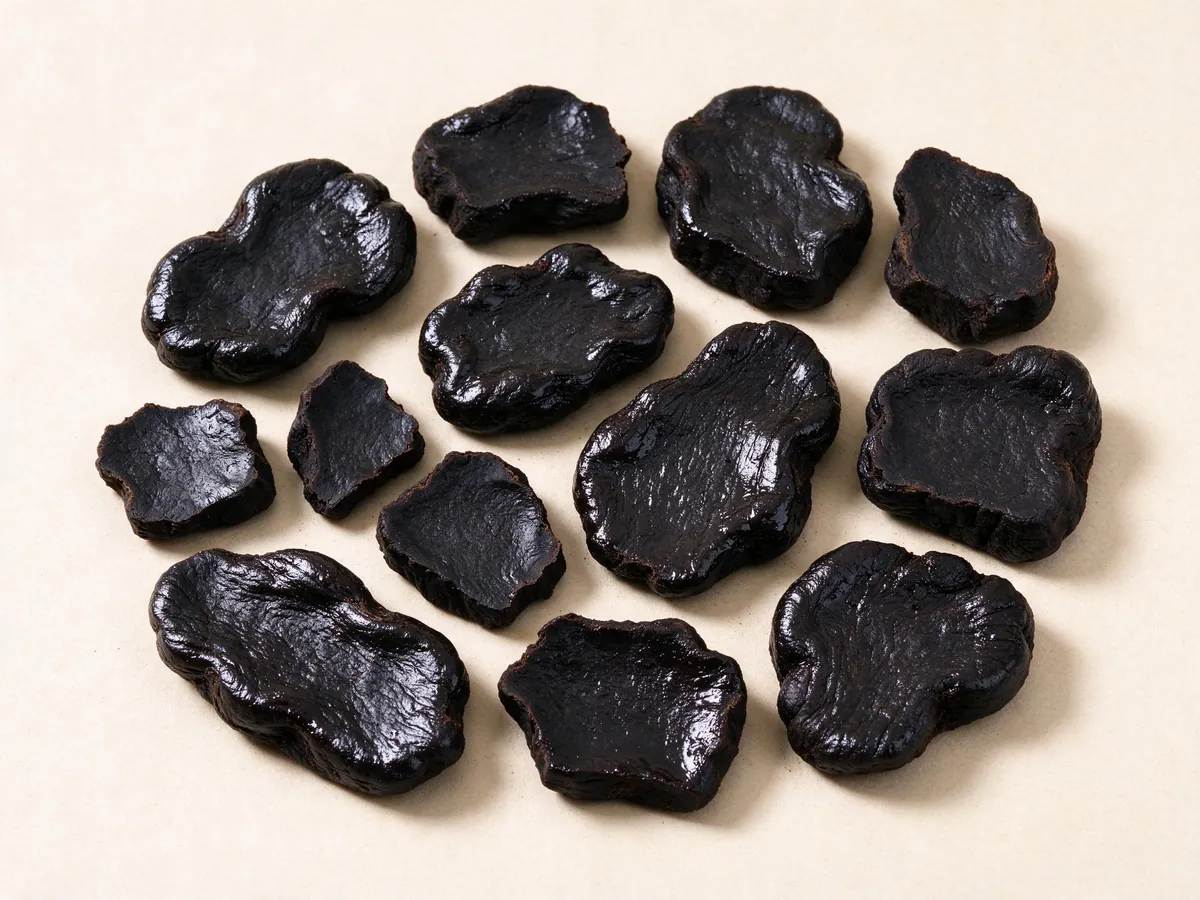
Shu Di Huang is the prepared product of the Rehmannia root, steamed until black and moist.1 It is sweet and slightly warm, entering the Liver and Kidney.1,2,3
It tonifies the Blood, enriches the Yin, generates essence and augments the marrow.1,2,3 It is black, heavy and still in nature.2
It is a cloying and rich substance that readily leads to stagnation of Dampness and impedes digestion.2
Identity and sources
The medicinal material is the prepared product of the Rehmannia root.1
Sheng Di Huang 生地黄, the unprepared root, is sweet and cold and is used to cool the Blood and generate fluids.1
Actions
- Tonifies the Blood. For facial pallor, dizziness, palpitations and insomnia, and for irregular menstruation, uterine bleeding and postpartum bleeding.2
- Nourishes the Yin. For Liver and Kidney Yin deficiency with weak lower back and limbs, dizziness, tinnitus, tidal fever and night sweats.2
- Enriches the Yin and relieves wasting and thirsting. For lower burner wasting and thirsting disorder, where it can be used alone in large doses.2
- Nourishes the Blood and tonifies the essence. For delayed development, blunted affect, premature ageing, greying of hair, impotence and memory loss where Blood and essence are both deficient.2
Clinical applications
Blood deficiency
For pallor, dizziness, palpitations and insomnia, and for irregular menstruation, uterine bleeding and postpartum loss, it is used where there is deficiency without significant stagnation.2
Liver and Kidney Yin deficiency
For a weak lower back, dizziness, tinnitus, tidal fever and night sweats, it nourishes the Yin.2
Wasting and thirsting
For lower burner wasting and thirsting disorder, it is used in large doses.2
Blood and essence deficiency
For delayed development, poor memory, greying hair and impotence.2
For lower burner wasting with thirst and deficiency fire, it is used with Anemarrhena and Phellodendron, or with Gypsum and Lycium cortex where fire has injured the fluids.2
For excessive uterine bleeding with Blood deficiency, it is combined with E Jiao and mugwort; for insomnia and palpitations, platycladi seed is added.2
It is especially useful for lower burner wasting, and it can be used as a stand-alone herb in large doses.2
Key combinations
It is the Blood-nourishing herb in Si Wu Tang, used for dizziness, palpitations and menstrual dysfunction.2
With Shan Zhu Yu 山茱萸 and Shan Yao 山药, as in Six-Ingredient Pill with Rehmannia, it is used for dizziness, tinnitus and sore lower back from Liver and Kidney deficiency.2
With Zhi Mu 知母 and Huang Bai 黄柏, as in Anemarrhena, Phellodendron and Rehmannia Pill, the combination is directed at heat from deficiency.2
With lean pork or other lean meat, it is used for chronic constipation from deficiency.2
Comparison with similar herbs
| Medicinal | Key difference |
|---|---|
| Shu Di Huang 熟地黄 (prepared root) | Sweet and slightly warm. Tonifies Blood, nourishes Yin and enriches essence.1,2 |
| Sheng Di Huang 生地黄 (unprepared root) | Sweet and cold. Cools the Blood, clears heat and generates fluids.1 |
Processing and preparation
The dried root is steamed until black and moist, then dried.1
Safety
Contraindications
Qi stagnation with profuse Phlegm, fullness and pain in the abdomen, reduced appetite, and diarrhoea, because the root is cloying and readily stagnates Dampness.2
Use with caution
Dampness inside or loose stools.3
Adverse effects
There has been one report of an allergic skin reaction with this herb.2
Modern research
A review of catalpol, an iridoid glycoside derived from the root tuber of Rehmannia glutinosa, summarised its anti-inflammatory and antioxidative stress mechanisms.4
A catalpol tablet has been approved to enter clinical trials in China as a new class I medicine based on the isolated compound.4
Dose and administration
The official reference dose is 9-15 g.1 In clinical use the dose ranges from 5-15 g up to 30 g.3,2
These are reference ranges, not safe upper limits.
Common questions
Why is it black and sticky?
It is steamed until black and moist, and that processing changes it from the raw root, which is cold and clears heat, to a warm root that tonifies Blood and Yin.1
Can it cause diarrhoea?
Yes. It is cloying and rich, and it readily stagnates Dampness and impedes digestion.2
Is it the same as Sheng Di Huang?
No. Sheng Di Huang is the unprepared root, which is sweet and cold and used to cool the Blood and generate fluids; Shu Di Huang is steamed until black and moist, and is used to tonify Blood and Yin.1
References
- Chinese Pharmacopoeia Commission. Pharmacopoeia of the People's Republic of China, 2020 edition, Volume I. Beijing: China Medical Science Press; 2020. Part I, pp. 129-130.
- Bensky D, Clavey S, Stöger E. Chinese Herbal Medicine: Materia Medica. Portable 3rd edition. Seattle: Eastland Press; 2015. pp. 777-779.
- Chang M, Jia M, Bare M, eds. Chinese Materia Medica. Beijing: People's Medical Publishing House; 2014. pp. 595-597.
- He G, Song J, Ma R, Zhou Y, Xue Y, Zhang F. Catalpol: a natural multifunctional iridoid glycoside with promising therapeutic properties. Front Mol Biosci. 2026. doi.org/10.3389/fmolb.2026.1768334
Educational reference only. Not medical advice or an individual prescription. Consult a qualified practitioner before using any herb or treatment.