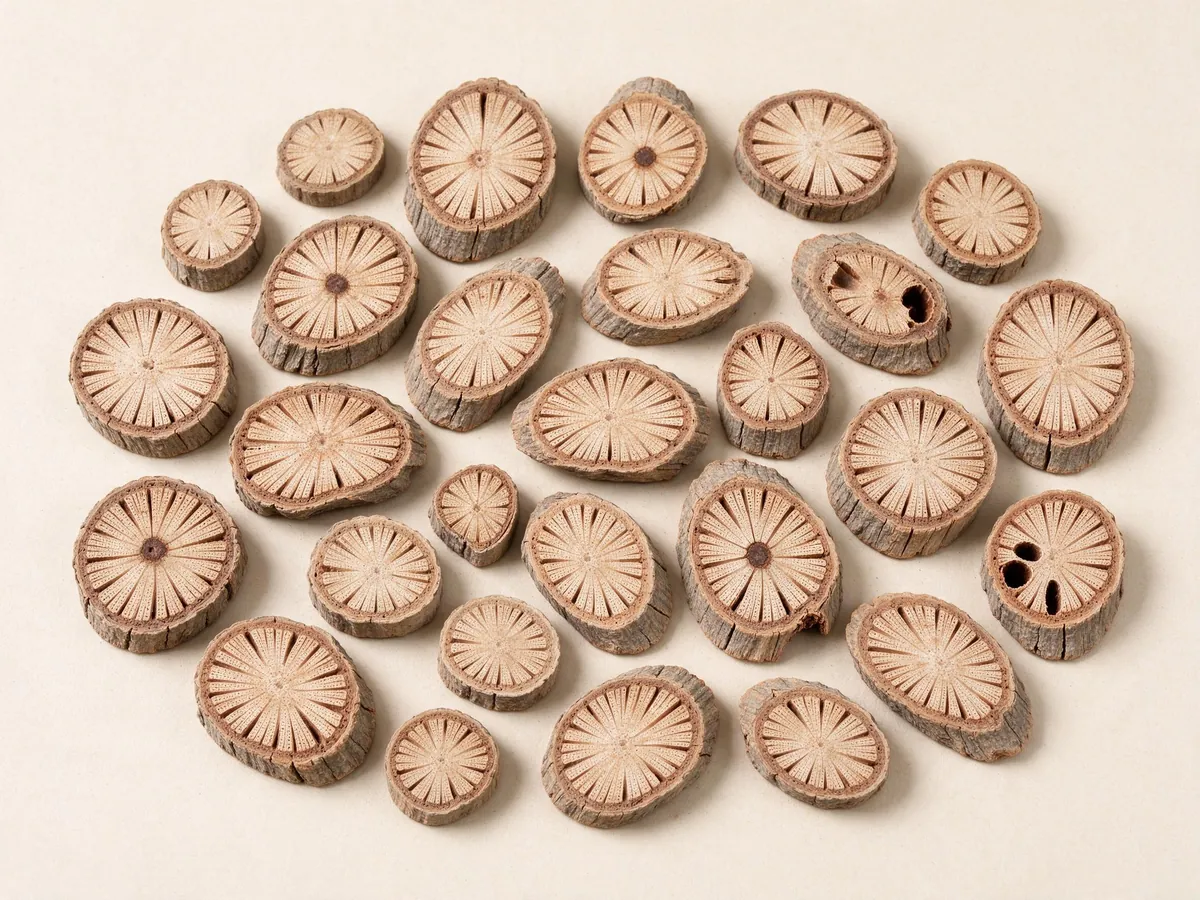
Overview
Mu Tong is bitter and cold, entering the Bladder, Heart and Small Intestine.1,2
It promotes urination, directs fire and Damp-heat downward and out through the urine, facilitates lactation and unblocks Blood stasis.1,2
It must be the Akebia stem, never Guan Mu Tong (Aristolochia manshuriensis), which contains aristolochic acid and should not be used.2
Identity and sources
The medicinal material is the dried stem of Akebia quinata or Akebia trifoliata.1
Aristolochiae manshuriensis Caulis (Guan Mu Tong) is a different plant; it contains the nephrotoxin aristolochic acid and should not be used.2
Akebia has been restored as the standard Mu Tong.2
Actions
- Promotes urination and unblocks painful urinary dribbling. For Damp-heat in the Bladder with dribbling, rough and painful urination, and for oedema and ascites.2
- Drains Heart fire through the Small Intestine. For irritability with mouth or tongue sores and scanty urine.2
- Promotes Qi and Blood flow, unblocks lactation and treats joint pain. For insufficient lactation, amenorrhoea from Blood stasis, and swelling and pain in the joints from obstructed collaterals.2
Clinical applications
Painful urinary dribbling and oedema
For Damp-heat in the Bladder with dribbling, rough, painful urination, and for oedema and ascites.2
Heart fire
For irritability with mouth or tongue sores and scanty urine.2
Lactation and menstruation
For insufficient lactation and amenorrhoea from Blood stasis.2
Joint pain
For swelling and pain in the joints from obstruction of the collaterals.2
Key combinations
With Plantago, Gardenia and Talcum in Eight-Herb Powder for Rectification, it is used for Damp-heat in the Bladder with painful urinary dribbling.2
With Nelumbinis Nodus Rhizomatis and Typhae Pollen, it is used for painful bloody urinary dribbling.2
With Jin Qian Cao and Lygodium Spora, it is used for stony painful urinary dribbling.2
With Poria and Polyporus, it is used for oedema.2
With Junci Medulla, it is used for Heart channel heat shifting into the Small Intestine.2
With Lophatherum and Rehmannia in Guide Out the Red Powder, it is used for oral ulcers, burning throat, irritability and insomnia from excess Heart fire.2
Comparison with similar herbs
| Herb | Key difference |
|---|---|
| Mu Tong 木通 | Bitter and slightly cold. Clears Heart and Small Intestine fire, promotes urination, facilitates lactation and unblocks Blood stasis.2 |
| Ze Xie 泽泻 | The adage is to use Mu Tong for sovereign (Heart) fire and Ze Xie for ministerial (Kidney) fire. Both promote the fluid pathways and are used together for internal water-Dampness, but Mu Tong clears Heart and Small Intestine fire and unblocks Qi and Blood, while Ze Xie clears ministerial fire in the Kidney channel.2 |
| Hu Po 琥珀 | Both clear Small Intestine and Heart fire; Mu Tong is used for mouth and tongue ulcers, red eyes and irritability.2 |
Processing and preparation
The stem is cleaned, soaked, sliced and dried.1
Dry-fried Akebia is baked until black scorched spots appear; it is less cold, does not injure the Stomach, and still cools heat and facilitates urination without draining the primal Qi.2
Safety
Contraindications
Use cautiously during pregnancy.2
It is contraindicated with insecurity, slipping essence, spermatorrhoea, Yang deficiency and weakness of Qi, or where internal Damp-heat is absent.2
Species warning
Never substitute Guan Mu Tong (Aristolochiae manshuriensis Caulis): it contains aristolochic acid, a genotoxic and carcinogenic nephrotoxin associated with aristolochic acid nephropathy.2,3
Toxicity
The oral herb has very low toxicity; preparations for injection are reported to be more toxic.2
Modern research
A review describes aristolochic acid as potently genotoxic and carcinogenic, found mainly in Aristolochia species.3
The 1993 Belgian weight-loss incident established its link to aristolochic acid nephropathy and Balkan endemic nephropathy and led to regulatory action.3
Dose and administration
The official reference dose is 3-6 g.1
Some clinical texts give 3-6 g.2
This is a reference range, not a safe upper limit.
Common questions
Which plant is Mu Tong?
The dried stem of Akebia quinata, Akebia trifoliata or A. trifoliata var. australis.1
Is Guan Mu Tong the same?
What is Mu Tong used for?
It promotes urination for painful dribbling and oedema, drains Heart fire for mouth sores and scanty urine, promotes lactation and unblocks Blood stasis.2
References
- Chinese Pharmacopoeia Commission. Pharmacopoeia of the People's Republic of China, 2020 edition, Volume I. Beijing: China Medical Science Press; 2020. Part I, p. 63.
- Bensky D, Clavey S, Stöger E. Chinese Herbal Medicine: Materia Medica. Portable 3rd edition. Seattle: Eastland Press; 2015. pp. 284-287.
- Yang L, Lin W, Shi M, Huang Z, Zhang X, Yang Y, Chu T, Zheng D, Yang D, Ma W. Whether aristolochic acid directly drives hepatocarcinogenesis: comprehensive investigations from mutational signatures to animal models. Arch Toxicol. 2025;99(9):3553-3564. doi:10.1007/s00204-025-04087-z pubmed.ncbi.nlm.nih.gov/40445366
Educational reference only. Not medical advice or an individual prescription. Consult a qualified practitioner before using any herb or treatment.