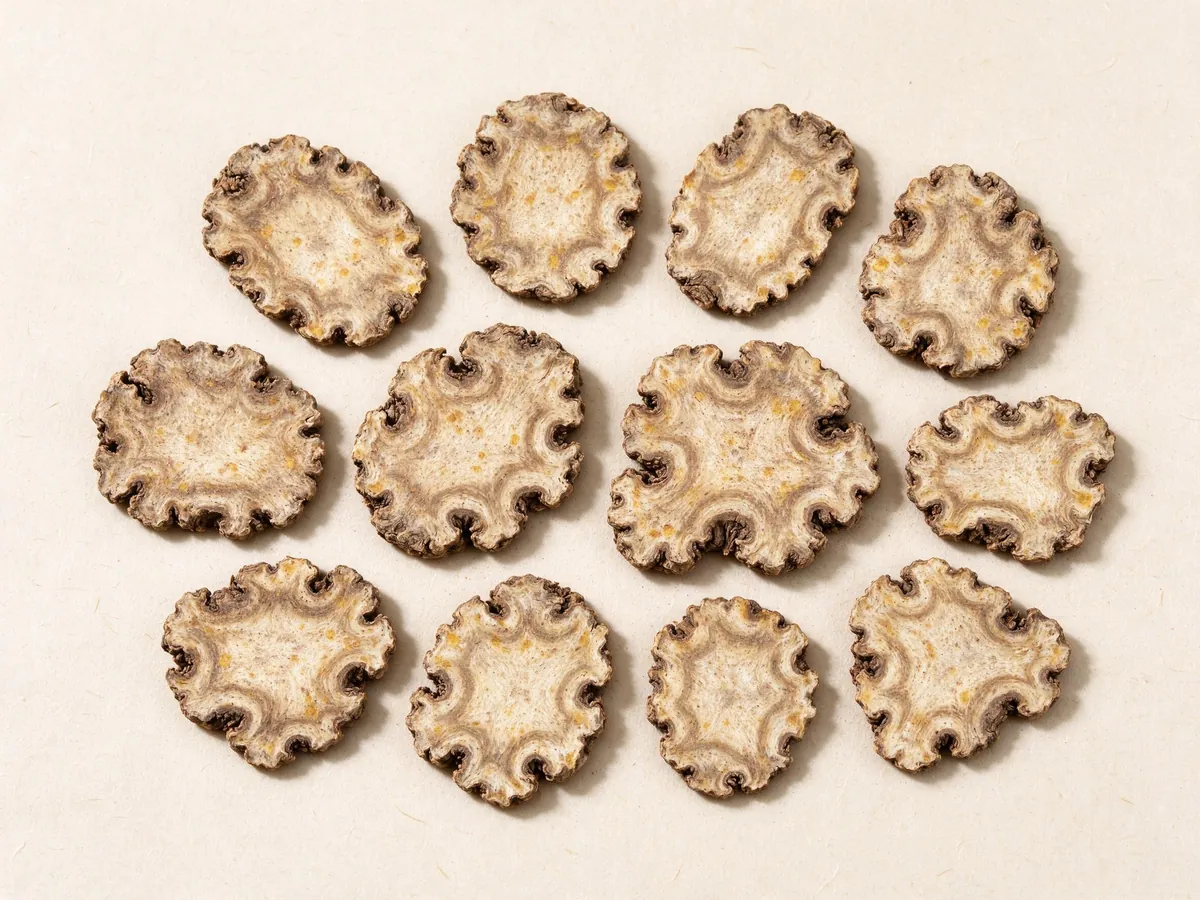
Overview
Chuan Xiong is acrid and warm, entering the Liver, Gallbladder and Pericardium.1,2,3,4 It invigorates the Blood, promotes the movement of Qi, expels Wind and stops pain.1,2,3
It invigorates the Blood and promotes the movement of Qi, and it is used for pain and soreness in the chest and flanks.2 In gynaecology that means menstrual pain, absent periods and retained lochia.2
It is light in weight and aromatic, and it raises and discharges, reaching upward to the head and outward to the exterior.2
Its pain-relieving action applies wherever stasis and stagnation sit together, and it is used for that reason in trauma as well as in menstrual pain.2
Identity and sources
The medicinal material is the dried rhizome of Ligusticum chuanxiong.1 Taiwan's official monograph has the same nature, flavour, channels and 3-10 g dose.4
It is used with Dang Gui 当归 for dysmenorrhoea, amenorrhoea and scanty late periods due to Blood deficiency.2
Actions
- Invigorates the Blood and moves Qi. For stasis with stagnation, with pain and soreness in the chest and flanks.2
- Regulates menstruation. It is an important herb in gynaecology, used for dysmenorrhoea, amenorrhoea, difficult labour and retained lochia.2
- Expels Wind and alleviates pain. For headache, dizziness and painful obstruction from externally contracted Wind, and it is particularly useful for headache.2
- Treats skin problems caused by Wind.2
Clinical applications
Chest and hypochondriac pain
For chest pain from stasis, it moves the Blood and relieves the pain.1,2
Menstrual disorders
For dysmenorrhoea, amenorrhoea, difficult labour and retained lochia, it is a main herb in the formulas that move Blood.2,1
Headache
For headache, including that from externally contracted Wind with dizziness and painful obstruction, it is particularly useful.2,1
Numbness and paralysis
For numbness of the limbs and paralysis from wind-dampness and stagnant Qi blocking the Blood channels, it is used with Astragalus and Pheretima, as in Tonify the Yang to Restore Five Decoctions.2
For headache with dizziness or painful obstruction from externally contracted Wind, it is a leading herb.2
Key combinations
For lower abdominal pain and cold accompanying the menses due to cold from deficiency of the Penetrating and Conception vessels.2
With Peach Kernel and Safflower in Tao Hong Si Wu Tang, it is used for abdominal pain with the menses, usually with clots, and for pain after trauma.2
With Fang Feng and Schizonepeta in Chuanxiong Powder to be Taken with Green Tea, it is used for headache from externally contracted wind-cold.2
With Chi Shao and Chai Hu for headache or chest pain from stagnant Liver Qi and Blood.2
Add Cinnamomi and Evodiae Fructus for lower abdominal pain and cold accompanying the menses due to cold from deficiency of the Penetrating and Conception vessels, as in Flow-Warming Decoction.2
Comparison with similar herbs
| Herb | Key difference |
|---|---|
| Chuan Xiong 川芎 | Acrid and warm. Moves Blood and Qi, and rises and discharges, reaching upward to the head and outward to the exterior.2 |
| Xiang Fu 香附 | Also a Qi-within-Blood herb, but it directs downward, harmonising the middle and relieving constraint, and it extends to all twelve channels.2 |
Both are called Qi-within-Blood herbs, and they are often combined because one rises and the other descends.2
Processing and preparation
The rhizome is cleaned, graded by size, moistened, cut into thick slices and dried.1
Dry-fried Chuanxiong is dry-fried at a moderate temperature until pale yellow; this moderates the tendency of unprepared Chuanxiong to exhaust Qi and Blood, so it suits Qi and Blood deficiency.2
External use
It is used for skin problems caused by Wind.2
Safety
Contraindications
Fire from Yin deficiency, with a red, dry tongue and a dry mouth.2
Use with caution
Pregnancy, and anyone who bleeds easily or has profuse menses, because it moves Blood.2
Adverse effects
Oral use has caused tingling abdominal pain, urinary frequency, pain on urinating, intense headache and vomiting.2 Allergic dermatitis and allergic cheilitis have been reported.2
Rare case reports describe a shortening of the interval between periods and heavy menstrual bleeding.2
Injection of preparations based on this herb can cause serious and even fatal reactions and should not be used.2
Modern research
Tetramethylpyrazine, the primary active constituent of the herb, has antiplatelet, anti-inflammatory, antioxidant and anti-apoptotic mechanisms.5
Dose and administration
The official reference dose is 3-10 g.1 The official dose in Taiwan is 3-10 g.4 As a powder the dose is smaller.2
This is a reference range, not a safe upper limit.
Common questions
Why is Chuan Xiong used in so many formulas?
Because it moves both Blood and Qi, it is used wherever stasis and stagnation occur together.2
Is it safe in pregnancy?
It is used with caution in pregnancy, and by anyone who bleeds easily or has profuse menses.2
Can it be used on the skin?
Yes, for skin problems caused by Wind.2
References
- Chinese Pharmacopoeia Commission. Pharmacopoeia of the People's Republic of China, 2020 edition, Volume I. Beijing: China Medical Science Press; 2020. Part I, pp. 42-43.
- Bensky D, Clavey S, Stöger E. Chinese Herbal Medicine: Materia Medica. Portable 3rd edition. Seattle: Eastland Press; 2015. pp. 632-634.
- Chang M, Jia M, Bare M, eds. Chinese Materia Medica. Beijing: People's Medical Publishing House; 2014. pp. 393-395.
- Ministry of Health and Welfare. Taiwan Herbal Pharmacopoeia, 4th edition (English edition). Taipei; 2022, with 2025 amendments where cited. pp. 92-93.
- Fan J, Zeng S, Liu Y, Xu H, Ma W, Zhang F. A critical review of tetramethylpyrazine: diseases and derivatives. Med Chem. 2026. doi.org/10.2174/0115734064473152260514071623
Educational reference only. Not medical advice or an individual prescription. Consult a qualified practitioner before using any herb or treatment.