Overview
Chi Shao is bitter and slightly cold, entering the Liver.1
Another clinical text gives the sour flavour and the Spleen channel.2
It invigorates the Blood, dispels stasis, stops pain and cools heat in the Blood.1,2
Its bitterness drains, so it moves the Blood and breaks stagnation.2
Identity and sources
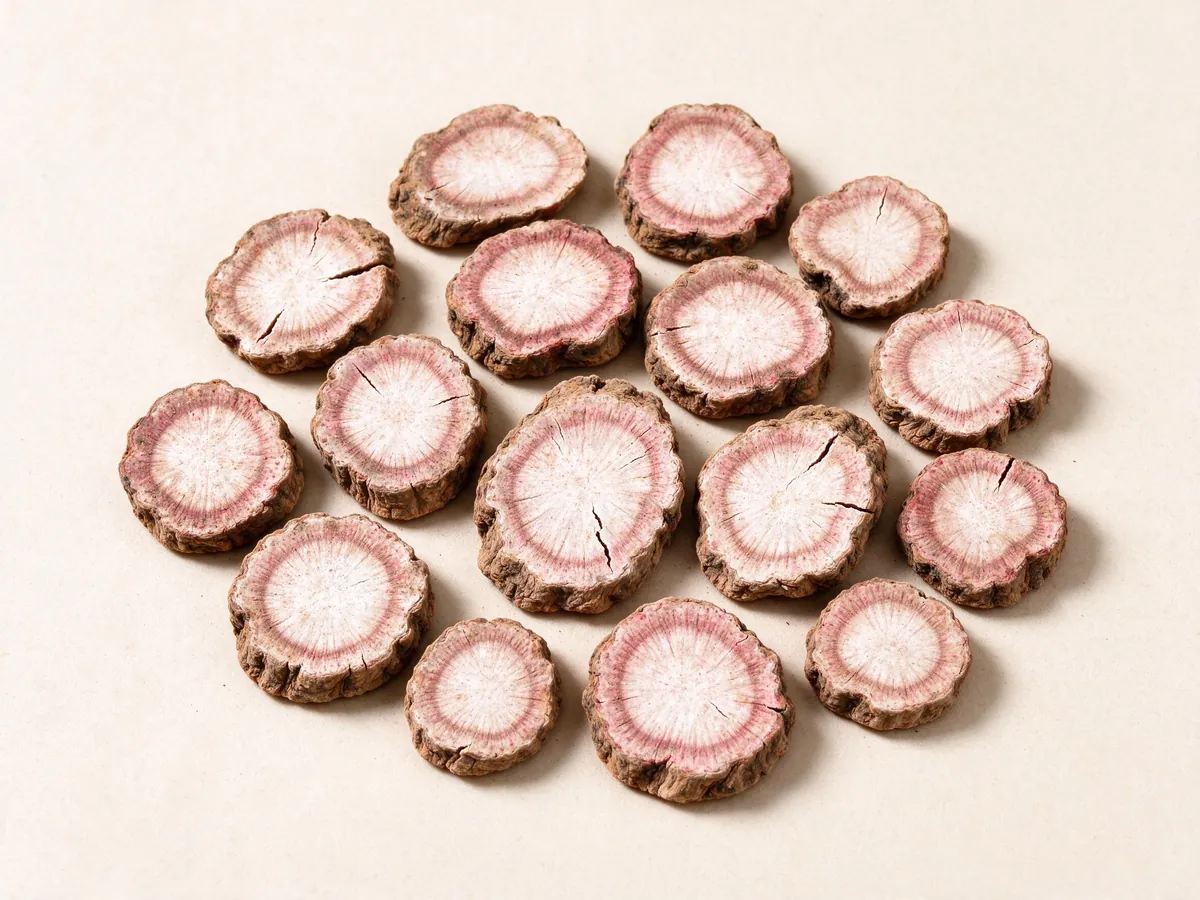
The medicinal material is the dried root of Paeonia lactiflora or Paeonia veitchii.3
Taiwan grades it mildly cold and bitter, clearing heat to cool the Blood and dissipating stasis, with a 3-12 g dose.4
Actions
- Invigorates the Blood and dispels stasis. For period pain, amenorrhoea, abdominal pain and fixed abdominal masses, and for swelling and pain from trauma or early abscesses and boils.2
- Clears heat and cools the Blood. For heat entering the Blood level with fever, a purple tongue, maculae and bleeding from hot Blood.2
Clinical applications
Menstrual and abdominal stasis
For period pain, amenorrhoea, abdominal pain and fixed abdominal masses.2
Trauma, abscesses and boils
For swelling and pain from trauma and the early stages of abscesses and boils.2
Heat in the Blood
For heat entering the Blood level with fever, a purple tongue, maculae and bleeding from the chaotic movement of hot Blood.2
Bleeding from hot Blood
For bleeding from the chaotic movement of hot Blood.2
Key combinations
With Chuanxiong and Angelica sinensis, it is used for Blood stasis gynaecological disorders such as fixed abdominal masses and amenorrhoea with abdominal pain, and for abscesses, boils and trauma pain.2
With Persicae Semen in Drive out Stasis from the Mansion of Blood Decoction, it is used for menstrual disorders with early periods, heavy bleeding and purple clots.2
With Cyperi Rhizoma, it is used for flank and abdominal pain and period pain from Qi and Blood obstruction.2
With Bai Shao, it is used for spasms and cramping pain from Blood deficiency with impeded Blood.2
With Olibanum and Myrrha, it is used for bruising, swelling and pain from trauma.2
With Lonicera and Forsythia added in Immortals' Formula for Sustaining Life, it is used for pain and swelling of boils and abscesses.2
With Moutan Cortex and Rehmannia, it is used for heat entering the Blood level.2
With Arnebiae Radix/Lithospermi Radix and Cicadae Periostracum, it is used for dull, not very red maculae in warm pathogen disease.2
With Cirsii Herba and Imperatae Rhizoma, it is used for painful bloody urinary dribbling.2
With Chrysanthemum and Scutellaria, it is used for redness, swelling and pain of the eyes.2
With Rhei Radix et Rhizoma, it breaks up Blood stasis and drains heat toxin; the pair drains heat, stops pain and breaks obstruction in the Blood, but is used with caution in cold abdominal pain or Yang deficiency.2
Comparison with similar herbs
| Herb | Key difference |
|---|---|
| Chi Shao 赤芍 | Sour, bitter and slightly cold. Invigorates the Blood, dispels stasis, stops pain and cools hot Blood.1,2 |
| Bai Shao 白芍 | Bai Shao is bitter, sour and slightly cold and mainly tonifies: it nourishes the Blood, restrains Yin, softens the Liver and stops pain. Chi Shao is bitter, slightly cold and mainly drains: it clears heat, cools the Blood, dispels stasis and stops pain.2 |
Processing and preparation
The root is cleaned, sorted by size, washed, moistened, cut into thick slices and dried.1
The root bark is an important source of active ingredients and should be retained during processing.2
Dry-frying until scorch marks appear reduces its cooling property; it is used for Blood stasis without heat in the Blood.2
Wine-frying more strongly promotes the movement of Blood.2
Vinegar-frying enables it to enter the Blood level of the Liver channel and strongly dispel stasis and stop pain.2
Safety
Contraindications
Use with caution in cold from deficiency.2
It breaks up Blood and should not be used in any Blood-deficient disorder or diarrhoea, after birth once the lochia has passed, once abdominal pain has ceased, or once sores have perforated.2
Interactions
Modern research
A review of Paeoniae Radix Rubra reports 264 compounds, including monoterpenes and their glycosides, sesquiterpenes, triterpenes, steroids, flavonoids, lignans, tannins and volatile oils.3
The review lists cardiovascular-protective, antidepressant, neuroprotective, antitumour, hepatoprotective and anti-inflammatory activity.3
The review gives the herb's traditional actions as clearing heat, cooling the Blood, dispelling Blood stasis and relieving pain.3
Dose and administration
The official reference dose is 6-12 g.1
The official dose in Taiwan is 3-12 g.4
This is a reference range, not a safe upper limit.
Common questions
Is Chi Shao the same as Bai Shao?
No. Bai Shao mainly tonifies, nourishing the Blood and restraining Yin; Chi Shao mainly drains, clearing heat, cooling the Blood, dispelling stasis and stopping pain.2
What is it used for in rashes?
It is used for maculae or bleeding from heat entering the Blood level, and for dull, not very red maculae in warm pathogen disease.2
When should it be avoided?
It is used with caution in cold from deficiency, and is not used in Blood deficiency, diarrhoea, after the lochia has passed, once abdominal pain has ceased, or once sores have perforated.2
References
- Chinese Pharmacopoeia Commission. Pharmacopoeia of the People's Republic of China, 2020 edition, Volume I. Beijing: China Medical Science Press; 2020. Part I, pp. 165-166.
- Bensky D, Clavey S, Stöger E. Chinese Herbal Medicine: Materia Medica. Portable 3rd edition. Seattle: Eastland Press; 2015. pp. 622-624.
- Fan Z, Liu J, Wang X, Yang S, Wang Q, Yan L, Zhang Y, Wu X. Paeoniae Radix Rubra: a review of ethnopharmacology, phytochemistry, pharmacological activities, therapeutic mechanism for blood stasis syndrome, and quality control. Chem Biodivers. 2024;21(8):e202401119. doi:10.1002/cbdv.202401119 pubmed.ncbi.nlm.nih.gov/38850115
- Ministry of Health and Welfare. Taiwan Herbal Pharmacopoeia, 4th edition (English edition). Taipei; 2022, with 2025 amendments where cited. p. 488.
Educational reference only. Not medical advice or an individual prescription. Consult a qualified practitioner before using any herb or treatment.