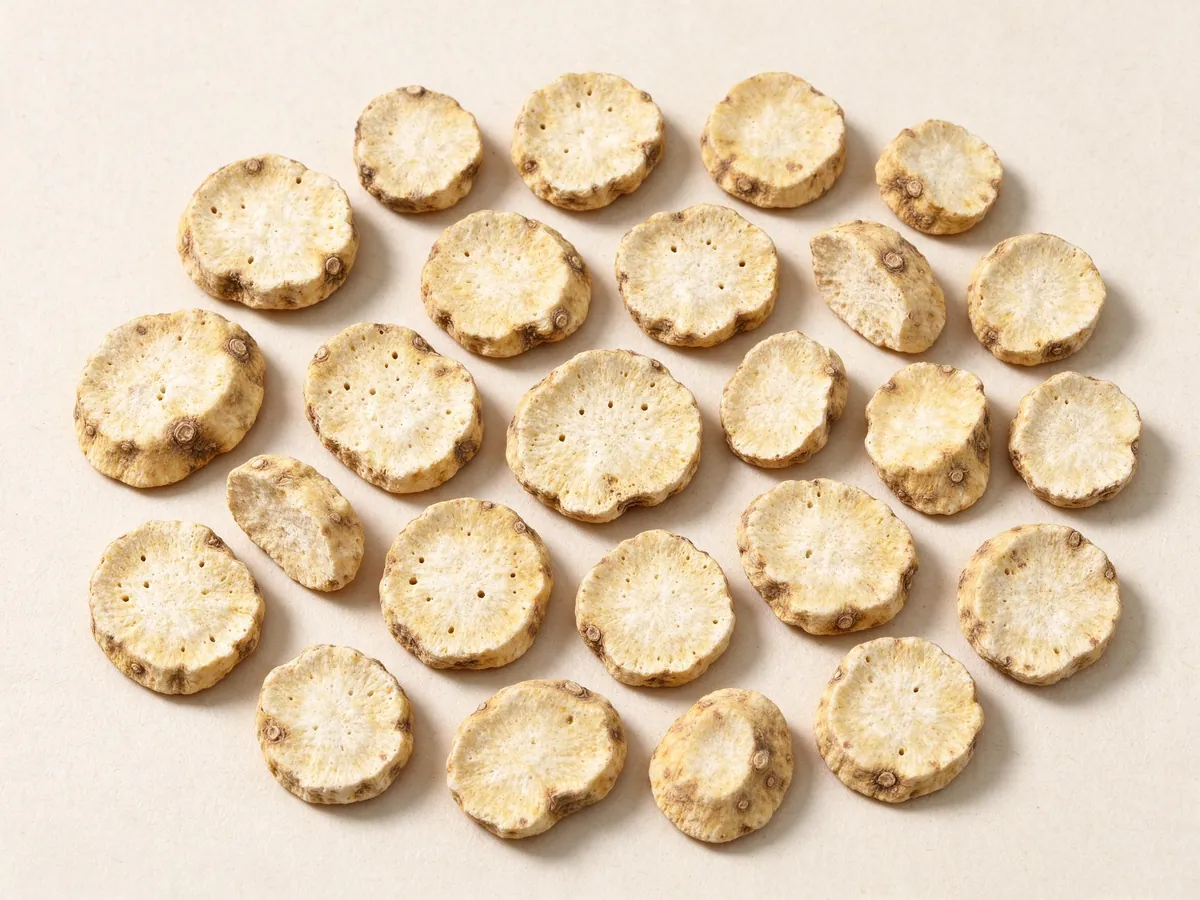
Overview
Ze Xie is sweet, bland and cold, entering the Kidney and Bladder.1,2,3 It promotes urination and leaches out Dampness.1,2,3
It settles ministerial fire in the Kidneys by draining Damp-heat from the lower burner.2
It enters the Bladder Channel, and it excels at draining Kidney Channel ministerial fire.2
It facilitates the fluid pathways and clears blazing ministerial fire.2
Identity and sources
The medicinal material is the dried tuber of Alisma plantago-aquatica or its oriental subspecies.1,4
It is sweet, bland and cold, entering the Kidney and Bladder.1,3
Actions
- Promotes urination and leaches out Dampness. For urinary difficulty, oedema, painful urinary dribbling, diarrhoea and dizziness from Dampness.2
- Drains lower-burner Damp-heat. It is especially useful when there is Damp-heat in the lower burner.2
- Settles ministerial fire in the Kidneys. For spermatorrhoea due to lower-burner Damp-heat disturbing the ministerial fire.2
- Drains heat, transforms turbidity and lowers lipids.1
Clinical applications
Oedema and difficult urination
For urinary difficulty, oedema, painful urinary dribbling, diarrhoea and dizziness it drains Dampness.2,1
Dizziness and vertigo from Dampness
For vertigo due to Phlegm and thin mucus.2
Lower-burner Damp-heat
For spermatorrhoea from lower-burner Damp-heat disturbing the ministerial fire of the Kidneys.2
Where tonics would cause fire
It is combined with Kidney-tonifying substances to prevent the appearance of Kidney fire as a side effect of tonification.2
For epigastric and abdominal distension with scanty urine from turbid Dampness festering in the middle burner.2
Key combinations
With Akebiae Caulis for painful urinary dribbling with scanty urine and oedema.2
With Amomum for urinary discomfort, scanty urine and abdominal distension.2
With Atractylodis macrocephalae Rhizoma (Bai Zhu) for vertigo due to Phlegm and thin mucus, as in Alisma Decoction.2
With Zhi Ban Xia for epigastric and abdominal distention with scanty urine from turbid Dampness festering in the middle burner.2
Comparison with similar herbs
| Herb | Key difference |
|---|---|
| Ze Xie 泽泻 | Sweet, bland and cold, entering the Kidney and Bladder.2 |
| Fu Ling 茯苓 | Sweet, bland and neutral, entering the Heart, Spleen, Kidney and Lung. Tonifies the Spleen, eliminates Dampness and calms the Heart spirit.2 |
| Zhu Ling 猪苓 | Both promote urination and clear heat, and are used together for oedema with scanty, difficult urination. Ze Xie is colder and especially indicated for blazing ministerial fire, while Zhu Ling more strongly removes pathogenic water. For spermatorrhoea, Zhu Ling suits Dampness predominant with turbid urine, Ze Xie heat predominant with heat disturbing the essence chamber.2 |
| Che Qian Zi 车前子 | Both promote water, reduce oedema, clear heat and drain Dampness, and are used together for oedema with abdominal distention, painful urinary dribbling and summerheat-Damp diarrhoea. Che Qian Zi mainly removes Dampness and also clears the Liver and eyes and transforms Phlegm in the Lungs; Ze Xie drains ministerial fire.2 |
| Mu Tong 木通 | The adage is to use Mu Tong for sovereign (Heart) fire and Ze Xie for ministerial (Kidney) fire. Mu Tong clears Heart and Small Intestine fire and unblocks the flow of Qi and Blood; Ze Xie clears ministerial fire in the Kidney channel.2 |
Processing and preparation
The tuber is cleaned, briefly soaked, moistened, cut into thick slices and dried.1
The salt-processed form, Yan Ze Xie, is made by stir-frying the slices with salt water until dry.1
Salt-frying enhances its ability to facilitate urination.2 Dry-frying, sometimes with bran, moderates its cold nature so that it does not injure the middle burner Qi, and is used when fluid retention comes from Spleen and Stomach Yang deficiency.2
Safety
Use with caution
Sunken middle burner Qi.2
Toxicity and overdose
Extended use or overdosage can disturb the electrolyte balance and may cause haematuria and, in severe cases, acidosis.2 Nausea, vomiting, abdominal pain, diarrhoea and disturbed liver function have been reported, and one case of allergic skin rash.2
Modern research
A review of Rhizoma alismatis covers its botany, traditional uses, phytochemistry, pharmacology, toxicology and processing.4
Its extracts and isolated compounds have diuretic, liver-protective and blood-pressure-lowering activity.4
The toxicity of R. alismatis has long been a controversial topic.4
Dose and administration
The official reference dose is 6-10 g.1
Some clinical texts use 4.5-9 g, and the official dose in Taiwan is 6-12 g.2,3
This is a reference range, not a safe upper limit.
Common questions
What is Yan Ze Xie?
It is the salt-processed form, made by stir-frying the slices with salt water until dry.1
Is it the same as Fu Ling?
No. Ze Xie is cold, while Fu Ling is neutral; Fu Ling also tonifies the Spleen and calms the Heart spirit.2
References
- Chinese Pharmacopoeia Commission. Pharmacopoeia of the People's Republic of China, 2020 edition, Volume I. Beijing: China Medical Science Press; 2020. Part I, pp. 239-240.
- Bensky D, Clavey S, Stöger E. Chinese Herbal Medicine: Materia Medica. Portable 3rd edition. Seattle: Eastland Press; 2015. pp. 305-306.
- Ministry of Health and Welfare. Taiwan Herbal Pharmacopoeia, 4th edition (English edition). Taipei; 2022, with 2025 amendments where cited. p. 19.
- Pan T, Tang R, Wang J, Gao J, Jiang F, Chen B. Botany, traditional uses, phytochemistry, pharmacology, toxicology and processing of Rhizoma alismatis: a review. Front Pharmacol. 2025;41424795. doi:10.3389/fphar.2025.1722483 pubmed.ncbi.nlm.nih.gov/41424795
Educational reference only. Not medical advice or an individual prescription. Consult a qualified practitioner before using any herb or treatment.