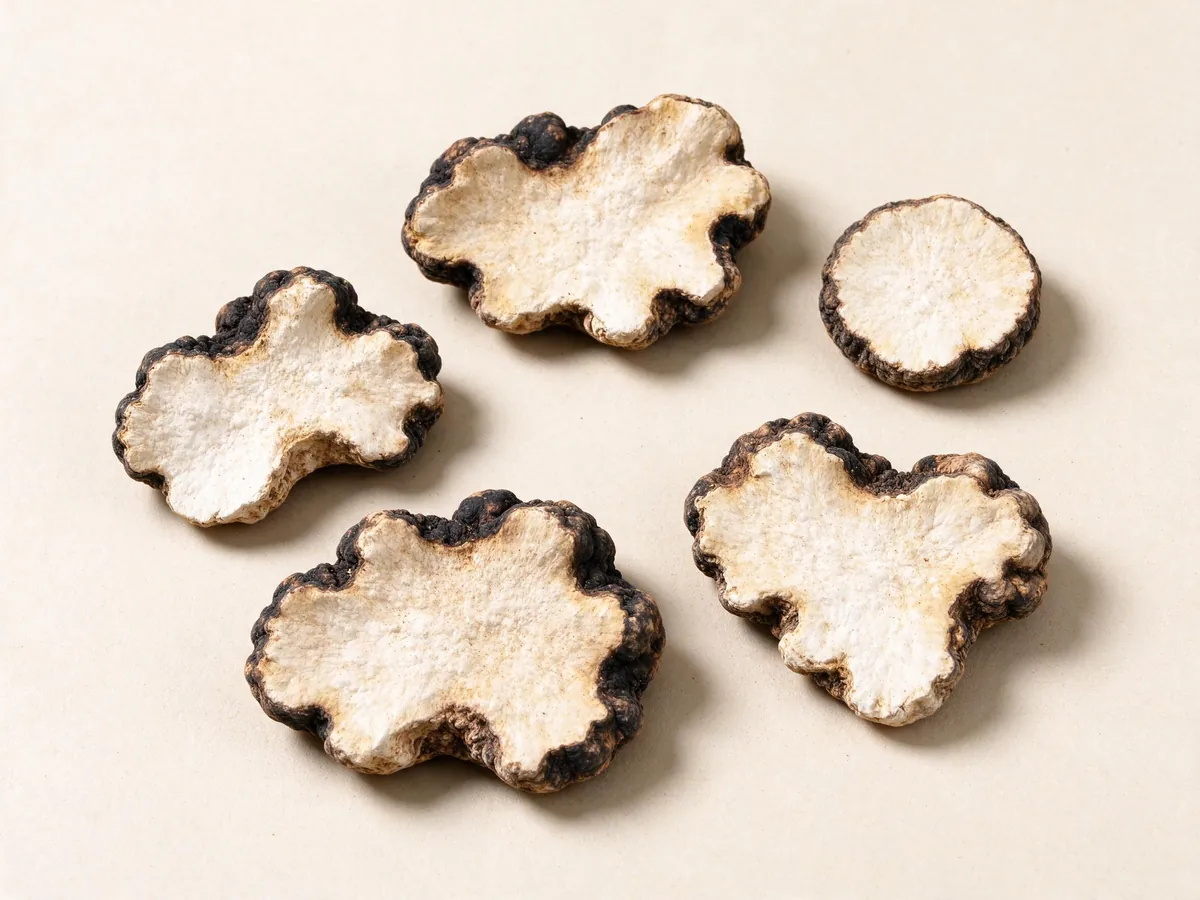
Overview
Zhu Ling is sweet, bland and neutral, entering the Bladder and Kidney.1
One source also includes the Spleen channel.2
It promotes urination, leaches out Dampness and facilitates fluid metabolism.1,2
It promotes urination more strongly than Poria but does not tonify.2
It opens the interstices and facilitates the lower orifices, leaching out Dampness and strongly promoting urination.2
Identity and sources
The medicinal material is the dried sclerotium of the fungus Polyporus umbellatus.1
The black outer cutis is removed before use.2
Actions
- Promotes urination and leaches out Dampness. For oedema, scanty urine, vaginal discharge, turbid painful urinary dribbling, jaundice and diarrhoea, and alone for painful urinary dribbling in pregnancy.2
- Drains Damp-heat. For turbid painful urinary dribbling, anuria, oedema with distention and fullness, Damp-heat jaundice, leg qi oedema and chronic diarrhoea.2
Clinical applications
Oedema and scanty urine
For oedema and scanty urine from stagnation of Dampness.2
Painful urinary dribbling
For turbid, painful urinary dribbling, and alone for painful urinary dribbling in pregnancy.2
Discharge, jaundice and diarrhoea
For vaginal discharge, jaundice and diarrhoea from Dampness.2
Jaundice and leg qi
For Damp-heat jaundice and leg qi oedema.2
Key combinations
With Poria, the ability to leach out Dampness and facilitate pathogenic water is strengthened, and Poria's Spleen-strengthening action assists the recovery of Spleen Qi, thereby preventing the further formation of Dampness.2
With Arecae Pericarpium, it is used for oedema, abdominal distention and urinary difficulty.2
With Akebiae Caulis and Talcum in Polyporus Decoction, it is used for painful urinary dribbling, bloody urine and abdominal distention, usually with heat signs.2
Comparison with similar herbs
| Herb | Key difference |
|---|---|
| Zhu Ling 猪苓 | Sweet, bland and neutral. Promotes urination more strongly than Poria but does not tonify.1,2 |
| Fu Ling 茯苓 | Poria also tonifies the Spleen, harmonises the middle and calms the spirit, which gives it a wider therapeutic scope than Zhu Ling.2 |
| Ze Xie 泽泻 | Both treat oedema with scanty, difficult urination. Ze Xie is cold and better at cooling heat, especially blazing ministerial fire; Zhu Ling more strongly facilitates the removal of pathogenic water. Both treat spermatorrhoea: Zhu Ling for lower-burner Damp-heat with Dampness predominant (turbid urine), and Ze Xie for heat predominant, especially heat disturbing the essence chamber from Kidney ministerial fire.2 |
Processing and preparation
The sclerotium is cleaned, soaked, washed, moistened, cut into thick slices and dried.1
It is used unprepared, and the black outer cutis must be removed.1,2
It is better used unprepared for mobilising Dampness.2
Safety
Contraindications
It is very drying and exhausts the body fluids, so it should not be taken by those without Damp disorders.2
Long-term use injures Kidney Qi and blurs the eyes.2
It is contraindicated in the absence of Dampness.2
Modern research
A review of Polyporus umbellatus polysaccharides calls the fungus a diuretic and Dampness-infiltration medicine in traditional Chinese medicine.3
The polysaccharides are the main active ingredients, with antioxidant, immunomodulatory, antitumour, antiproliferative and hepatoprotective activity.3
They have been isolated from the sclerotia, fruiting body, mycelia and fermentation liquid.3
Dose and administration
The official reference dose is 6-12 g.1
This is a reference range, not a safe upper limit.
Some clinical texts give 6-12 g.2
Common questions
How is Zhu Ling different from Fu Ling?
Zhu Ling promotes urination more strongly than Poria but does not tonify; Poria also tonifies the Spleen, harmonises the middle and calms the spirit.2
Can it be used in pregnancy?
It can be used alone for painful urinary dribbling during pregnancy.2
When should it be avoided?
It is very drying and exhausts body fluids, so it should not be taken by those without Damp disorders, and long-term use injures Kidney Qi and blurs the eyes.2
References
- Chinese Pharmacopoeia Commission. Pharmacopoeia of the People's Republic of China, 2020 edition, Volume I. Beijing: China Medical Science Press; 2020. Part I, pp. 329-330.
- Bensky D, Clavey S, Stöger E. Chinese Herbal Medicine: Materia Medica. Portable 3rd edition. Seattle: Eastland Press; 2015. pp. 270-272.
- Liu GK, Yang TX, Wang JR. Polysaccharides from Polyporus umbellatus: a review on their extraction, modification, structure, and bioactivities. Int J Biol Macromol. 2021;189:124-134. doi:10.1016/j.ijbiomac.2021.08.101 pubmed.ncbi.nlm.nih.gov/34419536
Educational reference only. Not medical advice or an individual prescription. Consult a qualified practitioner before using any herb or treatment.