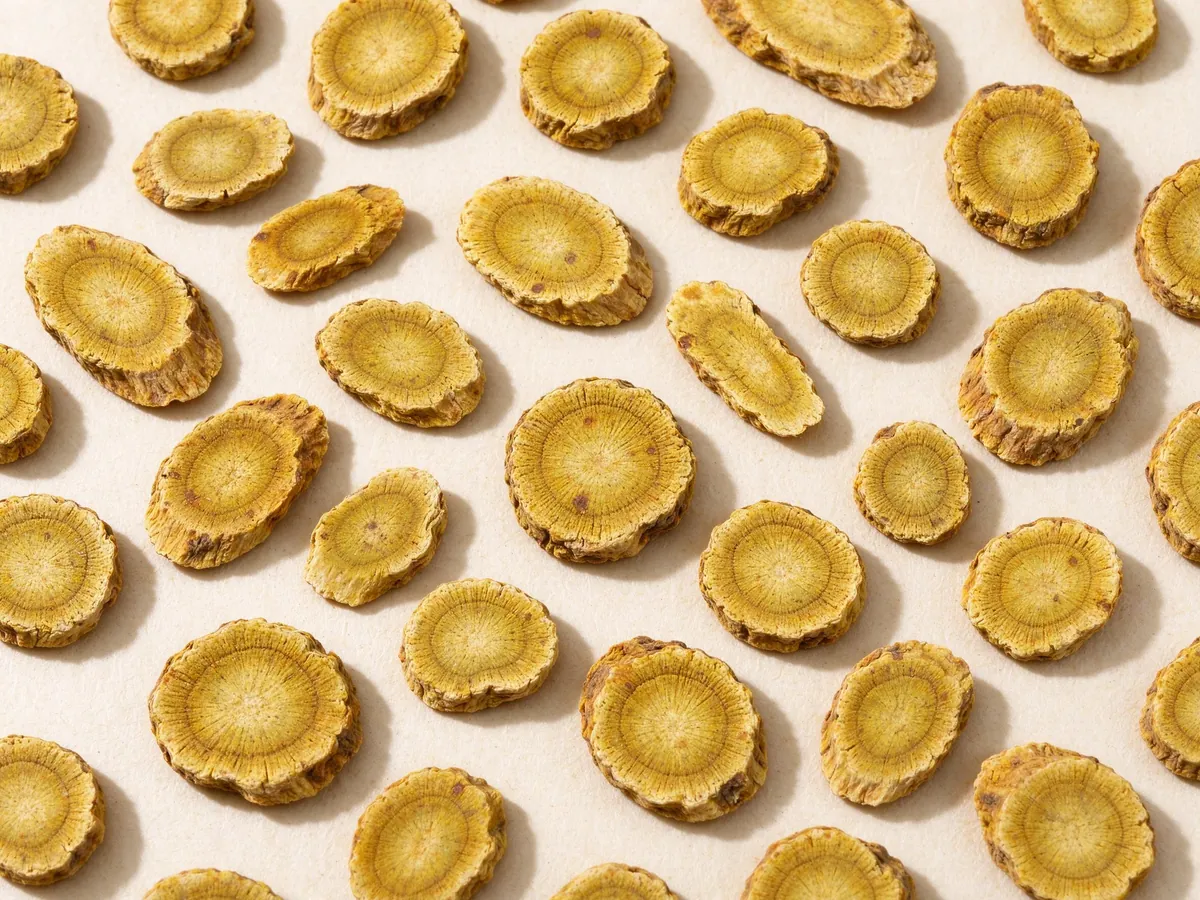
Overview
Huang Qin is bitter and cold, entering the Lung, Gallbladder, Spleen, Large Intestine and Small Intestine.1
Bitterness dries Dampness, and coldness clears heat.2
Its actions focus primarily on the Lungs, and somewhat less directly on the Large Intestine.2
It is used for persistent irritability with fever in febrile disorders, and for damp-heat focal distention.2
It is one of the bitter, cold herbs used where Dampness and heat are both present.2
Identity and sources
The medicinal material is the root of Scutellaria baicalensis.1
It is bitter and cold, entering the Lung, Gallbladder, Spleen, Large Intestine and Small Intestine.1
Actions
- Clears heat and dries Dampness. A major herb for damp-heat in the Stomach or Intestines, with diarrhoea or dysentery, and for lower-burner damp-heat with painful urinary dribbling.2
- Stops bleeding from heat. It is used for bleeding from internal heat.2
- Calms the fetus. It pacifies the Womb when the fetus is restless or kicking excessively from heat.2
- Sedates ascendant Liver Yang. For headache, irritability, red eyes, a flushed face and a bitter taste.2
- Clears heat and resolves toxicity.1
Clinical applications
Damp-heat in the digestive tract
For diarrhoea and dysentery from damp-heat in the Stomach or Intestines, it is a main herb.2
Lower-burner damp-heat
For damp-heat in the lower burner with painful urinary dribbling.2
Bleeding and sores
For bleeding from internal heat, nosebleed, sores and swellings, and red, swollen, sore eyes, it cools the Blood.2
Restless fetus
When heat disturbs the pregnancy, it is a noted fetal-quieting herb that benefits both mother and fetus.2
Rising Liver Yang
For headache, irritability, red eyes and a flushed face from ascendant Liver Yang, it sedates the ascending Yang.2
For damp-warmth, with fever, a stifling sensation in the chest and thirst but an inability to drink, it dries the Dampness and clears the heat.2
For jaundice, diarrhoea and dysenteric disorders due to Damp-heat.2
For persistent irritability with fever in febrile disorders.2
Key combinations
With Huang Lian 黄连 in Coptis Decoction to Resolve Toxicity, it is used for high fever and irritability in warm-heat disease.2
With Saposhnikoviae Radix, it is used for Intestinal Wind with blood in the stool.2
With Gardeniae Fructus, Artemisiae scopariae Herba and Rhei Radix et Rhizoma, it is used for damp-heat jaundice.2
With Talcum, Tetrapanacis Medulla and Amomi Fructus rotundus in Scutellaria and Talcum Decoction, it is used for damp-heat encumbering and obstructing with fever, sweating, a stifling sensation in the chest and a greasy tongue coating.2
With Bupleuri Radix in Minor Bupleurum Decoction, it is used for alternating chills and fever with nausea from lesser yang disorders.2
With Trichosanthis Fructus, Mori Cortex and Armeniacae Semen, it is used for acute and chronic Lung heat cough.2
With Pinelliae Rhizoma praeparata and Arisaematis Rhizoma praeparatum, it is used for cough due to phlegm-heat.2
With Coptidis Rhizoma, Forsythiae Fructus and Taraxaci Herba, it is used for external or internal sores and abscesses.2
With Phellodendri Cortex, Moutan Cortex and Rhei Radix et Rhizoma, it is used for vomiting of blood and nosebleed.2
With Imperatae Rhizoma and Rehmanniae Radix, it is used for internal heat from excess causing the Blood to move chaotically.2
With Sanguisorbae Radix, it is used for bloody stools from Intestinal Wind and for the fever and abdominal pain of Intestinal abscess.2
With Atractylodis macrocephalae Rhizoma and Angelicae sinensis Radix, it is used for restless fetus due to heat.2
With Prunellae Spica, it is used for dizziness and headache from extreme rebellion of Liver fire; Ostreae Concha is added for scrofula from accumulated obstruction of Liver fire.2
Comparison with similar herbs
| Herb or form | Key difference |
|---|---|
| Huang Qin 黄芩 (raw root) | Bitter and cold. Dries Dampness, clears heat, stops bleeding from heat and quiets the fetus.2 |
| Jiu Huang Qin 酒黄芩 (wine-fried) | Stir-fried with wine until dry. Slightly scorched, with a faint wine aroma.1 |
| Shi Gao 石膏 | Both cool Lung heat and drain fire at the Qi level. Huang Qin is bitter and cold, clears heat and dries Dampness, cools the Blood to stop bleeding and calms the fetus when heat disturbs pregnancy. Shi Gao is acrid, sweet and very cold, and focuses on cooling, releasing and venting heat in the muscle layer, with its strongest suit the elimination of heat so that fluids regenerate.2 |
Processing and preparation
The root is cleaned, moistened thoroughly and cut into thin slices, or steamed for half an hour before slicing and drying.1
It is best used dry-fried or baked, so that its bitterness and coldness are moderated.2
Wine-frying (Jiu Huang Qin) helps the actions ascend and strengthens the ability to clear upper-burner Damp-heat.1,2 The charred form is dry-fried over a high flame until the surface is scorched brown with black edges while keeping its shape; it still cools heat but now also stops bleeding.2
Safety
Contraindications
Cold from deficiency of the Spleen and Stomach.2
Use with caution
Its bitterness can harm the Stomach because of its downward-directing action.2
Adverse effects
Oral use or injection has caused stomach discomfort and diarrhoea.2 Allergic reactions have been reported: flushing of the skin with vesicles or macular erythema, mainly on the face and exposed areas of the limbs.2
Modern research
A review of Scutellaria baicalensis calls it rich in flavonoids, including baicalein, baicalin and wogonin.3
The review explores the therapeutic potential of the herb and its active compounds in skeletal system diseases.3
Dose and administration
The official reference dose is 3-10 g.1
Some clinical texts use 3-9 g.2
This is a reference range, not a safe upper limit.
Common questions
What is Jiu Huang Qin?
It is the slices stir-fried with wine until dry, slightly scorched and with a faint wine aroma.1
Is it used for high fever?
With Huang Lian in Coptis Decoction to Resolve Toxicity, it is used for high fever and irritability in warm-heat disease.2
References
- Chinese Pharmacopoeia Commission. Pharmacopoeia of the People's Republic of China, 2020 edition, Volume I. Beijing: China Medical Science Press; 2020. Part I, pp. 314-315.
- Bensky D, Clavey S, Stöger E. Chinese Herbal Medicine: Materia Medica. Portable 3rd edition. Seattle: Eastland Press; 2015. pp. 164-167.
- Sun W, Wu Y, Chen L, Ni Y, Zhao C, Sun W, Cui Y, Yi Q. Harnessing the power of Scutellaria baicalensis: advances in active compounds and their impact on skeletal system diseases. Int J Mol Med. 2026;42992547. doi:10.3892/ijmm.2026.6039 pubmed.ncbi.nlm.nih.gov/42992547
Educational reference only. Not medical advice or an individual prescription. Consult a qualified practitioner before using any herb or treatment.