Overview
Zhi Shi is bitter, acrid, sour and slightly cold, entering the Spleen and Stomach.1
It breaks up Qi and reduces accumulation, transforms Phlegm and disperses focal distension.1
It promotes the flow of Qi and unblocks plugs.2
Identity and sources
The medicinal material is the dried young fruit of Citrus aurantium and its cultivated varieties, or of Citrus sinensis.1
The fruits that fall naturally are collected in May and June, cleaned, cut in half across the middle and dried in the sun or at low temperature; smaller fruits are dried whole.1
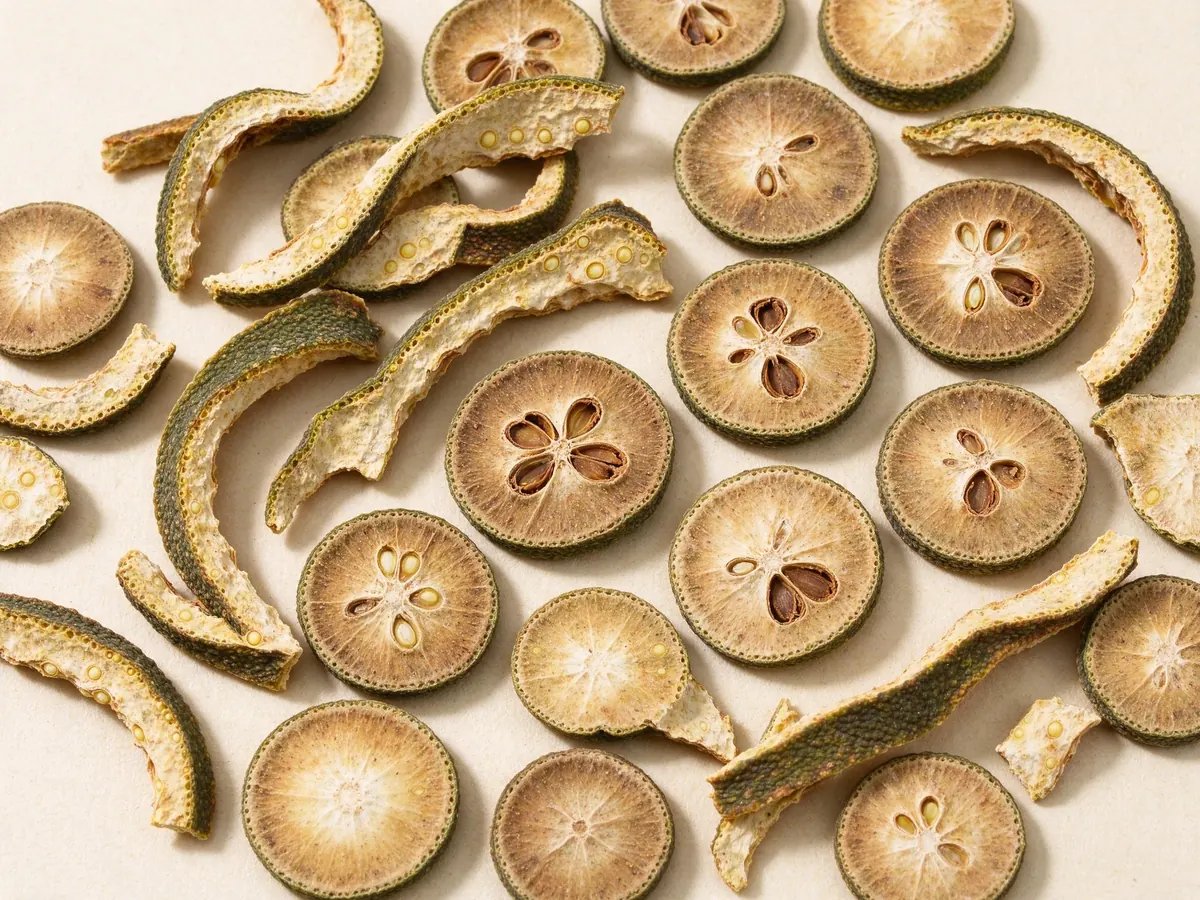
The fruit is hemispherical, rarely spherical,, with a dark green or brown pericarp bearing granular protrusions and wrinkles, and a stalk scar or style remains.1
Actions
- Breaks up stagnant Qi and reduces accumulation. For epigastric or abdominal pain and distension, or indigestion with focal distension or gas.2
- Breaks Qi, reduces accumulation, transforms Phlegm and disperses focal distension. For food stagnation, focal distension and pain, constipation, Phlegm obstructing the chest and organ prolapse.1
Clinical applications
Focal distension and pain
For focal distension, swelling and pain from food stagnation and Qi obstruction.2
Constipation
For abdominal distension, pain and fullness from heat clumping with the stool, as in Minor Order the Qi Decoction.2
Food stagnation
For focal distension, swelling and pain with foul-smelling belching from food stagnation and Qi obstruction.2
Spleen deficiency with stagnation
For focal distension in the epigastrium and abdomen from Spleen and Stomach deficiency with food stagnation.2
Key combinations
With Hou Po for focal distension, swelling and pain from food stagnation and Qi obstruction.2
With Da Huang for abdominal distension, pain and fullness from heat clumping with the stool, as in Minor Order the Qi Decoction.2
With Shan Zha and Shen Qu for focal distension, swelling and pain with foul-smelling belching.2
With Bai Zhu for focal distension in the epigastrium and abdomen from Spleen and Stomach deficiency with food stagnation.2
Comparison with similar herbs
| Form | Key difference |
|---|---|
| Zhi Shi 枳实 (unripe) | The unripe fruit. It breaks up Qi, disperses clumps, promotes the dispersal of Phlegm and reduces focal distension.2 |
| Zhi Ke 枳壳 (almost ripe) | The almost ripe fruit of the same plant. It governs the chest, diaphragm, skin and body hair, while Zhi Shi governs the Heart, Spleen and Stomach.2 |
Processing and preparation
The fruit is cleaned of impurities, washed, softened, cut into thin slices and dried.1
The slices are irregular curved strips or round thin slices, with a dark green or brown outer rind, a yellowish-white to yellowish-brown mesocarp and brown oil cavities near the edge.1
The bran-fried form is made by stir-frying the slices until the colour darkens; it is darker, sometimes with scorch marks, and has a scorched aroma.1
Safety
Contraindications
It is used with caution in pregnancy and in Spleen and Stomach deficiency.2
Classical texts say it is especially forbidden in pregnancy.2
Use with caution
It only reduces and guides out, breaks up Qi and injures the true; it greatly injures the true basis, and if there is no excess pathogen it should not be used.2
Modern research
A review of Citrus species covers preclinical and clinical studies of their effects on key metabolic parameters.3
Preclinical studies reported that citrus essential oils and extracts improved insulin sensitivity, reduced body weight and lipid levels, and aided blood pressure regulation.3
Clinical trials showed significant improvements in metabolic markers after citrus-based interventions.3
Citrus aurantium is among the species reported to treat metabolic syndrome.3
Dose and administration
The official reference dose is 3-10 g.1
This is a reference range, not a safe upper limit.
Common questions
How does it differ from Zhi Ke?
They are the same plant at different stages: Zhi Shi is the unripe fruit and Zhi Ke the almost ripe. Zhi Ke governs the chest, diaphragm, skin and body hair, while Zhi Shi governs the Heart, Spleen and Stomach.2
Can it be used in pregnancy?
What is the bran-fried form?
Stir-frying the slices until the colour darkens gives a darker form, sometimes with scorch marks and a scorched aroma.1
References
- Chinese Pharmacopoeia Commission. Pharmacopoeia of the People's Republic of China, 2020 edition, Volume I. Beijing: China Medical Science Press; 2020. Part I, p. 258.
- Bensky D, Clavey S, Stöger E. Chinese Herbal Medicine: Materia Medica. Portable 3rd edition. Seattle: Eastland Press; 2015. pp. 550-551.
- Kumari P, Barbhuiya PA, Pathak MP. Therapeutic Potential of Citrus Species Against Metabolic Syndrome: Insights from Preclinical and Clinical Studies. Curr Nutr Rep. 2025;14(1):101. doi:10.1007/s13668-025-00691-8 pubmed.ncbi.nlm.nih.gov/40804580
Educational reference only. Not medical advice or an individual prescription. Consult a qualified practitioner before using any herb or treatment.