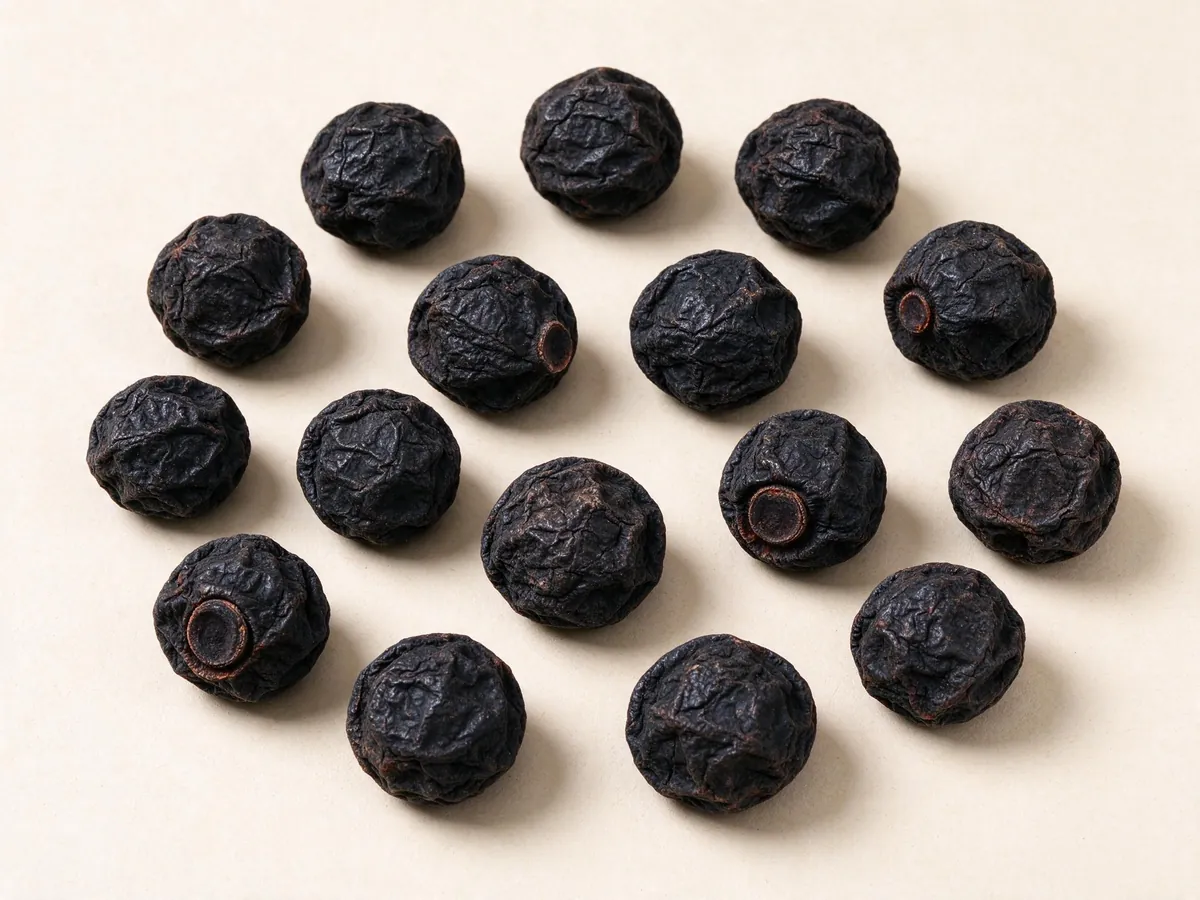
Overview
Wu Mei is sour and astringent, and neutral, entering the Liver, Spleen, Lung and Large Intestine.1
It restrains the Lungs, binds the Intestines, generates fluids and expels roundworms.1
Its sour, astringent nature restrains and inhibits, binding the Intestines and restraining the Lungs.1
Identity and sources
The medicinal material is the dried nearly ripe fruit of Prunus mume.1
The fruit is cleaned and dried as Wu Mei, softened and pitted as Wu Mei Rou, or charred as Wu Mei Tan.1
Actions
- Restrains the Lungs and stops cough. For chronic cough from Lung deficiency.2
- Binds the Intestines and stops diarrhoea. For chronic diarrhoea and dysentery, and for blood in the stool; the charred form can be used alone.2
- Generates fluids and alleviates thirst. For thirst from deficiency heat or Qi and Yin deficiency, and for wasting and thirsting disorder.2
- Expels roundworms and alleviates pain. For roundworm-induced vomiting and abdominal pain, and occasionally for abdominal pain and vomiting without parasites.2
Clinical applications
Chronic cough
For chronic cough from Lung deficiency.2
Chronic diarrhoea and dysentery
For incessant chronic diarrhoea or dysentery, and for blood in the stool.2
Thirst and wasting
For thirst from deficiency heat or Qi and Yin deficiency, and for wasting and thirsting disorder.2
Roundworm pain
For roundworm-induced vomiting and abdominal pain.2
Key combinations
With Xing Ren, Zhi Ban Xia and Ejiao, it is used for chronic cough from Lung deficiency.2
With Ophiopogon, Trichosanthes and Pueraria, it is used for thirst and irritability from injured fluids in heat disorders or wasting and thirsting.2
With Rehmannia, Dioscorea, Corni Fructus and Alismatis Rhizoma, it is used in a contemporary prescription for diabetes.2
With Zanthoxylum, ginger and Asarum in Mume Pill, it is used for roundworms causing abdominal pain, irritability and vomiting after eating.2
With Areca, it is used for abdominal pain from roundworms in the intestines or bile duct.2
Comparison with similar herbs
| Herb | Key difference |
|---|---|
| Wu Mei 乌梅 | Sour, astringent and neutral. Restrains the Lungs, binds the Intestines, generates fluids and expels roundworms.1 |
| He Zi 诃子 | Both are sour, binding herbs that restrain Lung Qi for chronic cough from Lung deficiency and enter the Large Intestine for long-term diarrhoea and dysentery.2 |
Processing and preparation
Wu Mei is cleaned of impurities, washed and dried.1
Wu Mei Rou is made by moistening the clean fruit with water or steaming it until soft, then removing the pit.1
Wu Mei Tan is made by stir-frying the clean fruit until the skin and flesh swell, with a scorched black surface.1
Safety
Contraindications
Internal heat from excess with stagnation, and unresolved exterior disorders.2
Modern research
A review covers the long East Asian culinary and medicinal use of Prunus mume fruit extracts.3
The extracts show hepatoprotective, anti-inflammatory, antioxidative and antibacterial effects, as well as anticancer properties.3
The extract MK615 inhibits proliferation and induces apoptotic death in cancer cell lines from solid and haematological tumours.3
Dose and administration
The official reference dose is 6-12 g.1
This is a reference range, not a safe upper limit.
Common questions
What is Wu Mei used for?
It restrains the Lungs for chronic cough, binds the Intestines for chronic diarrhoea and dysentery, generates fluids for thirst, and expels roundworms.2
How is it different from He Zi?
Both restrain Lung Qi and treat chronic diarrhoea, but He Zi also binds the Intestines.2
When should it be avoided?
It is contraindicated in internal heat from excess with stagnation and in unresolved exterior disorders.2
References
- Chinese Pharmacopoeia Commission. Pharmacopoeia of the People's Republic of China, 2020 edition, Volume I. Beijing: China Medical Science Press; 2020. Part I, p. 79.
- Bensky D, Clavey S, Stöger E. Chinese Herbal Medicine: Materia Medica. Portable 3rd edition. Seattle: Eastland Press; 2015. pp. 864-866.
- Bailly C. Anticancer properties of Prunus mume extracts (Chinese plum, Japanese apricot). J Ethnopharmacol. 2020;246:112215. doi:10.1016/j.jep.2019.112215 pubmed.ncbi.nlm.nih.gov/31491438
Educational reference only. Not medical advice or an individual prescription. Consult a qualified practitioner before using any herb or treatment.