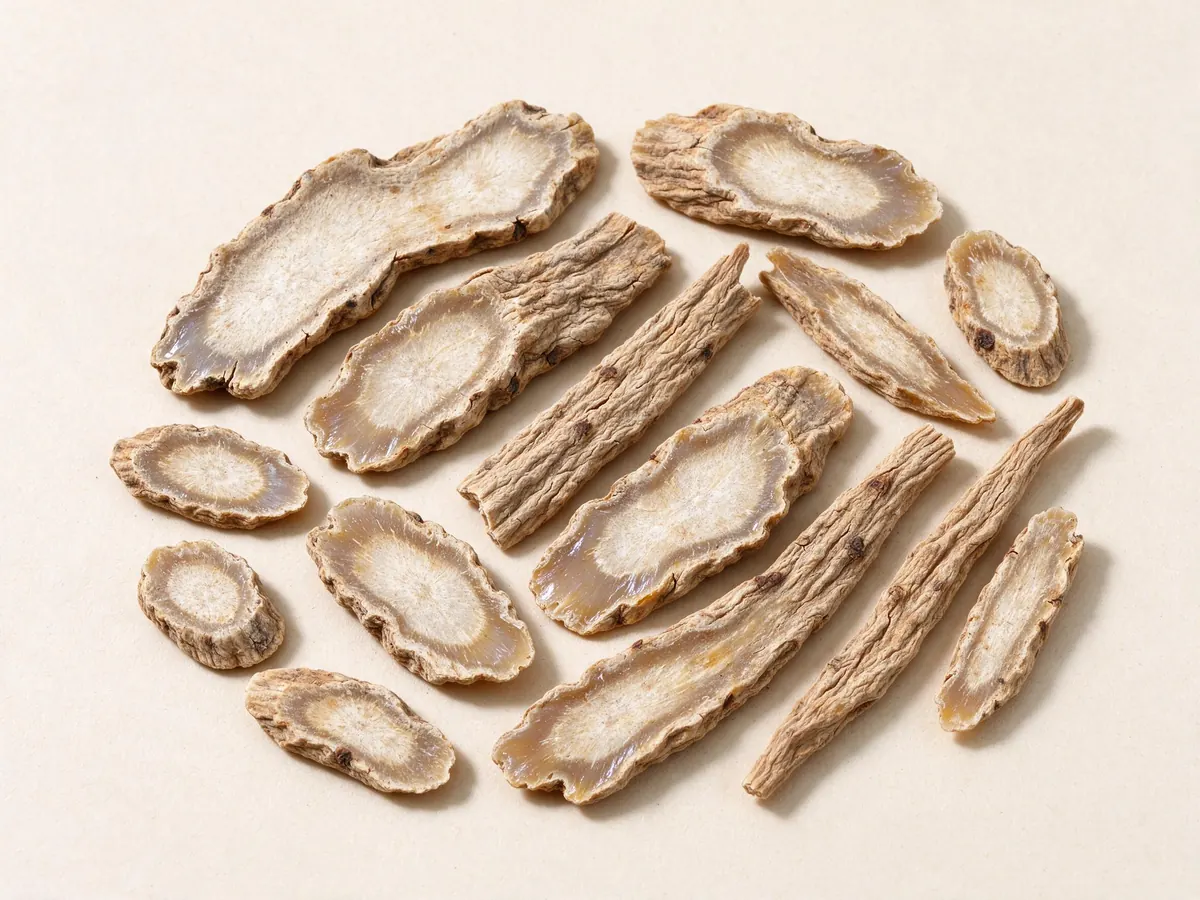
Overview
Bai Bu is sweet, bitter and slightly warm, entering the Lung.1,2
It moistens the Lungs, stops cough and kills parasites and lice.1,2
For internal use the prepared root is preferred, because fresh root causes mild adverse reactions in 20-30% of people.2
Identity and sources
The medicinal material is the dried tuberous root of Stemona sessilifolia, Stemona japonica or Stemona tuberosa.1
It is cleaned, moistened, cut into thick slices and dried, or honey-fried as Mi Bai Bu.1
Actions
- Moistens the Lungs and stops cough. For both acute and chronic cough, and especially for cough from deficiency, including Yin deficiency.2
- Expels parasites and kills lice. Applied topically as a tincture or decoction for head or body lice and fleas, as a wash for bacterial vaginosis, and as a nightly retained enema for pinworm.2
Clinical applications
Cough
For acute and chronic cough, especially cough from deficiency, including Yin deficiency.2
Lice and parasites
Topically for head and body lice, fleas, bacterial vaginosis and pinworm.2
Key combinations
With Cynanchum stauntonii (Bai Qian), it is used for chronic cough and wheezing from obstruction of Lung Qi by external or internal causes.2
With Ophiopogon, Rehmannia and Bletilla, it is used for cough from Lung heat injuring the Qi and fluids.2
With Fritillaria cirrhosa, it is used for cough and chest pain from Phlegm-heat.2
With Schizonepeta, Platycodon and Aster in Stop Coughing Powder, it is used for stubborn cough from Wind-Cold.2
With Sophora flavescens as an external wash, it is used for lice.2
Comparison with similar herbs
| Herb | Key difference |
|---|---|
| Bai Bu 百部 | Sweet, bitter and slightly warm. Stops cough (especially cold and deficient cough) and kills parasites.2 |
| Tian Men Dong 天冬 | Both are similar in shape and enter the Lungs to treat cough, but Tian Men Dong is sweet, moistening and cold and treats hot coughs, while Bai Bu is bitter, drying and warm, treats cold coughs, and also kills parasites.2 |
Processing and preparation
The root is cleaned, moistened, cut into thick slices and dried.1
Mi Bai Bu is made by stir-frying the slices with honey until they no longer stick to the hand.1
For internal use the prepared root is preferred over the fresh root.2
Safety
Contraindications
Loose stools from Spleen deficiency.2
Toxicity
Fresh root taken orally causes mild reactions in 20-30% of patients: burning in the chest, dryness of the mouth, nose or throat, dizziness, chest tightness, rapid breathing, anorexia, abdominal pain or diarrhoea.2
Ingestion should cease if any of these symptoms occur.2
Do not self-treat with this herb.
Modern research
A review of the genus Stemona identifies alkaloids and stilbenoids as its major bioactive substances.3
The extracts and compounds show insecticidal and antifeedant, antitussive, anti-inflammatory, anticancer, antimicrobial and antiviral activity.3
Dose and administration
The official reference dose is 3-9 g.1
Some clinical texts give 3-9 g.2
This is a reference range, not a safe upper limit.
Common questions
What is Bai Bu used for?
It moistens the Lungs and stops acute and chronic cough, especially deficient cough, and is applied topically for lice, fleas, bacterial vaginosis and pinworm.2
Why is the prepared root preferred?
Fresh root causes mild adverse reactions in 20-30% of people, including chest burning, dry mouth and throat, dizziness, chest tightness and diarrhoea.2
How is it different from Tian Men Dong?
Tian Men Dong is sweet, moistening and cold and treats hot coughs; Bai Bu is bitter, drying and warm, treats cold coughs and also kills parasites.2
References
- Chinese Pharmacopoeia Commission. Pharmacopoeia of the People's Republic of China, 2020 edition, Volume I. Beijing: China Medical Science Press; 2020. Part I, p. 132.
- Bensky D, Clavey S, Stöger E. Chinese Herbal Medicine: Materia Medica. Portable 3rd edition. Seattle: Eastland Press; 2015. pp. 448-450.
- Liu Y, Shen Y, Teng L, Yang L, Cao K, Fu Q, Zhang J. The traditional uses, phytochemistry, and pharmacology of Stemona species: a review. J Ethnopharmacol. 2021;265:113112. doi:10.1016/j.jep.2020.113112 pubmed.ncbi.nlm.nih.gov/32726680
Educational reference only. Not medical advice or an individual prescription. Consult a qualified practitioner before using any herb or treatment.