Overview
Shi Jun Zi is sweet and warm, entering the Spleen and Stomach.1,2
It kills parasites and strengthens the Spleen, and is used for roundworm and pinworm infections and for childhood nutritional impairment.1,2
The unprocessed fruit is toxic in overdose, and taking it with hot tea increases its toxic effects.2
Identity and sources
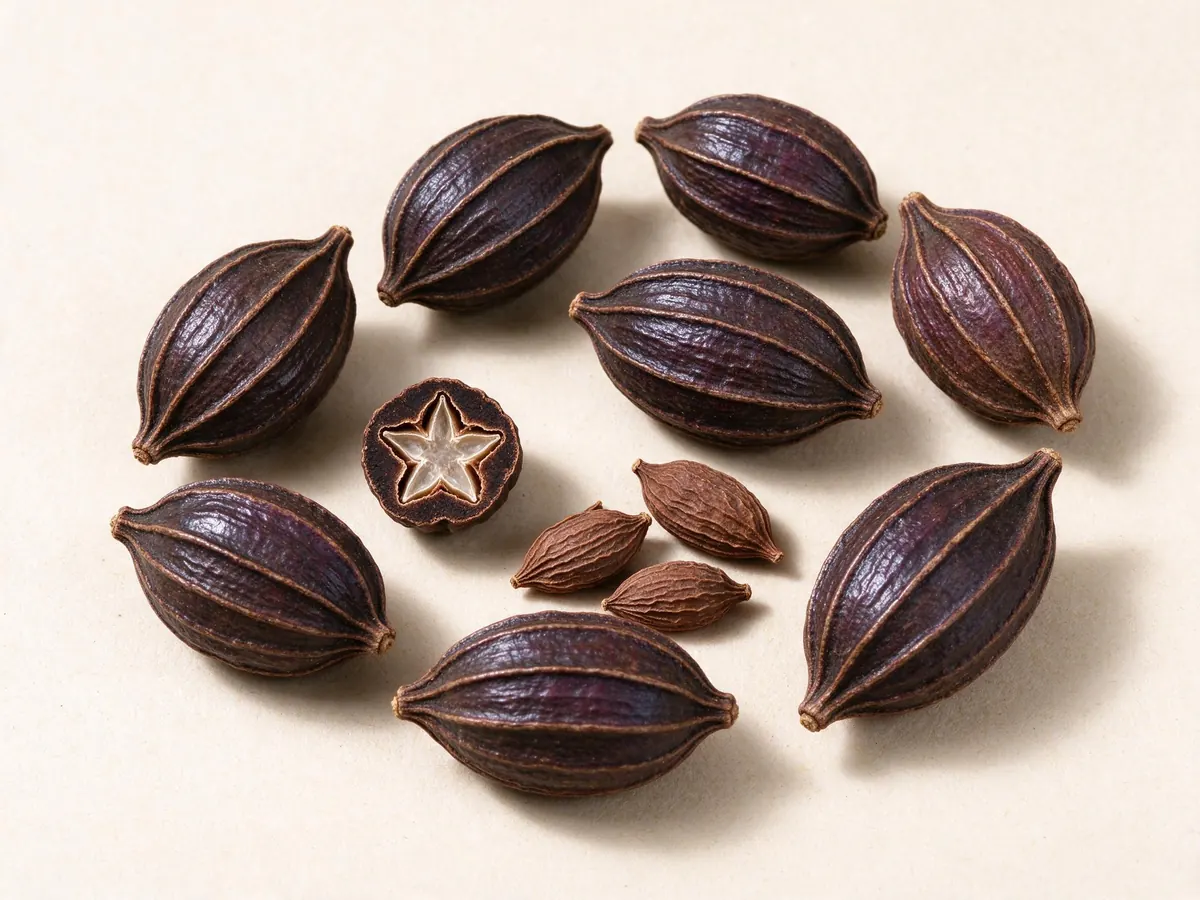
The medicinal material is the dried ripe fruit of Quisqualis indica.1
The whole fruit is crushed for decoction; the kernel is removed from the shell and may be stir-fried.1
Actions
Clinical applications
Roundworm and pinworm
For roundworm and pinworm infections, alone in mild cases.2
Childhood nutritional impairment
For childhood nutritional impairment with abdominal distention, poor appetite or weakness.2
Key combinations
With Areca and Melia Cortex, it is used to dislodge and expel roundworms.2
With Ulmus preparata, Carpesium and other herbs, the effect against roundworms is strengthened.2
With Stemonae Radix, Areca and Rhei as a topical application, it is used for pinworms.2
With Ji Nei Jin and Shen Qu, it is used for childhood nutritional impairment with significant food stagnation.2
With Rhei and Aloe, it is used for childhood nutritional impairment with constipation.2
With Ulmus preparata, Bai Zhu and Licorice in Cloth Sack Pill, it is used for childhood nutritional impairment due to parasites.2
With Picrorhiza and Myristica in Fat Baby Pill, it is used for chronic childhood nutritional impairment with abdominal distention and poor appetite.2
Comparison with similar herbs
| Form | Key difference |
|---|---|
| Shi Jun Zi 使君子 (whole fruit) | Sweet and warm. Kills parasites, treats childhood nutritional impairment and strengthens the Spleen; its sweetness makes it especially useful for children.2 |
| Shi Jun Zi Rou 使君子肉 (kernel only) | Its ability to kill parasites and reduce accumulation is stronger, but it is more toxic, readily causing nausea and dizziness.2 |
Processing and preparation
The whole fruit is cleaned and crushed when used.1
The kernel is removed from the shell, and the stir-fried kernel is prepared by dry-frying.1
Dry-frying until aromatic and chewing the seeds, or grinding them into powder with rice porridge or honey pills, reduces the side effects.2
Safety
Contraindications
Hot tea is forbidden with this herb because it causes diarrhoea.2
Children with Spleen and Stomach cold from deficiency should not take it, and it should not be used when there is no parasitic accumulation.2
Toxicity
Unprocessed fruit or excess dosage can cause abdominal discomfort, hiccough, vomiting, abdominal pain and diarrhoea, which usually resolve in a few hours.2
Overdose of the unprocessed fruit can cause dizziness, headache, haematuria, albuminuria, cyanosis, convulsion, low blood pressure, dyspnoea and, in severe cases, shock.2
Dry-frying reduces these effects, hot tea increases them, and rare allergic skin reactions have occurred.2
Do not self-treat with this herb.
Modern research
A repeated-dose toxicity study of a standardized Quisqualis indica extract gave rats 500, 1000 or 2000 mg/kg daily for 13 weeks.3
The no-observed-adverse-effect level of the extract was above 2000 mg/kg in both male and female rats.3
Dose and administration
The official dose is 9-12 g of the fruit, crushed and decocted, or 6-9 g of the kernel, usually in pills or powders.1
Some clinical texts give 9-12 g.2
This is a reference range, not a safe upper limit.
Common questions
What is Shi Jun Zi used for?
It kills roundworms and pinworms and strengthens the Spleen, and is used for childhood nutritional impairment with abdominal distention and poor appetite.2
Why is it given to children?
It is sweet, strengthens the Spleen and kills parasites, and its sweetness makes it especially useful for children.2
Why must hot tea be avoided?
Hot tea increases its toxic effects and can cause diarrhoea and belching.2
References
- Chinese Pharmacopoeia Commission. Pharmacopoeia of the People's Republic of China, 2020 edition, Volume I. Beijing: China Medical Science Press; 2020. Part I, pp. 224-225.
- Bensky D, Clavey S, Stöger E. Chinese Herbal Medicine: Materia Medica. Portable 3rd edition. Seattle: Eastland Press; 2015. pp. 997-999.
- Kim JW, Kim H, Park H, Yoon JS, Kim MI, Ko JW, Kim TW. Repeated oral dose toxicity and genotoxicity of a standardized Quisqualis indica extract. Toxicol Res. 2022;38(4):577-589. doi:10.1007/s43188-022-00140-6 pubmed.ncbi.nlm.nih.gov/36277358
Educational reference only. Not medical advice or an individual prescription. Consult a qualified practitioner before using any herb or treatment.