Overview
Chen Pi is bitter, acrid and warm, entering the Lung and Spleen.1
It regulates the Qi and strengthens the Spleen, dries Dampness and transforms Phlegm.1
It also enters the Stomach.2
Identity and sources
The medicinal material is the dried ripe peel of Citrus reticulata and its cultivated varieties.1
Two trade forms are used, Chen Pi and Guang Chen Pi; the peel is stripped from ripe fruit and dried in the sun or at low temperature.1
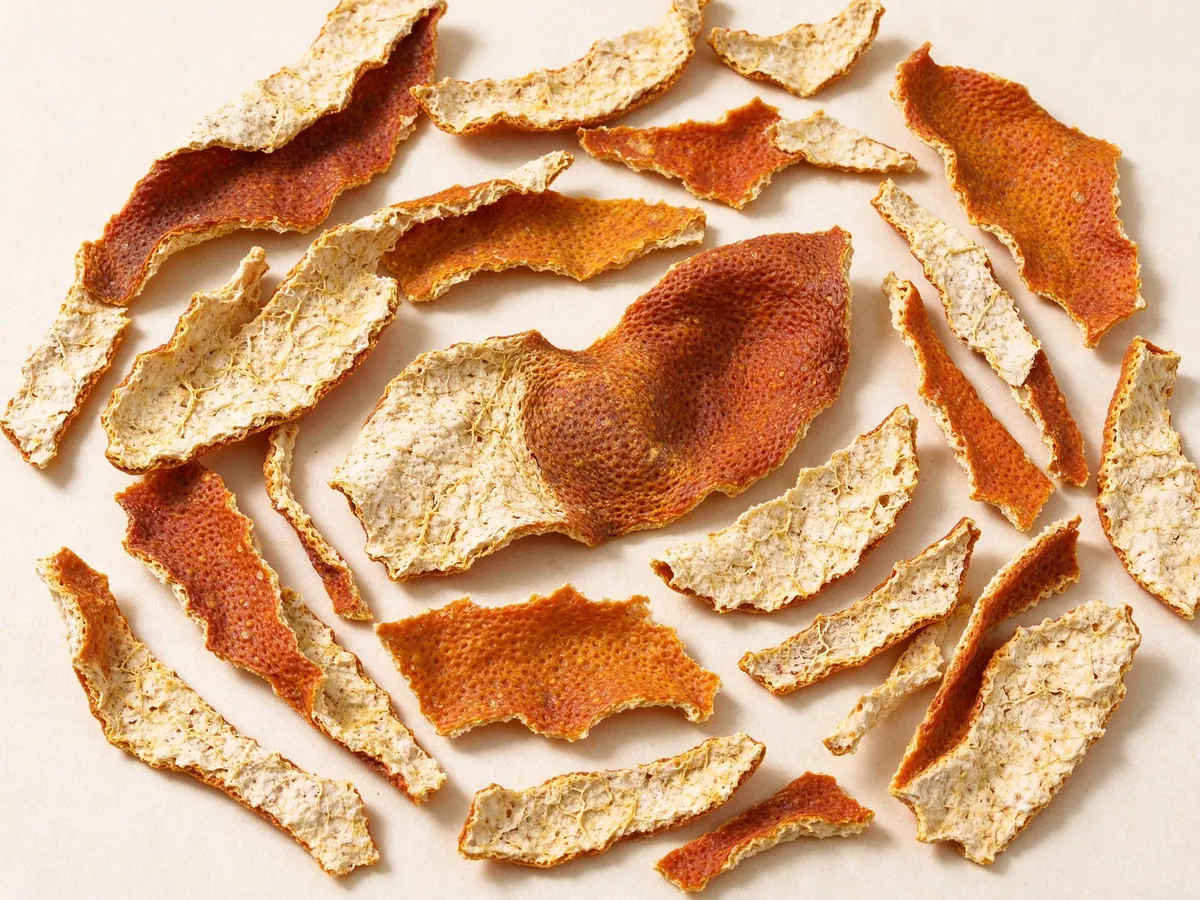
The peel is usually divided into several petals joined at the base and 1-4 mm thick, orange-red to red-brown outside with fine wrinkles and sunken dotted oil cavities.1
The inner surface is pale yellowish-white and coarse, with a yellowish-white or yellowish-brown network of vascular bundles.1
Actions
- Regulates the Qi, adjusts the middle and relieves the diaphragm. For Spleen or Stomach Qi stagnation with epigastric or abdominal distension, fullness, bloating, belching, and nausea and vomiting.2
- Dries Dampness and transforms Phlegm. For Phlegm-Dampness cough with a stifling chest and copious viscous sputum, and for Damp turbidity obstructing the middle with a thick greasy tongue coating.2
- Helps prevent stagnation. It is used with tonifying herbs to stop their cloying nature from causing stagnation.2
Clinical applications
Stomach and Spleen Qi stagnation
It regulates the Qi, adjusts the middle and relieves the diaphragm, and is used for epigastric or abdominal distension, fullness, bloating, belching, and nausea and vomiting.2
Phlegm-Dampness cough
It dries Dampness and transforms Phlegm, and is used for a Phlegm-Dampness cough with a stifling sensation in the chest and copious, viscous sputum.2
Damp turbidity
For Damp turbidity obstructing the middle with a stifling chest, abdominal distension, loss of appetite, fatigue, loose stools and a thick greasy tongue coating.2
Mild conditions
Because its power to regulate the Qi and transform Phlegm is of moderate strength, it is most appropriate when the Dampness or Phlegm is not too intense.2
Key combinations
With Aurantii Fructus and Aucklandia for abdominal distension, fullness and pain.2
With Hou Po and Cang Zhu for epigastric and abdominal fullness and distension, acid regurgitation, fatigue and loose stools from cold-Dampness stagnating in the Spleen and Stomach, as in Calm the Stomach Powder.2
With fresh ginger for vomiting and hiccough from disharmony of the Stomach Qi, as in Tangerine Peel Decoction.2
With bamboo shavings and Coptis for vomiting from Phlegm-heat.2
With Qing Pi for flank pain and chest and abdominal distension from stagnant Liver Qi.2
With Bai Zhu and Fang Feng for borborygmus, abdominal pain and diarrhoea from Liver attacking the Spleen, as in Important Formula for Painful Diarrhoea.2
With prepared Pinellia for a stifling chest and cough with excessive white, viscous sputum from Phlegm-Dampness obstruction.2
With Qi-tonifying herbs such as Codonopsis and Astragalus to prevent the bloating they can cause.2
Comparison with similar herbs
Processing and preparation
The peel is cleaned of impurities, sprayed with water, softened, cut into threads and dried.1
The prepared threads are irregular strips, orange-red to red-brown outside with fine wrinkles and sunken oil cavities, and pale yellowish-white and coarse inside.1
It is stored in a cool, dry place and protected from mould and insects.1
Safety
Use with caution
It is an acrid, dispersing, bitter and drying substance, so it is used with caution in heat from excess and is unsuitable for dry coughs from Qi or Yin deficiency.2
Adverse effects
Long-term use can injure the primal Qi.2
Modern research
A review of the peel presents its anticancer, cardiovascular-protecting, gastrointestinal-modulating, antioxidant, anti-inflammatory and neuroprotective effects.3
The peel is extracted from Citrus reticulata cultivars and aged for more than three years.3
It is used as a functional ingredient in teas, porridges and traditional medicinal formulations.3
Dose and administration
The official reference dose is 3-10 g.1 The dose in Taiwan is 3-12 g.4
This is a reference range, not a safe upper limit.
Common questions
Does the flesh of the fruit act the same way?
No; the peel drives Qi downward to promote the movement of Phlegm, while the flesh of the fruit generates Phlegm and clusters Qi.2
Can it be used for a dry cough?
No; it is unsuitable for dry coughs from Qi or Yin deficiency, and long-term use can injure the primal Qi.2
References
- Chinese Pharmacopoeia Commission. Pharmacopoeia of the People's Republic of China, 2020 edition, Volume I. Beijing: China Medical Science Press; 2020. Part I, p. 199.
- Bensky D, Clavey S, Stöger E. Chinese Herbal Medicine: Materia Medica. Portable 3rd edition. Seattle: Eastland Press; 2015. pp. 510-513.
- Shi M, Guo Q, Xiao Z, Sarengaowa, Xiao Y, Feng K. Recent Advances in the Health Benefits and Application of Tangerine Peel (Citri Reticulatae Pericarpium): A Review. Foods. 2024;13(13). doi:10.3390/foods13131978 pubmed.ncbi.nlm.nih.gov/38998484
- Ministry of Health and Welfare. Taiwan Herbal Pharmacopoeia, 4th edition (English edition). Taipei; 2022, with 2025 amendments where cited. p. 310.
Educational reference only. Not medical advice or an individual prescription. Consult a qualified practitioner before using any herb or treatment.