Overview
Ban Xia is pungent, warm and toxic, entering the Spleen, Stomach and Lung.1,2 It dries Dampness, transforms Phlegm, sends rebellious Qi downward, stops vomiting and dissipates nodules.1
It is not taken raw. The raw rhizome cannot be given by mouth; it is processed before use.3,1
Identity and sources
The medicinal material is the rhizome of Pinellia ternata.2
Botany, sourcing and quality
The medicinal material is the dried tuber of Pinellia ternata, dug in summer and autumn, washed, peeled and sun-dried.1
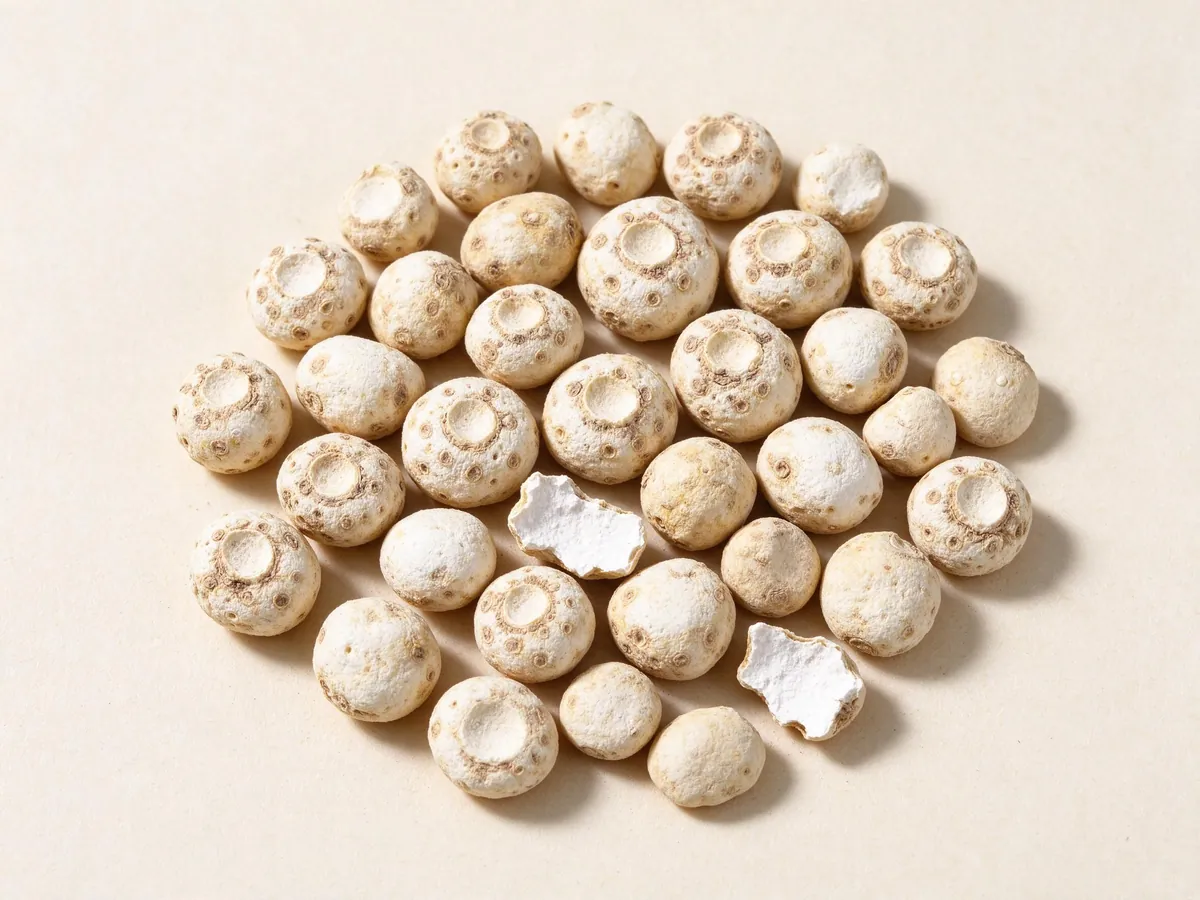
The tuber is subglobose, white or pale yellow, with a depressed stem scar and dotted root scars; the fracture is white and starchy, and the taste is acrid, numbing and throat-piercing.1
Good quality consists of large, brownish yellow, globular rhizomes with a powdery texture.2
Name and history
The herb first appears in the Divine Husbandman's Classic of the Materia Medica.2
Li Shizhen explains the name: it grows at the half of summer, so it is called Ban Xia; the names are Shou Tian (守田) and Shui Yu (水玉).4
Actions
- Dries Dampness, transforms Phlegm and descends rebellious Qi. For cough with copious sputum, especially cold-phlegm in the Lungs.2
- Stops vomiting and harmonises the Stomach. For nausea and vomiting with epigastric distension from Stomach disharmony.2
- Dissipates nodules and reduces clumps. For Phlegm nodules in the neck, such as goitre and scrofula, and for Phlegm lingering in the chest.2
Clinical applications
Cough with copious sputum
For cough with profuse sputum from cold-phlegm, it dries the Dampness and descends the Qi.2
Nausea and vomiting
For nausea and vomiting with epigastric distension it harmonises the Stomach.2
Nodules and lumps
For Phlegm nodules in the neck, such as goitre and scrofula, it dissipates the clumps.2
Phlegm-heat
Where the sputum is thick and yellow it is used with Scutellaria and Anemarrhena.2
For a stifling, distended epigastrium that is worse on pressure it is used with Coptis and Trichosanthes.2
For scrofula and a phlegm-dampness cough it is used with Fritillariae thunbergii Bulbus.2
For a productive cough with a stifling sensation in the chest from Phlegm-dampness obstruction it is used in Two Aged Herb Decoction.2
Patterns treated
Phlegm-Dampness Harassing Upward
For Phlegm-Dampness harassing upward with headache, dizziness, focal distention, chest and diaphragm stifling, a white greasy coating and a wiry, slippery pulse, as in Pinellia, White Atractylodes and Gastrodia Decoction.2
Key combinations
With Citri reticulatae pericarpium for epigastric and abdominal distension, nausea and vomiting, as in Two Aged Herb Decoction.2
With Asarum and Ginger for copious frothy sputum with cold, vomiting from cold, and thin mucus in the Lungs.2
With Huang Qin 黄芩 and Zhi Mu 知母 for thick yellow sputum with heat and vomiting from phlegm-heat in the Lungs.2
With Coptis and Trichosanthes for clumping of Phlegm and heat in the chest and epigastrium.2
Key formulas
With Chen Pi, for epigastric and abdominal distension, nausea and vomiting from Stomach disharmony, as in Er Chen Tang.2
With fresh ginger it forms Minor Pinellia Decoction, used for vomiting from cold and thin mucus.2
With Magnolia Bark it forms Pinellia and Magnolia Bark Decoction, used for Phlegm-induced cough, vomiting and epigastric distension.2
With Coptis and Trichosanthes it forms Minor Decoction for Pathogens Stuck in the Chest, for clumping of Phlegm and heat in the chest and epigastrium.2
With Gastrodia and Bai Zhu it forms Pinellia, White Atractylodes and Gastrodia Decoction, used for Phlegm-Dampness with internal Wind.2
Comparison with similar herbs
| Compared with | Key difference |
|---|---|
| Ban Xia 半夏 (raw rhizome) | Pungent, warm and toxic. Not given by mouth; the raw rhizome is processed first.1,3 |
| Fa Ban Xia 法半夏 | A processed product of the rhizome with its own official monograph.1 |
| Further processed forms | Prepared with adjuvants such as ginger juice, alum, liquorice or lime.3 |
| Tian Nan Xing 天南星 | Both dry Dampness and transform cold-Phlegm, but Tian Nan Xing also enters the Liver channel and is particularly good at eliminating wind-Phlegm.2 |
| Fu Ling 茯苓 | Both expel Phlegm-Dampness. Ban Xia dries and transforms Phlegm, draining the branch manifestation, the visible Phlegm, while Fu Ling strengthens the Spleen, expels Dampness and transforms Phlegm, treating the root.2 |
| Sheng Jiang 生姜 | Both harmonise the Stomach and settle nausea. Ban Xia dries Dampness and disperses Phlegm to stop the nausea, while Sheng Jiang warms the Stomach and awakens the Spleen.2 |
Processing and preparation
The processing is called Fuzhi, and the main adjuvants are ginger juice, alum, liquorice and lime.3
External use
For carbuncles and Phlegm nodules it is applied externally, ground and mixed with wine or rubbed with its juice.1
Safety
Contraindications
Dry cough from Yin deficiency, sore throat from excess fire, and bleeding.2
Pregnancy
Animal studies report pregnancy toxicity and teratogenicity from the raw rhizome.3
Incompatibilities
It is not to be combined with Chuan Wu, Zhi Chuan Wu, Cao Wu, Zhi Cao Wu or Fu Zi.1
Toxicity
The toxic components are needle-like calcium oxalate crystals and lectin proteins, and reported toxic effects include death in animals, inflammation, eye irritation, pregnancy toxicity, teratogenicity, organ toxicity, loss of voice and vomiting.3 Do not self-treat with this herb.
In the classical texts
味辛,平。主伤寒寒热,心下坚,下气,喉咽肿痛,头眩胸胀,咳逆肠鸣,止汗。Pungent, neutral; it treats cold damage with alternating chills and fever, hardness below the heart, and directs Qi downward, and it treats swelling and pain of the throat, dizziness and chest distension, cough with counterflow and bowel rumbling, and it stops sweating.5
生微寒、熟温,有毒。Raw, it is slightly cold; prepared, it is warm; it is toxic.6
生令人吐,熟令人下。用之汤洗,令滑尽Raw it makes people vomit; prepared it makes people purge; wash it with hot water until the slipperiness is gone.6
若修事半夏四两,用捣了白芥子末二两,头醋六两,二味搅令浊,将半夏投于中,洗三遍用之。To prepare four liang of Ban Xia, take two liang of pounded white mustard seed and six liang of strong vinegar; stir the two until cloudy, put the Ban Xia in, and wash it three times.7
半夏上有隙涎,若洗不净,令人气逆,肝气怒满。If the slime on the Ban Xia is not washed clean, it causes Qi counterflow and fullness with anger in the Liver Qi.7
Modern research
A systematic review of Pinelliae Rhizoma covers 107 compounds with anti-inflammatory, antitussive, antiemetic and other activities.8
Metabolic studies suggest cardiotoxicity and pregnancy toxicity for the raw rhizome.8
In a randomized controlled trial in advanced colorectal cancer, Hezhong granules (containing Pinellia) added to a 5-HT3-receptor antagonist and dexamethasone gave significant improvements in delayed nausea and vomiting, and no serious adverse events were attributed to the herbal medicine.9
Dose and administration
The official reference dose is 3-9 g of processed rhizome.1
This is a reference range for processed material, not a safe upper limit, and it does not make the raw rhizome safe.
Common questions
Can Ban Xia be taken raw?
What must it not be combined with?
Chuan Wu, Zhi Chuan Wu, Cao Wu, Zhi Cao Wu and Fu Zi.1
References
- Chinese Pharmacopoeia Commission. Pharmacopoeia of the People's Republic of China, 2020 edition, Volume I. Beijing: China Medical Science Press; 2020. Part I, p. 124.
- Bensky D, Clavey S, Stöger E. Chinese Herbal Medicine: Materia Medica. Portable 3rd edition. Seattle: Eastland Press; 2015. pp. 445-450.
- Peng W, Li N, Jiang E, Zhang C, Huang Y, Tan L, Chen R, Wu C, Huang Q. A review of traditional and current processing methods used to decrease the toxicity of the rhizome of Pinellia ternata in traditional Chinese medicine. J Ethnopharmacol. 2022;36087845. doi:10.1016/j.jep.2022.115696 pubmed.ncbi.nlm.nih.gov/36087845
- Li Shizhen 李时珍. Ben Cao Gang Mu (Comprehensive Outline of the Materia Medica), Ming dynasty, 1578. Digital text: TCM-Ancient-Books corpus (github.com/xiaopangxia/TCM-Ancient-Books), from the Daizhige collection; library/text/bencao-gangmu/, full.txt, entries numbered in INDEX.txt. 草部, 半夏.
- Shen Nong Ben Cao Jing (Divine Husbandman's Classic of the Materia Medica), Eastern Han. Edition reconstructed by Sun Xingyan 孙星衍, Qing dynasty. Digital text: TCM-Ancient-Books corpus (github.com/xiaopangxia/TCM-Ancient-Books), from the Daizhige collection; library/text/shennong-bencao/, full.txt, entries numbered in INDEX.txt. 下品, 半夏.
- Ming Yi Bie Lu (Miscellaneous Records of Famous Physicians), compiled by Tao Hongjing 陶弘景, c. 500 CE. Digital text: TCM-Ancient-Books corpus (github.com/xiaopangxia/TCM-Ancient-Books), from the Daizhige collection; library/text/mingyi-bielu/, full.txt, entries numbered in INDEX.txt. 下品·卷第三, 半夏.
- Lei Xiao 雷敩. Lei Gong Pao Zhi Lun (Master Lei's Discourse on Processing Medicinals), Liu Song dynasty, 5th century CE. Digital text: TCM-Ancient-Books corpus (github.com/xiaopangxia/TCM-Ancient-Books), from the Daizhige collection; library/text/leigong-paozhi/, full.txt, entries numbered in INDEX.txt. 下卷, 半夏.
- Liang Z, Wei J, Chan S, Zhang S, Xu L, Shen C, Zhong Z, Wang Y. Pinelliae Rhizoma: a systematic review on botany, ethnopharmacology, phytochemistry, preclinical and clinical evidence. Chin J Nat Med. 2025;23(1):1-20. doi:10.1016/S1875-5364(25)60807-7 pubmed.ncbi.nlm.nih.gov/39855824
- Wu Z, Fu X, Jing H, Huang W, Li X, Xiao C, Li Z, You F. Herbal medicine for the prevention of chemotherapy-induced nausea and vomiting in patients with advanced colorectal cancer: a prospective randomized controlled trial. J Ethnopharmacol. 2024;325:117853. doi:10.1016/j.jep.2024.117853 pubmed.ncbi.nlm.nih.gov/38341113
Educational reference only. Not medical advice or an individual prescription. Consult a qualified practitioner before using any herb or treatment.