Overview
Mu Dan Pi is bitter, acrid and slightly cold, entering the Heart, Liver and Kidney.1,2 It clears heat from the Blood and invigorates the Blood to resolve stasis.1
It cools heat from either excess or deficiency, moves the Blood without injuring it, and clears lurking fire from the Blood.2
Because it moves the Blood gently, it can be used where the Blood or Yin must not be injured.2
Identity and sources
The medicinal material is the dried root bark of Paeonia suffruticosa.1
It is bitter, acrid and slightly cold, entering the Heart, Liver and Kidney.1,2
Actions
- Clears heat from the Blood and cools the Blood. For heat that has entered the nutritive and blood levels, with rash, nosebleed and spitting of blood.1
- Cools heat from deficiency. For fever at night that clears by morning, and for steaming bone disorder without sweating.2,1
- Invigorates the Blood and resolves stasis. For closed periods, menstrual pain, pain from injury and swellings.1
- Clears ascending Liver fire. For headache, eye pain, flank pain, flushing and dysmenorrhoea.2
- Drains pus and reduces swelling. Used topically for firm, non-draining sores, or internally for Intestinal abscess.2
Clinical applications
Heat in the Blood
For heat that has entered the nutritive and blood levels, with rash, nosebleed and spitting of blood.1
Deficiency fire
For night fever that clears by morning, and for steaming bone disorder without sweating.1
Pain from stasis
For bruises and pain after trauma it moves the Blood, and for amenorrhoea and abdominal pain from stasis it does the same.2
Rising Liver fire
For headache, eye pain, flank pain, flushing and dysmenorrhoea, it clears the ascending fire.2
Key combinations
With Persicae Semen and Cinnamomi Ramulus for bruises and pain from injury, and for menstrual pain from stasis.2
With Olibanum, Myrrha and Sappan Lignum for swelling and pain from Blood stasis.2
With Gardenia, Chai Hu 柴胡 and Bai Shao 白芍 in Augmented Rambling Powder, it is used where constrained fire has become Liver fire.2
With Chrysanthemum for dizziness and red, swollen eyes from ascending Liver fire.2
With Cinnamomi Ramulus, it is used for chest and abdominal pain from Blood stasis obstructing the channels.2
With Rhei Radix et Rhizoma and Benincasae Semen in Rhubarb and Moutan Decoction, it is used for abdominal pain, constipation and low-grade fever from Intestinal abscess.2
With Lonicerae Flos and Angelicae dahuricae Radix, it is used for carbuncles.2
With Chi Shao, the pair's ability to cool and invigorate the Blood is greatly enhanced, and it is the most frequently used pair for cooling the Blood and dispersing stasis.2
Comparison with similar herbs
| Herb | Key difference |
|---|---|
| Mu Dan Pi 牡丹皮 | Bitter, acrid and slightly cold. Clears heat from excess and from deficiency, clears lurking fire from the Blood, and moves the Blood gently.2 |
| Chi Shao 赤芍 | Cannot clear the heat of Yin deficiency from the Blood, only the heat of excess. Its Blood-moving action is stronger.2 |
| Sheng Di Huang 生地黄 | Both treat heat from Yin deficiency. Sheng Di Huang is sweet, cold and nourishes Yin, so heat eases as Yin returns; Mu Dan Pi is cool, aromatic and piercing and disperses heat to help the Yin recover. The two are often combined.2 |
Where the heat is from deficiency, Mu Dan Pi is the one that clears it; where the Blood must be moved strongly, Chi Shao is stronger.2
Processing and preparation
The bark is washed quickly, moistened and cut into thin slices, then sun-dried.1
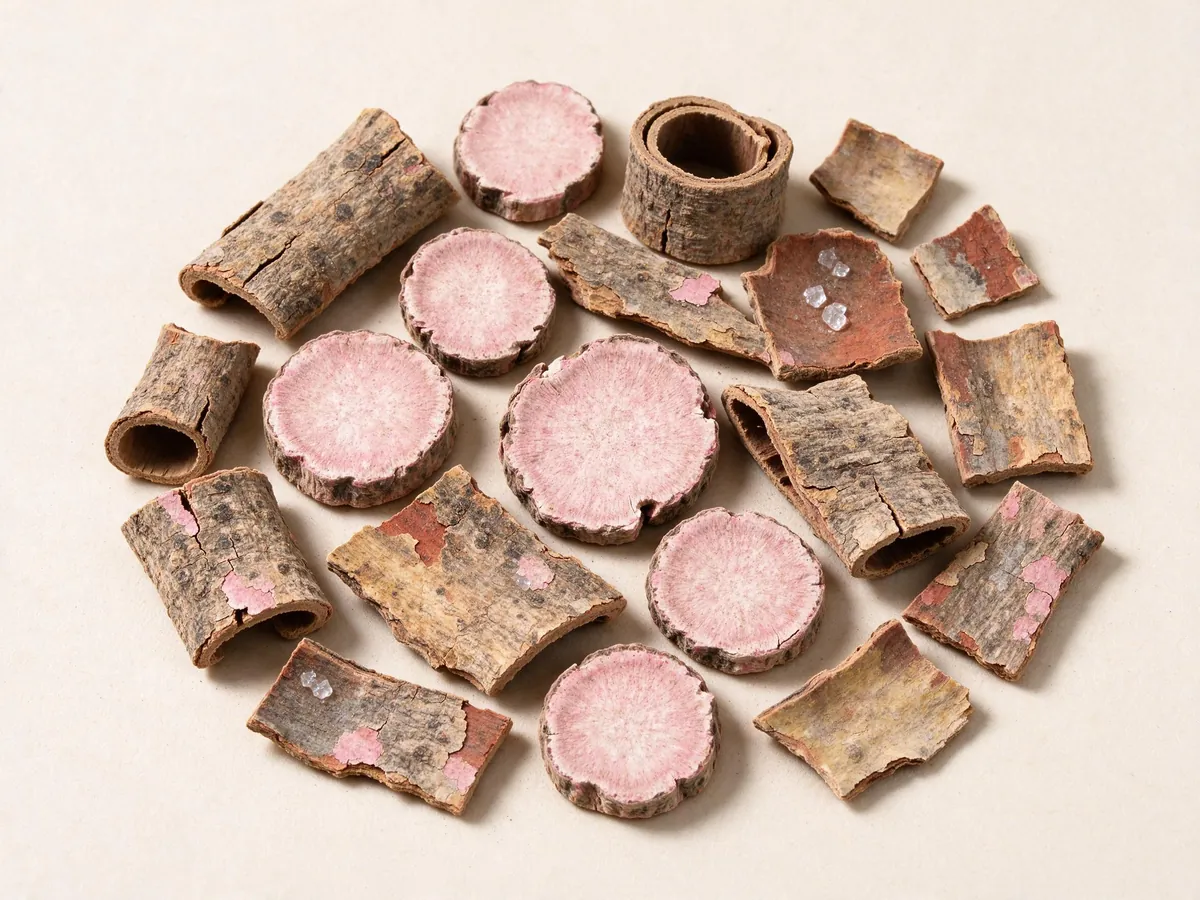
The slices are round or curled.1
Two grades are sold: the bark with cork attached, and the scraped bark, which is reddish-brown or pale greyish-yellow on the outside.1
Safety
Contraindications
Pregnancy, cold deficiency of the Stomach, and heavy or prolonged menstruation.2,1
Use with caution
It cannot be used for bleeding from Blood heat when there is no Blood stasis at the same time.2
Adverse effects
Its turbid aroma very easily brings on nausea.2
Modern research
A review of Moutan Cortex covers its origins and the anti-fibrotic pharmacology of paeonol and paeoniflorin.3
The review also covers patents and clinical research on the two compounds.3
Dose and administration
The official reference dose is 6-12 g.1
This is a reference range, not a safe upper limit.
Common questions
Is Mu Dan Pi the same as Chi Shao?
No. Chi Shao cannot clear the heat of Yin deficiency, only the heat of excess, though it moves Blood more strongly.2
Can it be given in pregnancy?
What does the cut surface look like?
It is pale pink and powdery, and the inner surface may show glistening crystals.1
References
- Chinese Pharmacopoeia Commission. Pharmacopoeia of the People's Republic of China, 2020 edition, Volume I. Beijing: China Medical Science Press; 2020. Part I, pp. 179-180.
- Bensky D, Clavey S, Stöger E. Chinese Herbal Medicine: Materia Medica. Portable 3rd edition. Seattle: Eastland Press; 2015. pp. 159-161.
- Zheng W, Li Y, Wu X, Yuan L. Moutan Cortex: a review of origins, phytochemical characterization strategies, and anti-fibrosis-related pharmacological mechanisms and applications. Planta Med. 2025;41082904. doi:10.1055/a-2706-7513 pubmed.ncbi.nlm.nih.gov/41082904
Educational reference only. Not medical advice or an individual prescription. Consult a qualified practitioner before using any herb or treatment.