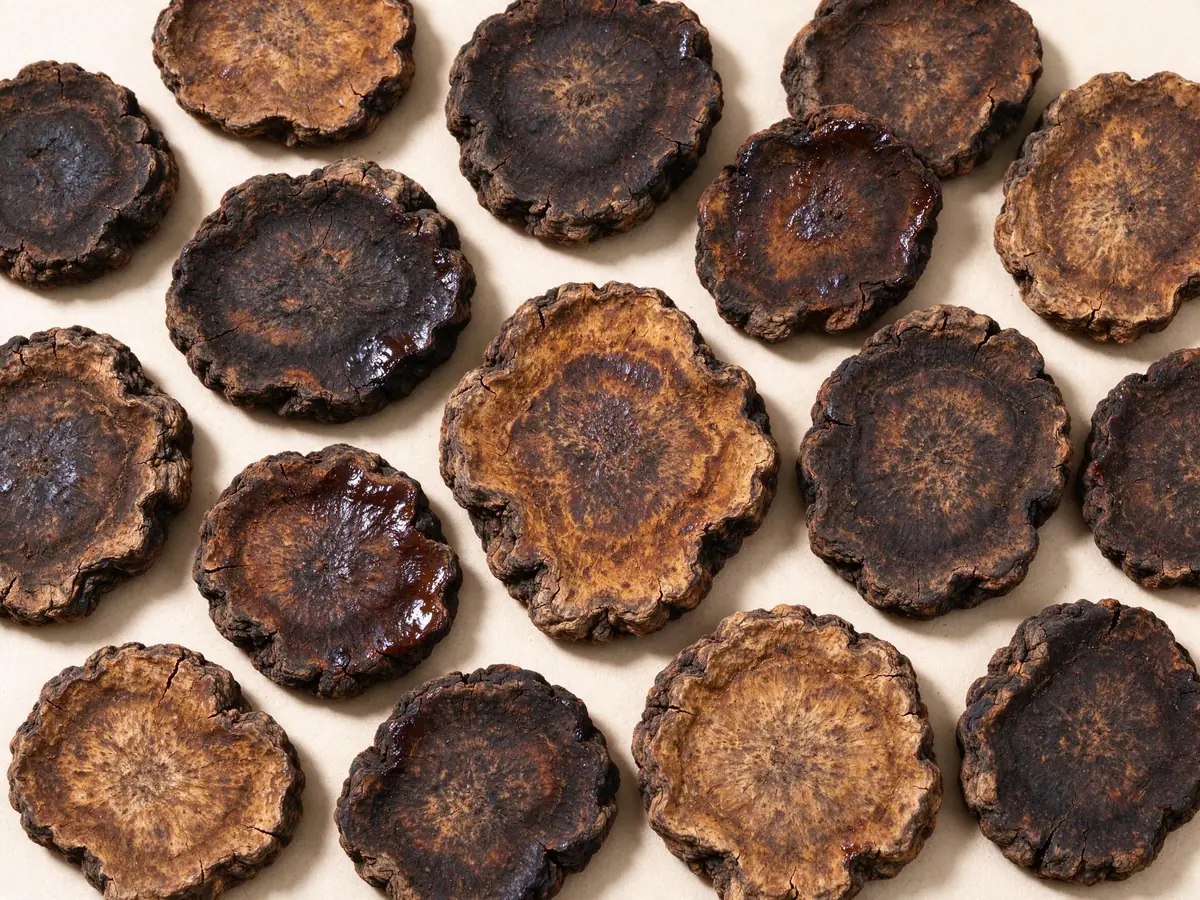
Overview
Sheng Di Huang is sweet and cold, entering the Heart, Liver and Kidney.1
Its coldness drains heat, while its cold, sweet and moistening qualities enrich the Yin and moisten dryness.2 It enters the blood level of the Heart and Liver, so it clears heat from the nutritive and blood levels.2
It is prescribed whenever there is exhaustion of Yin, deficiency of Blood, or insufficient fluids.2
It treats insatiable thirst, internal heat and hot flushes from Yin deficiency, and bleeding or rashes from heat in the Blood.2
Its cold, sweet and moistening quality is what makes it suit both fever and dryness.2
Identity and sources
The medicinal material is Rehmannia glutinosa.1
It is cold in nature and enters the Heart, Liver and Kidney.1,2
Actions
- Cools heat and the Blood. For warm-heat diseases where heat enters the nutritive level with very high fever, thirst and a scarlet tongue.2
- Stops bleeding from heat in the Blood. For haemorrhage due to heat entering the blood level.2
- Enriches the Yin and generates fluids. For insatiable thirst, internal heat and hot flushes from Yin deficiency.2
- Cools the Blood and resolves rash. For rashes due to heat in the blood.2
Clinical applications
Heat in the nutritive level
For high fever, thirst and a scarlet tongue in warm-heat disease, it drains the pathogenic heat from the nutritive level.2
Bleeding and rash
For haemorrhage due to heat entering the blood level.2
Thirst and fluid damage
For excessive thirst, irritability and a scarlet tongue from extreme heat in the nutritive level, and for throat pain with Yin deficiency, it generates fluids.2
Yin deficiency with heat
For heat smouldering in the Yin regions with night fever, morning coolness, emaciation and a red tongue, it enriches the Yin.2
For throat pain from Yin deficiency, and in wasting and thirsting disorder.2
For Stomach Yin deficiency with dry mouth, thirst and a red tongue, it is combined with Ophiopogonis Radix and Glehniae/Adenophorae Radix.2
It enters the blood level of the Heart and Liver and clears heat from the nutritive and blood levels.2
Key combinations
In Rhinoceros Horn and Rehmannia Decoction it is used for rashes due to heat in the Blood.2
With Mai Dong 麦冬 and Glehnia for dry mouth, thirst and a red tongue from Stomach Yin deficiency, it moistens the middle.2
With Anemarrhenae Rhizoma and Trionycis Carapax for heat smouldering in the Yin regions.2
With Amomi Fructus it is used for patients who suffer from both Blood and Spleen deficiency.2
Comparison with similar herbs
Safety
Contraindications
Significant Dampness from Spleen deficiency, and loose stools with abdominal fullness.2
Modern research
A review of Radix Rehmanniae calls the dried root non-toxic and widely used.4
It lists hemostatic, antioxidant, anti-osteoporosis, glucose-lowering, renal-protective and anti-inflammatory actions, and treats the dried root and the prepared root as two different processed products.4
It also names the diseases the root is used for in prescriptions, including anaemia, irregular menstruation and renal failure.4
Dose and administration
The official reference dose is 10-15 g.1
Common questions
Can it be given in loose stools?
It is contraindicated where there is significant Dampness from Spleen deficiency, or loose stools with abdominal fullness.2
References
- Chinese Pharmacopoeia Commission. Pharmacopoeia of the People's Republic of China, 2020 edition, Volume I. Beijing: China Medical Science Press; 2020. Part I, pp. 129-130.
- Bensky D, Clavey S, Stöger E. Chinese Herbal Medicine: Materia Medica. Portable 3rd edition. Seattle: Eastland Press; 2015. pp. 153-156.
- Ministry of Health and Welfare. Taiwan Herbal Pharmacopoeia, 4th edition (English edition). Taipei; 2022, with 2025 amendments where cited. p. 540.
- Li M, Jiang H, Hao Y, Du K, Du H, Ma C, Tu H, He Y. A systematic review on botany, processing, application, phytochemistry and pharmacological action of Radix Rehmnniae. J Ethnopharmacol. 2021;34767834. doi:10.1016/j.jep.2021.114820 pubmed.ncbi.nlm.nih.gov/34767834
Educational reference only. Not medical advice or an individual prescription. Consult a qualified practitioner before using any herb or treatment.