Overview
Han Fang Ji is bitter and cold, entering the Bladder and Lung.1
Another clinical text gives the Bladder, Spleen and Kidney channels and the acrid flavour.2
It clears Damp-heat, facilitates the fluid pathways and treats painful obstruction.2,1
It is the root of Stephania tetrandra, not the Aristolochia root also called Fang Ji.2
Identity and sources
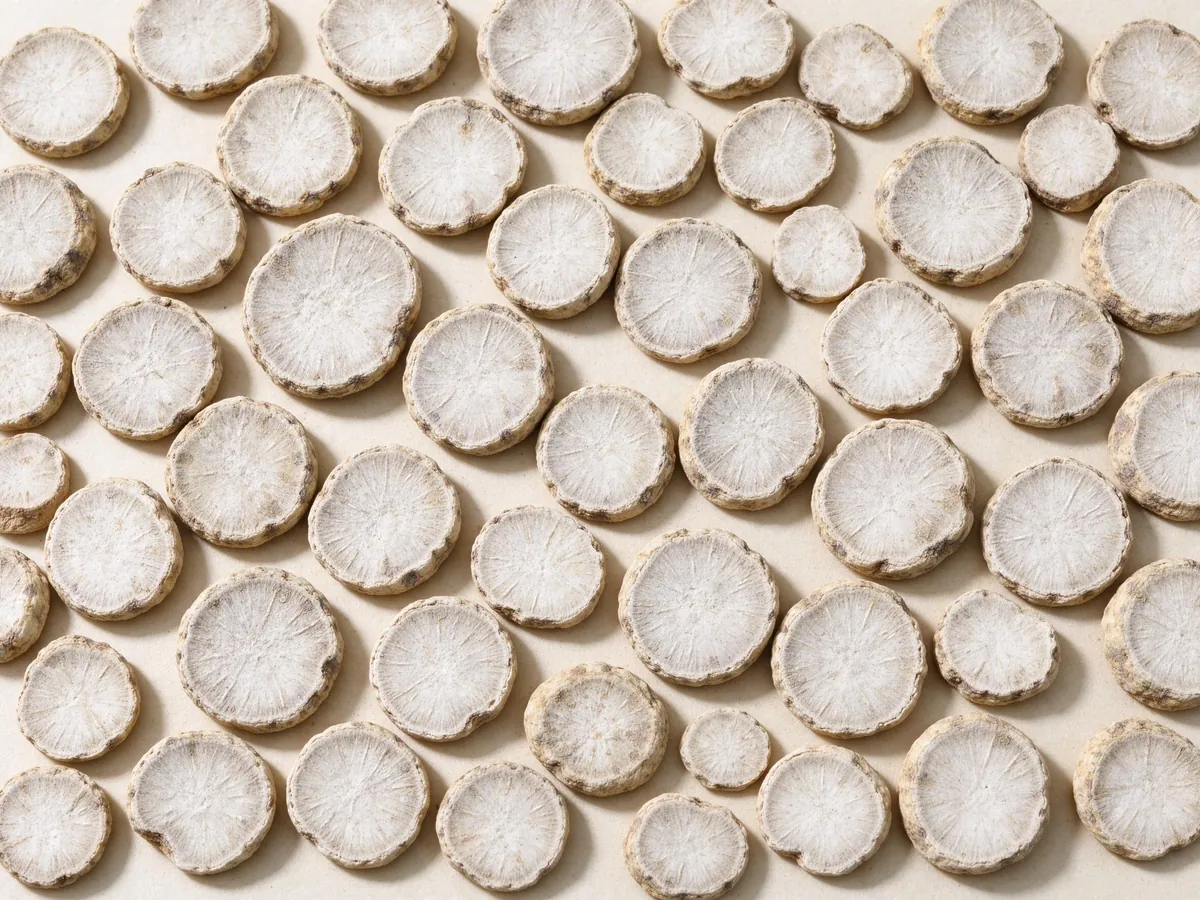
The medicinal material is the dried root of Stephania tetrandra.1
Actions
- Promotes urination and reduces oedema. For oedema, especially of the lower body, Damp leg qi, gurgling intestines, abdominal distention, and ascites from Dampness accumulating in the lower burner.2
- Expels Wind-Dampness and alleviates pain. For Wind-Damp-heat collecting in the channels with fever and red, swollen, hot, painful joints.2
Clinical applications
Oedema, leg qi and ascites
For oedema, especially of the lower body, Damp leg qi, abdominal distention and ascites from lower-burner Dampness.2
Wind-Damp-heat painful obstruction
For Wind-Damp-heat in the channels with fever and red, swollen, hot, painful joints.2
Oedema with urinary difficulty
For oedema with urinary dysfunction.2
Key combinations
With Poria and Cinnamomi Ramulus, it is used for oedema in constitutionally weak patients and for swelling from leg qi.2
With Huang Qi and Atractylodes macrocephala in Stephania and Astragalus Decoction, it is used for sweating, a heavy sensation in the body and superficial oedema from exterior deficiency with Wind-Dampness.2
With Lycopi Herba, it is used for oedema from Blood stasis blocking the collaterals.2
With Coix and Bombycis Faeces in Disband Painful Obstruction Decoction, it is used for Wind-Damp painful obstruction.2
With Achyranthes, Chaenomeles and Phellodendron, it is used for Damp-heat painful obstruction.2
With Notopterygium and Angelica pubescens, it is used for Wind-Cold-Damp painful obstruction.2
With Malva, Saposhnikovia and Plantago, it is used for oedema with urinary dysfunction.2
With Cinnamomi Ramulus and Poria, it is used for oedema.2
Comparison with similar herbs
| Herb | Key difference |
|---|---|
| Han Fang Ji 防己 | Bitter, acrid and cold. Better at removing pathogenic water and expelling Wind, so it is best for oedema with abdominal distention, wheezing from Phlegm and thin mucus, and Wind-Damp painful obstruction.2 |
| Mu Tong 木通 | Both are very bitter and very cold, move downward, clear heat, facilitate the fluid pathways and open the orifices, and are used together for oedema and urinary difficulty from Damp-heat and for Wind-Damp painful obstruction. Mu Tong excels at clearing Heart and Small Intestine fire and moving Blood, for mouth and tongue ulcers, painful urination from Heart and Small Intestine fire, and amenorrhoea from Blood stasis.2 |
Processing and preparation
The root is cleaned, briefly soaked, washed, moistened, cut into thick slices and dried.1
Safety
Contraindications
Its bitter, cold nature readily injures the Stomach, so it is used with caution in Spleen and Stomach deficiency or Yin deficiency.2
Traditionally it is not used in Stomach deficiency, night sweats or spontaneous sweating with a bitter taste and dry tongue.2
Toxicity
Overdosage can cause vomiting, tremor, ataxia, hypertonicity, quadriplegia, convulsions and death from respiratory failure.2
Species warning
Do not substitute Aristolochiae fangchi Radix (Guang Fang Ji); it contains aristolochic acid and should not be used.2
Modern research
A review of Stephania tetrandra roots describes tetrandrine and fangchinoline as the dominant bisbenzylisoquinoline alkaloids.3
Tetrandrine inhibits colon cancer cell proliferation and tumour growth by inducing apoptosis and G1 arrest, and suppresses adhesion, migration and invasion.3
Fangchinoline inhibits breast cancer cell proliferation by inducing apoptosis and G1 arrest, and inhibits cell migration.3
Dose and administration
The official reference dose is 5-10 g.1
This is a reference range, not a safe upper limit.
Common questions
Which plant is Han Fang Ji?
Is Guang Fang Ji the same herb?
No. Guang Fang Ji is Aristolochiae fangchi Radix; it contains the nephrotoxin aristolochic acid and should not be used.2
What are its main uses?
It promotes urination and reduces oedema, and expels Wind-Dampness to relieve the pain of hot, swollen joints.2
How toxic is it?
Overdosage can cause vomiting, tremor, ataxia, convulsions and death from respiratory failure.2
References
- Chinese Pharmacopoeia Commission. Pharmacopoeia of the People's Republic of China, 2020 edition, Volume I. Beijing: China Medical Science Press; 2020. Part I, pp. 148-149.
- Bensky D, Clavey S, Stöger E. Chinese Herbal Medicine: Materia Medica. Portable 3rd edition. Seattle: Eastland Press; 2015. pp. 268-270.
- Chan EWC, Wong SK, Chan HT. An overview on the chemistry, pharmacology and anticancer properties of tetrandrine and fangchinoline (alkaloids) from Stephania tetrandra roots. J Integr Med. 2021;19(4):311-316. doi:10.1016/j.joim.2021.01.001 pubmed.ncbi.nlm.nih.gov/33583757
Educational reference only. Not medical advice or an individual prescription. Consult a qualified practitioner before using any herb or treatment.