Overview
He Shi is bitter, acrid and neutral, and slightly toxic, entering the Spleen and Stomach.1,2
It kills intestinal parasites and relieves the abdominal pain they cause.1,2
Side effects can occur even within the normal dose, and overdose can cause poisoning.2
Identity and sources
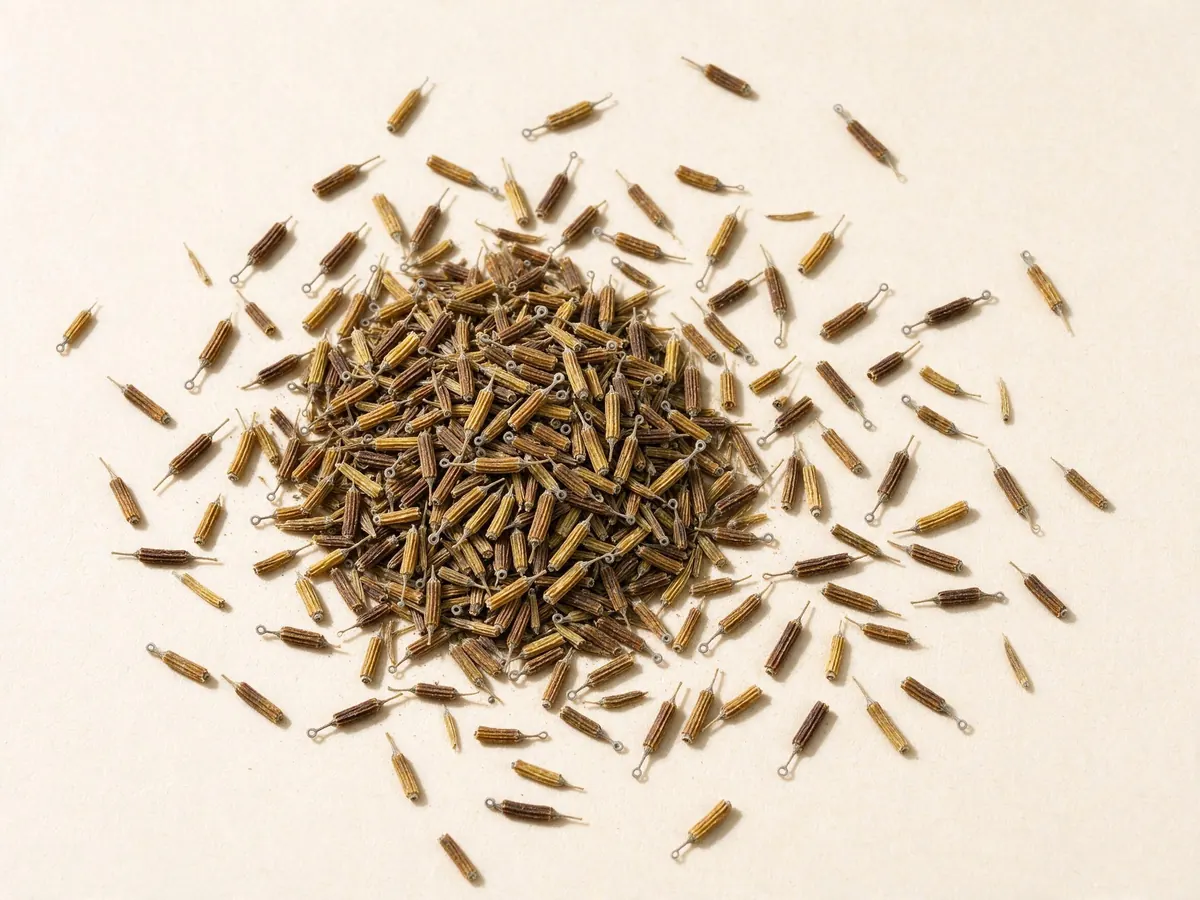
The medicinal material is the dried ripe fruit of Carpesium abrotanoides.1
Northern He Shi, from Carpesium abrotanoides, is better for expelling parasites, especially tapeworms.2
Southern He Shi is a different product, the seed of the wild carrot (Carota Fructus).2
Actions
- Kills parasites and alleviates pain. For many disorders due to intestinal parasites, primarily abdominal pain from roundworms, pinworms, hookworms or tapeworms.2
- Regulates rebellious Qi and resolves Phlegm. It enters the terminal Yin Liver channel, regulates rebellious Qi and treats congealed Phlegm and Qi stagnation throughout the body.2
Clinical applications
Parasite abdominal pain
For abdominal pain caused by roundworms, pinworms, hookworms or tapeworms.2
Vaginal itching
As a steam and wash for vaginal itching.2
Malaria and sores
It stops malarial disorders and is applied topically to noxious sores.2
Key combinations
With Areca, Quisqualis and Melia Cortex in Dissolve Parasites Pill, it is used to dislodge and expel roundworms, pinworms, hookworms and tapeworms.2
With Sophora flavescens, Stemona and Cnidium, it is used as a steam and wash for vaginal itching.2
Comparison with similar herbs
Processing and preparation
The fruit is collected when ripe, sun-dried and cleaned of impurities.1
Northern Carpesium fruit is preferred for parasite expulsion, especially tapeworms.2
It is traditionally taken as a powder mixed with fatty meat juice, or in pills.2
Safety
Contraindications
Use with caution in weak or debilitated patients and during pregnancy.2
Adverse effects
Side effects can occur within the normal dose: dizziness, tinnitus, nausea, abdominal pain and diarrhoea, which resolve after the herb is stopped.2
Toxicity
Overdosage can cause poisoning with nausea, vomiting, headache, weakness of the extremities and, in severe cases, clonic convulsions.2
Do not self-treat with this herb.
Modern research
A review of Carpesium abrotanoides lists anthelmintic use against roundworms, tapeworms, hookworms and pinworms among its traditional applications.3
Its sesquiterpenes and other constituents have anti-inflammatory, cytotoxic, antimicrobial and insecticidal activity.3
Dose and administration
The official reference dose is 3-9 g.1
Some clinical texts give 3-9 g.2
This is a reference range, not a safe upper limit.
Common questions
What is He Shi used for?
It kills roundworms, pinworms, hookworms and tapeworms and relieves the abdominal pain they cause; it is also used as a wash for vaginal itching.2
How toxic is it?
Side effects can occur at normal doses, and overdose can cause nausea, vomiting, headache, weakness and clonic convulsions.2
What is southern He Shi?
It is the seed of the wild carrot (Carota Fructus), a different product from the Carpesium fruit.2
References
- Chinese Pharmacopoeia Commission. Pharmacopoeia of the People's Republic of China, 2020 edition, Volume I. Beijing: China Medical Science Press; 2020. Part I, p. 379.
- Bensky D, Clavey S, Stöger E. Chinese Herbal Medicine: Materia Medica. Portable 3rd edition. Seattle: Eastland Press; 2015. pp. 1003-1005.
- Ibrahim SRM, Fadil SA, Fadil HA, Hareeri RH, Abdallah HM, Mohamed GA. Ethnobotanical uses, phytochemical composition, biosynthesis, and pharmacological activities of Carpesium abrotanoides L. (Asteraceae). Plants (Basel). 2022;11(12):1598. doi:10.3390/plants11121598 pubmed.ncbi.nlm.nih.gov/35736748
Educational reference only. Not medical advice or an individual prescription. Consult a qualified practitioner before using any herb or treatment.