Overview
Ku Lian Pi is the dried stem bark or root bark of Melia toosendan or Melia azedarach.1,2 It is bitter, cold and toxic, and enters the Liver, Spleen and Stomach.3,2
Its main use is to kill and expel intestinal parasites, and it also clears Damp-heat.3,1 It is relatively strong and effective, and can be used by itself.1
Applied externally it treats tinea and scabies.1 Its bitter coldness can injure the digestion, and the bark is toxic to the stomach, liver and heart.1,2 It is not taken long-term.1
Identity and sources
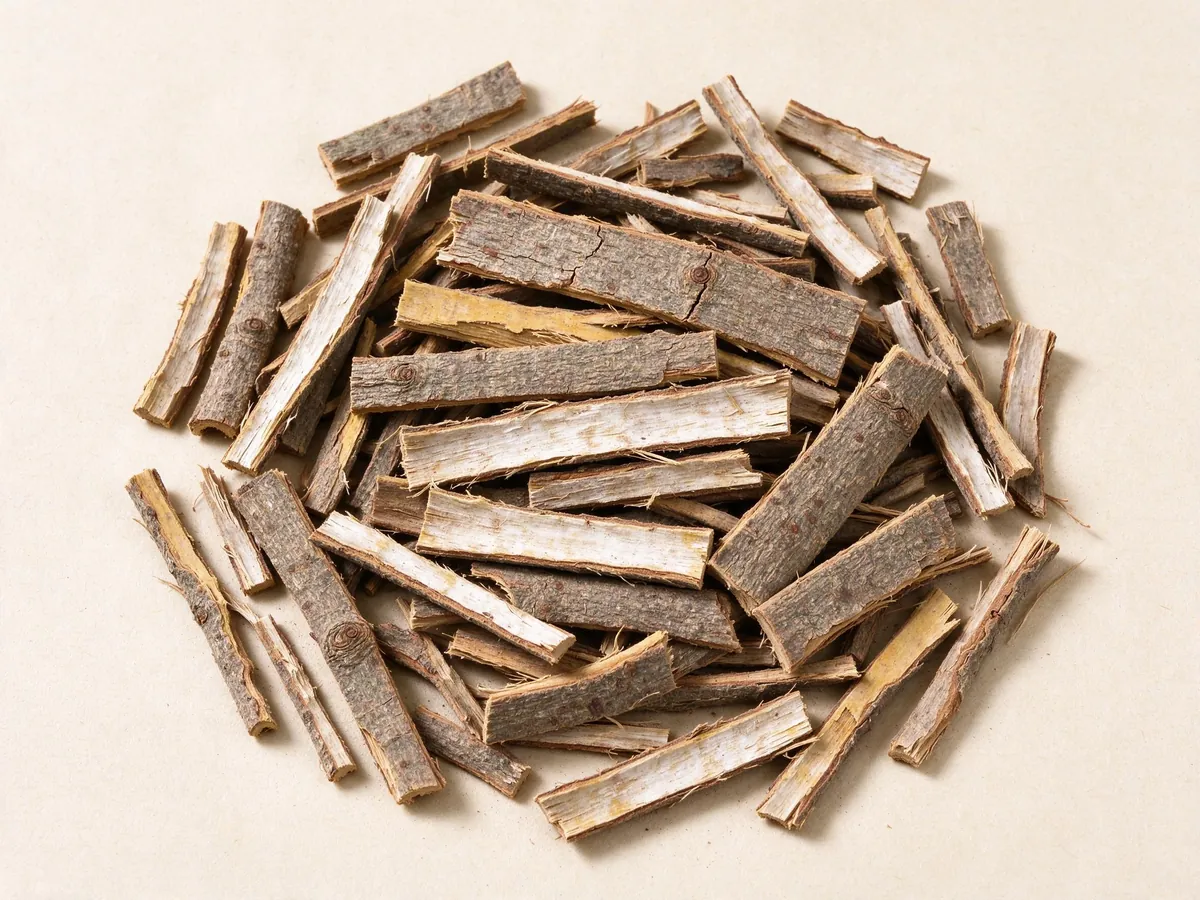
The medicinal material is the dried stem bark or root bark of Melia toosendan or Melia azedarach.1,2 Root bark is thick and fibrous, while stem bark has a thin, purplish brown skin with transverse white spots.1
The crude outer bark is more toxic than the inner bark and is removed completely during preparation.2
Actions
Clinical applications
Intestinal parasites
Taken internally, it is used for roundworm, hookworm and pinworm infestation.1
Skin conditions
Externally, it is used for tinea infections.1
Vaginal trichomoniasis
It has a traditional use in vaginal trichomoniasis.1
Key combinations
With Bing Lang 槟榔 and He Shi 鹤虱 in Hua Chong Wan, it forms a stronger combined treatment for intestinal parasites.1,2
With Bai Bu 百部 and Wu Mei 乌梅, it is used as a rectal enema for pinworm, repeated over several days.1,2
With Wu Yi 芜荑, Shi Jun Zi 使君子 and Bing Lang 槟榔, it is used in the same worm-expelling pill for roundworm.2
Comparison with similar herbs
| Herb | Key difference |
|---|---|
| Ku Lian Pi 苦楝皮 | Bitter, cold and toxic. Expels parasites and clears Damp-heat, but the same qualities can harm the Spleen and Stomach.1 |
| Shi Jun Zi 使君子 | Also expels parasites, particularly roundworm; Ku Lian Pi is bitter and cold, can harm the Spleen and Stomach, and is relatively toxic.1 |
Processing and preparation
The bark is cleaned, the coarse outer layer removed, softened, cut into strips and dried.3,2 The outer crude bark is the more toxic part and is not retained.2
It is ground into a powder and made into a thick paste with vinegar for external use.1
External use
Two external forms are described: a powder ground and made into a thick paste with vinegar, and a powder mixed with lard for scabies and itching lesions.1,3
The bark remains toxic, and side effects may occur even within the normal dosage range.1
Safety
Contraindications
Pregnancy, liver disease and heart disease.1 Not for long-term use.1
Use with caution
Impaired kidney function.3 Weak constitution, Spleen or Stomach deficiency, peptic ulcer and anaemia.1 Weak digestion is a particular reason to choose a substitute.1
Adverse effects
Dizziness, headache, vomiting, drowsiness and abdominal pain can occur even within the usual dose range.1 Allergic skin reactions have also been reported.1
Toxicity and overdose
Overdose can cause severe vomiting and diarrhoea, toxic hepatitis, bleeding from the abdominal viscera, respiratory paralysis and circulatory failure.1 The bark also damages the stomach and liver and can affect the heart.2
Suspected poisoning needs emergency care. Do not self-treat with this herb.
Modern research
Toosendanin is the principal toxic compound in the bark.4 In liver cell and mouse studies it triggers ferroptosis through ALOX5-mediated lipid peroxidation, and knocking down ALOX5 reduced the liver injury.4
A second study found that toosendanin disrupted lipid metabolism in hepatocytes and in mice by inhibiting the LXRalpha/Lipin1/SREBP1 pathway, with serum lipids falling aberrantly.5 A third reported that it causes unrepaired DNA damage and impairs autophagy, leading to cell cycle arrest.6
Toosendanin inhibited the metabolism of tamoxifen and raised its plasma concentration, with a half-maximal inhibitory concentration of 11.50 micromolar for CYP2D6.7 That is a pharmacokinetic interaction study, not a clinical trial.
A review catalogued 116 insecticidal triterpenes from 22 plant species in the Meliaceae.8 In liver cancer cell and mouse models, isotoosendanin from the bark inhibited proliferation and promoted apoptosis.9
Dose and administration
The official reference dose is 3-6 g.3 Some clinical texts use 4.5-9 g1 or, for the dried bark, 6-15 g, and 15-30 g of fresh bark.2
Common questions
Can it be used on the skin for fungal infections?
Is it safe to take at home for worms?
No. Side effects can occur even at the usual dose, and overdose can cause toxic hepatitis, bleeding and respiratory failure.1
Which herb is preferred for a child with worms?
Shi Jun Zi is preferred because Ku Lian Pi is bitter and cold, can harm the Spleen and Stomach, and is relatively toxic.1
References
- Bensky D, Clavey S, Stöger E. Chinese Herbal Medicine: Materia Medica. Portable 3rd edition. Seattle: Eastland Press; 2015. pp. 999-1001.
- Chang M, Jia M, Bare M, eds. Chinese Materia Medica. Beijing: People's Medical Publishing House; 2014. pp. 347-349.
- Chinese Pharmacopoeia Commission. Pharmacopoeia of the People's Republic of China, 2020 edition, Volume I. Beijing: China Medical Science Press; 2020. Part I, pp. 212-213.
- Ni J, Huang L, Tian Y, et al. Toosendanin induces hepatotoxicity by facilitating ALOX5-mediated lipid peroxidation and sensitizing cells to ferroptosis. Pharmaceuticals (Basel). 2025;18(7):1078. doi.org/10.3390/ph18071078
- Chen S, Ni J, Luo L, et al. Toosendanin induces hepatotoxicity via disrupting LXRalpha/Lipin1/SREBP1 mediated lipid metabolism. Food Chem Toxicol. 2024:114631. doi.org/10.1016/j.fct.2024.114631
- Lin Y, Zhang J, Gao X, et al. Toosendanin-induced liver damage through irreparable DNA damage and autophagy flow blockade. Phytomedicine. 2025:156586. doi.org/10.1016/j.phymed.2025.156586
- He X, Zhen Y, Lin P, Lin T, Chang Y. Drug-drug interaction between toosendanin and tamoxifen and its potential mechanism. 2026. doi.org/10.1159/000550093
- Lin M, Bi X, Zhou L, Huang J. Insecticidal triterpenes in Meliaceae: plant species, molecules, and activities: part II (Cipadessa, Melia). Int J Mol Sci. 2022;23(10):5329. doi.org/10.3390/ijms23105329
- Huang Y, Gao E, Liu Q, et al. Anti-hepatocarcinoma activity and mechanism of isosendanin and its novel structural analogues isolated from the bark of Melia azedarach L. Antioxidants (Basel). 2026;15(5):562. doi.org/10.3390/antiox15050562
Educational reference only. Not medical advice or an individual prescription. Consult a qualified practitioner before using any herb or treatment.