Overview
Bing Lang is acrid, bitter and warm, entering the Large Intestine and Stomach.1,2
It expels parasites, resolves accumulations, facilitates urination, resolves Phlegm and food stagnation, and directs Qi downward.1,2
It is toxic in overdose and contains arecoline, which is implicated in oral submucous fibrosis.2,3
Identity and sources
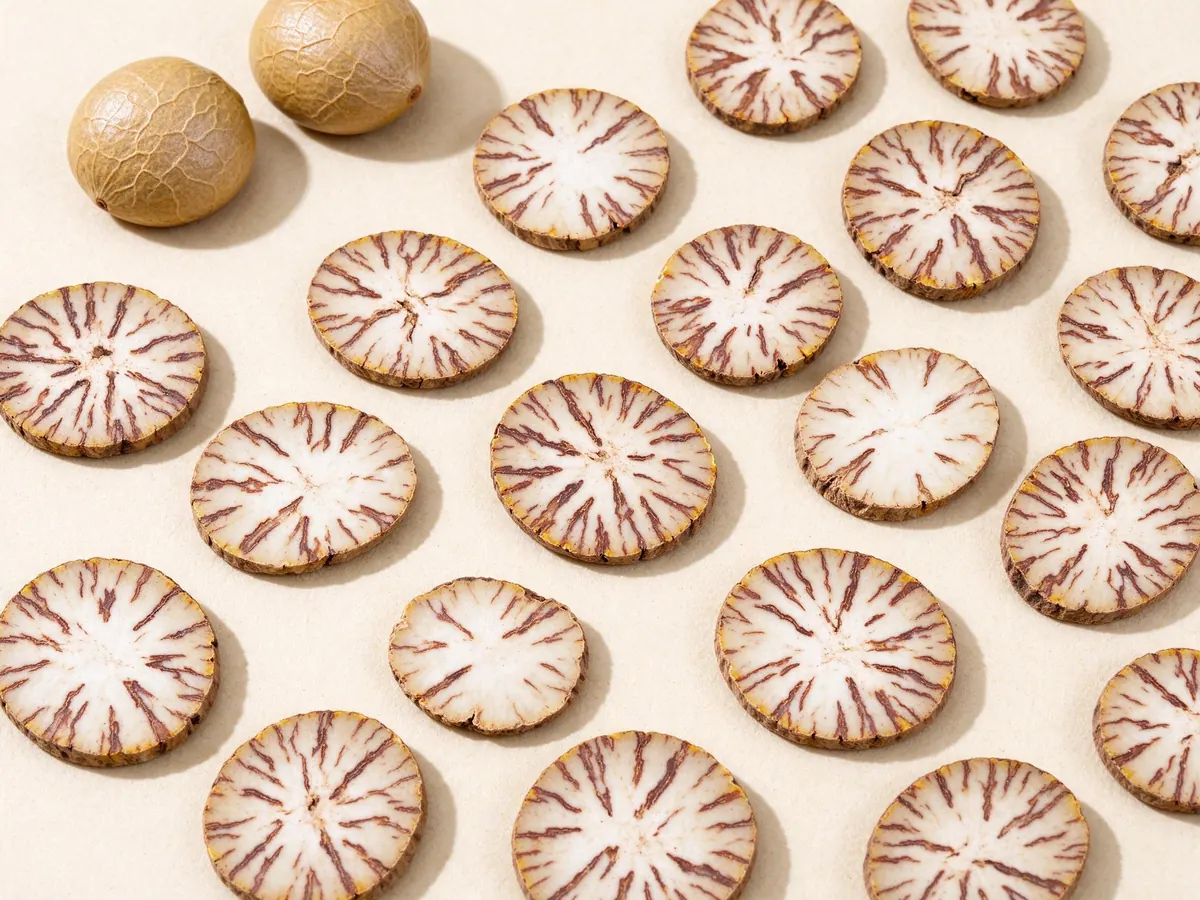
The medicinal material is the dried ripe seed of Areca catechu.1
The seeds are soaked, sliced and sun-dried as areca slices.2
Actions
- Kills parasites. Best for tapeworms, and also used for fasciolopsis, pinworms, roundworms and blood flukes; its downward draining helps expel the parasites.2
- Promotes Qi movement and reduces accumulation. For food accumulation and stagnant Qi with abdominal distention and constipation, leading stagnation out by mildly draining downward.2
- Promotes Qi movement and urination. For Damp leg qi and oedema.2
- Treats malarial disorders.2
Clinical applications
Intestinal parasites
For tapeworm, fasciolopsis, pinworm, roundworm and blood fluke infections.2
Food stagnation
For food accumulation and stagnant Qi with abdominal distention and constipation.2
Leg qi and oedema
For Damp leg qi and oedema.2
Malaria
For malarial disorders.2
Key combinations
With pumpkin seed and Aucklandia, it is used to dislodge and expel tapeworms.2
With Mume Fructus and Glycyrrhiza, it is used for fasciolopsiasis.2
With Carpesium and Melia in Dissolve Parasites Pill, it is used for a variety of intestinal parasites.2
With Pharbitis, it is used for accumulation due to intestinal parasites.2
With Aucklandia and Qing Pi in Aucklandia and Betel Nut Pill, it is used for food accumulation and Qi stagnation.2
With Bai Zhu, Mai Ya and Sha Ren, it is used for food stagnation in Spleen deficiency with indigestion and abdominal fullness.2
With Bai Shao, Aucklandia and Coptis in Peony Decoction, it is used for Damp-heat dysentery with tenesmus.2
With Evodia and Chaenomeles in Powder to Take at Cock's Crow, it is used for cold-Damp leg qi with swelling and pain.2
With Phytolacca, Akebia and Alismatis, it is used for oedema.2
With Dichroa and Tsaoko in Seven-Treasure Drink to Check Malarial Disorders, it is used for malaria with internal Phlegm-Dampness.2
Comparison with similar herbs
| Herb | Key difference |
|---|---|
| Bing Lang 槟榔 | Acrid, bitter and warm. Kills parasites and also directs Qi downward, resolves accumulations, facilitates urination and reduces Phlegm and food accumulation.2 |
| Nan Gua Zi 南瓜子 | Both have a good parasite-expelling action against tapeworms, roundworms and other intestinal parasites, and are combined to enhance it. Areca has a wider range of effects, including directing Qi downward, resolving accumulations, facilitating urination and reducing Phlegm and food accumulation.2 |
Processing and preparation
The clean seed is soaked, moistened, cut into thin slices and shade-dried.1
Stir-frying until slightly yellow gives Chao Bing Lang; stir-frying until scorched yellow gives Jiao Bing Lang.1
The seeds are also soaked, sliced and sun-dried as areca slices, or crushed into chunks.2
Safety
Contraindications
Use with caution where the middle Qi has collapsed.2
It is contraindicated in Qi deficiency, and is not used in Spleen and Stomach deficiency even when there is accumulation or stagnation; in dysentery it is used only when there is tenesmus.2
Toxicity
Overdosage (over 30 g) can cause salivation, nausea, vomiting, abdominal pain, palpitations, dizziness and convulsions.2
Arecoline is implicated in oral submucous fibrosis, and arecoline-treated oral fibroblasts show cell death and mitochondrial fission.3
Do not self-treat with this herb.
Modern research
A study of oral submucous fibrosis identifies arecoline and TGF-beta as key mediators of the disease.3
Arecoline-treated oral fibroblasts showed significant cell death, mitochondrial fission and a glycolytic metabolic profile.3
Dose and administration
The official reference dose is 3-10 g, and 30-60 g for tapeworm or fasciolopsis.1
Some clinical texts give 6-15 g.2
This is a reference range, not a safe upper limit.
Common questions
What is Bing Lang used for?
It kills intestinal parasites (especially tapeworm), resolves food accumulation and Qi stagnation, promotes urination for leg qi and oedema, and treats malaria.2
How toxic is it?
When should it be avoided?
It is contraindicated in Qi deficiency and in Spleen and Stomach deficiency, even with accumulation, and in dysentery it is used only with tenesmus.2
References
- Chinese Pharmacopoeia Commission. Pharmacopoeia of the People's Republic of China, 2020 edition, Volume I. Beijing: China Medical Science Press; 2020. Part I, pp. 380-381.
- Bensky D, Clavey S, Stöger E. Chinese Herbal Medicine: Materia Medica. Portable 3rd edition. Seattle: Eastland Press; 2015. pp. 1008-1010.
- Desai KM, Tadkalkar NA, Amin M, Kumar R, Rahman SU, Ponnusamy S, Angadi P, Liu W, Dayani RV, Kale AD, Slone J, Chandra D, Arany PR. TGF-beta1 directs TFAM-mediated mitochondrial reprogramming in oral submucous fibrosis. J Dent Res. 2026;105(8):1068-1078. doi:10.1177/00220345251394281 pubmed.ncbi.nlm.nih.gov/41366638
Educational reference only. Not medical advice or an individual prescription. Consult a qualified practitioner before using any herb or treatment.