Overview
Jiang Ban Xia is a processed product of the Pinellia rhizome.1
It is pungent and warm, entering the Spleen, Stomach and Lung.1
It warms the middle, transforms Phlegm and stops vomiting.1
Identity and sources
The medicinal material is the processed rhizome of Pinellia ternata.1,2
Actions
- Warms the middle, transforms Phlegm and stops vomiting.1
- Dries Dampness and transforms Phlegm. For cough with copious sputum from cold-Phlegm in the Lungs, especially Phlegm from Spleen Dampness.2
- Directs rebellious Qi downward and stops vomiting. For nausea and vomiting from cold, Phlegm-fluid, Stomach deficiency or Stomach heat.2
Clinical applications
Indications
It is used for vomiting from Phlegm-fluid and fullness in the epigastrium.1
Cough with copious sputum
For cough with copious sputum from cold-Phlegm or Spleen Dampness.2
Vomiting
For nausea and vomiting from cold, Phlegm-fluid, Stomach deficiency or Stomach heat.2
Key combinations
With Chen Pi, it is used for epigastric and abdominal distention, nausea and vomiting from Stomach disharmony, and for productive cough and chest stifling from Phlegm-Dampness, as in Two Aged Herb Decoction.2
With fresh ginger in Minor Pinellia Decoction, it is used for vomiting from cold and Phlegm-fluid.2
With Xi Xin and Gan Jiang, it is used for copious frothy sputum with signs of cold, vomiting from cold, and Phlegm-fluid in the Lungs.2
With Huang Qin and Zhi Mu, it is used for viscous yellow sputum with heat signs and vomiting from Phlegm-heat in the Lungs.2
With Huang Lian and Zhu Ru, it is used for vomiting from Stomach heat.2
With Perilla stem and Sha Ren, it is used for morning sickness.2
Comparison with similar herbs
| Form | Key difference |
|---|---|
| Ban Xia 半夏 (raw) | Pungent, warm and toxic; for internal use it is generally used after processing.1 |
| Fa Ban Xia 法半夏 | Processed with a liquorice decoction and lime solution, at 15 kg liquorice and 10 kg lime per 100 kg. Its drying action is more moderate than the other forms, so it is used for Spleen deficiency with Dampness and internal Phlegm, and for both cold deficiency and Damp-heat.1,2 |
| Jiang Ban Xia 姜半夏 | Boiled with fresh ginger and alum, at 25 kg ginger and 12.5 kg alum per 100 kg. The ginger reduces toxicity and changes the nature from fiercely acrid-hot to warm and drying, to dry Dampness, transform Phlegm, direct Qi downward and stop nausea; it is best for Phlegm from Spleen deficiency or cold-Phlegm cough.1,2 |
| Qing Ban Xia 清半夏 | Soaked or boiled in 8% alum solution, using 12.5 kg alum per 100 kg. This greatly reduces the acrid, drying properties, making it more suitable for weak patients with copious Phlegm and relatively mild cold and Dampness.1,2 |
Processing and preparation
The clean rhizome is soaked until no dry core remains, then boiled through in a decoction of sliced fresh ginger with alum added.1
Every 100 kg of clean rhizome is processed with 25 kg of fresh ginger and 12.5 kg of alum.1
It is then dried, or cut into thin slices and dried.1
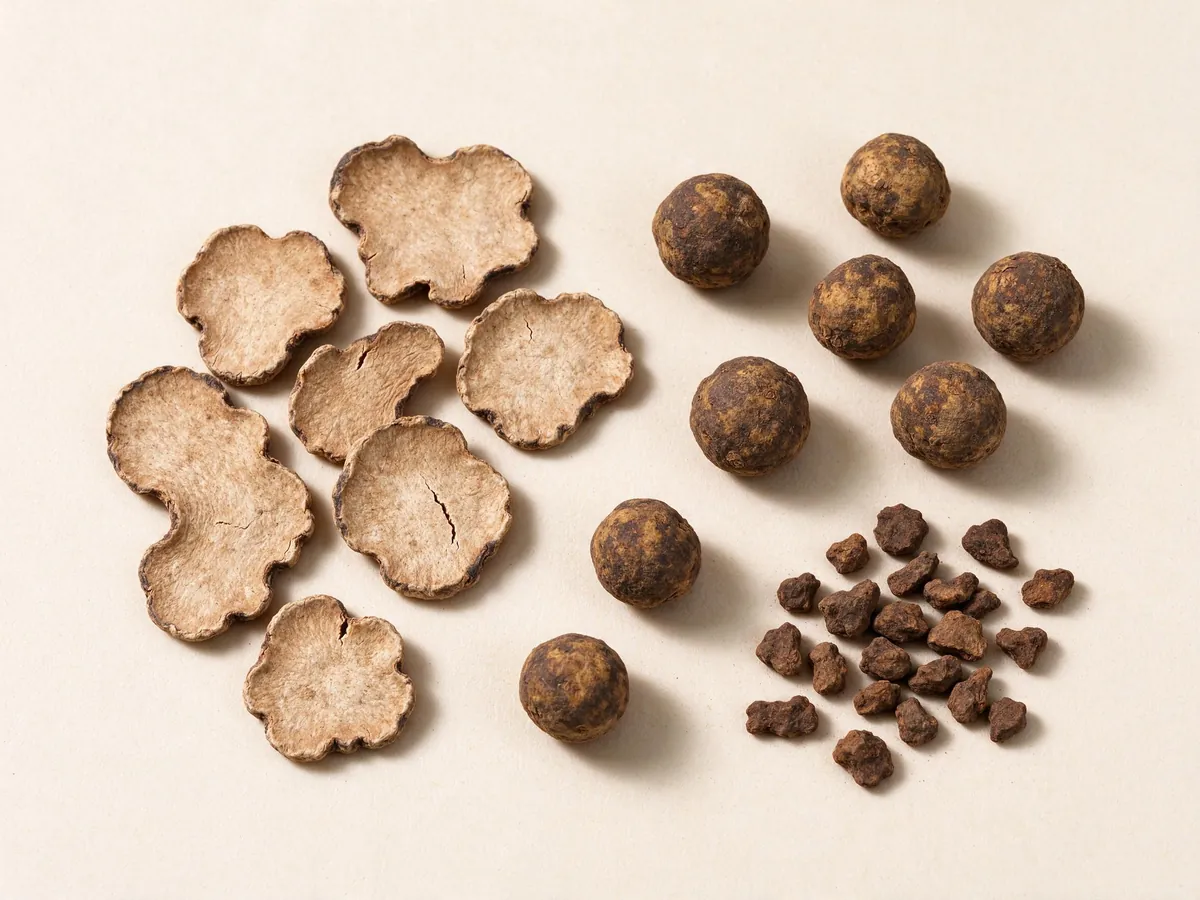
The pieces are slice-shaped, granular or roughly spherical, brown to brownish-brown on the surface.1
It is stored in a ventilated dry place and protected from insects.1
Safety
Incompatibilities
It should not be combined with Chuan Wu, Zhi Chuan Wu, Cao Wu, Zhi Cao Wu or Fu Zi.1
As a warm, drying herb it is used with caution, if at all, in dry cough from Yin deficiency, sore throat from excess fire, or bleeding.2
Pregnancy
In pregnancy, use only under a qualified practitioner.
Modern research
Toxic effects can be detoxified by Fuzhi processing.3
Fuzhi processing has remained the predominant method for preparing Pinellia rhizome.3
Dose and administration
The official reference dose is 3-9 g.1
Common questions
Is it the same as raw Ban Xia?
No. It is a processed product of the Pinellia rhizome.1
What must it not be combined with?
Chuan Wu, Zhi Chuan Wu, Cao Wu, Zhi Cao Wu and Fu Zi.1
References
- Chinese Pharmacopoeia Commission. Pharmacopoeia of the People's Republic of China, 2020 edition, Volume I. Beijing: China Medical Science Press; 2020. Part I, p. 124.
- Bensky D, Clavey S, Stöger E. Chinese Herbal Medicine: Materia Medica. Portable 3rd edition. Seattle: Eastland Press; 2015. pp. 445-450.
- Peng W, Li N, Jiang E, Zhang C, Huang Y, Tan L, Chen R, Wu C, Huang Q. A review of traditional and current processing methods used to decrease the toxicity of the rhizome of Pinellia ternata in traditional Chinese medicine. J Ethnopharmacol. 2022;36087845. doi:10.1016/j.jep.2022.115696 pubmed.ncbi.nlm.nih.gov/36087845
Educational reference only. Not medical advice or an individual prescription. Consult a qualified practitioner before using any herb or treatment.