Overview
Hou Po is bitter, acrid and warm, entering the Spleen, Stomach, Lung and Large Intestine.1
It dries Dampness and transforms Phlegm, and it directs the Qi downward to remove fullness.1
It is an important herb for reducing and eliminating distension and fullness.2
Identity and sources
The medicinal material is the dried trunk, root and branch bark of Magnolia officinalis or its variety biloba.1
The bark is stripped from April to June; root and branch bark are dried in the shade.1
Trunk bark is boiled briefly, heaped in a damp place until the inner surface turns purple-brown, then steamed, rolled into tubes and dried.1
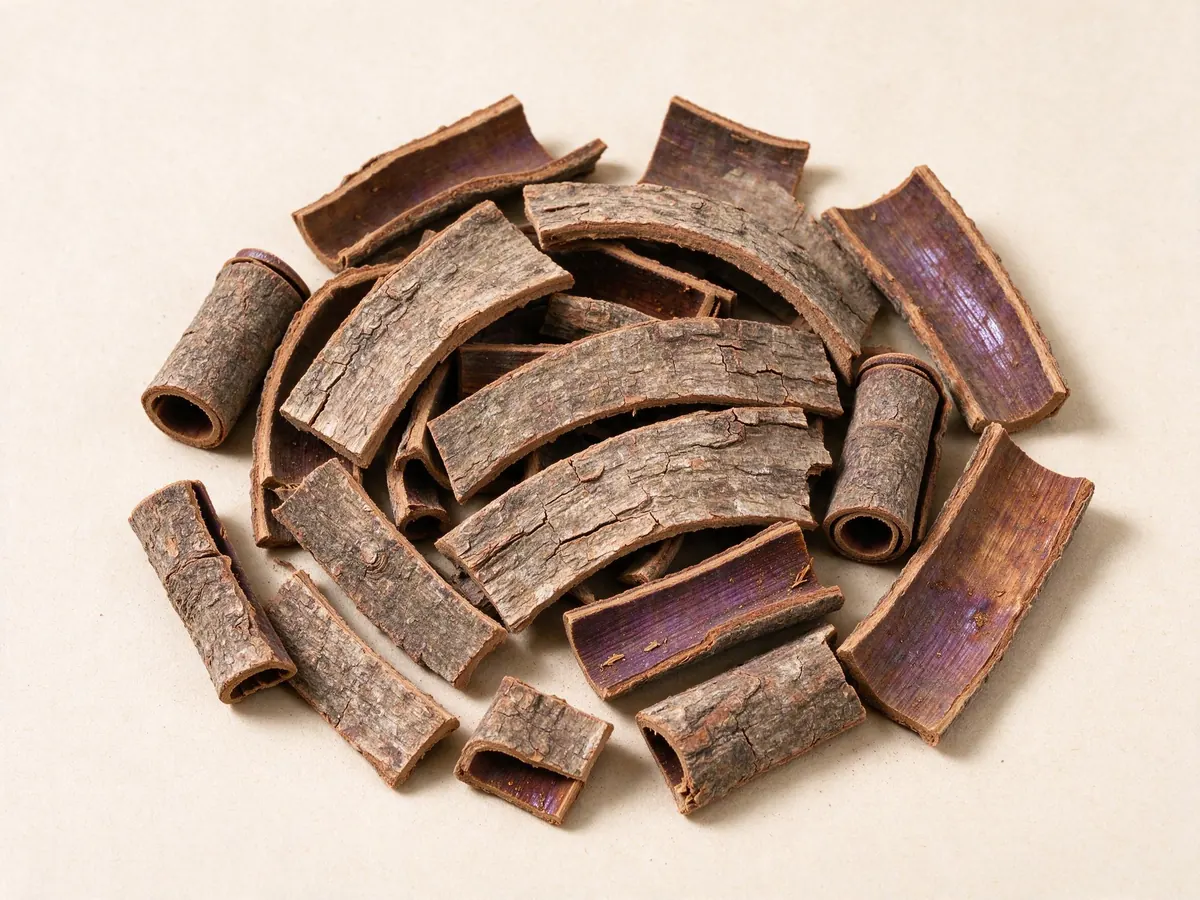
The trunk bark comes as single or double rolls, grey-brown and rough outside with oval lenticels and longitudinal wrinkles, and purple-brown, smooth and oily inside with fine longitudinal lines.1
Actions
- Promotes the movement of Qi in the middle burner and resolves stagnation. For Qi stagnation in the Spleen and Stomach and for food stagnation, with distension and fullness of the chest and abdomen.2
- Promotes the downward movement of Qi, dries Dampness and transforms Phlegm. For Dampness or Phlegm obstructing the middle burner with distension, fullness, nausea, diarrhoea and a turbid greasy tongue coating.2
- Directs Qi downward, reduces Phlegm and calms wheezing. For cough and wheezing from Phlegm clogging the Lungs.2
Clinical applications
Distension and fullness
It promotes the movement of Qi in the middle burner and resolves stagnation, and is used for distension and fullness of the chest and abdomen from Qi stagnation and food stagnation.2
It treats fullness from an accumulation with form, such as constipation, as well as fullness from formless constrained Dampness.2
Damp-Phlegm obstruction
For distension, fullness, nausea and diarrhoea with a turbid, greasy tongue coating.2
Cough and wheezing
It directs Qi downward and reduces Phlegm, and is used for cough and wheezing from Phlegm clogging the Lungs.2
Key combinations
With Gui Zhi and Gan Jiang for distension and fullness from cold congealing and leading to Qi stagnation.2
With prepared Pinellia and Poria for Phlegm obstructing the Qi dynamic, with coughing, vomiting or a sense of something stuck in the throat, as in Pinellia and Magnolia Bark Decoction.2
With Cang Zhu and Chen Pi for Stomach excess with epigastric fullness and distension, acid reflux, distasteful belching and nausea or vomiting, as in Calm the Stomach Powder.2
With Gan Jiang and Cao Dou Kou for cold-Dampness in the middle burner, as in Magnolia Bark Decoction for Warming the Middle.2
With Zi Su Zi and Rou Gui for cough and wheezing from excess above and deficiency below with Phlegm clogging.2
With Xing Ren and Gui Zhi for cough and wheezing with externally contracted wind.2
Comparison with similar herbs
| Herb | Key difference |
|---|---|
| Hou Po 厚朴 | Bitter, acrid and warm. Its focus is to direct the Qi downward, and its warmth dries Dampness and strengthens the Stomach and Spleen.3,2 |
| Zhi Shi 枳实 | Cold; its function is to break up Qi stasis. Both treat obstruction from food, Dampness or Phlegm with fullness and distension.2 |
| Cang Zhu 苍术 | Acrid, bitter and warm, and especially drying. It strengthens the Spleen internally and, by inducing sweating, releases the exterior and dispels wind-Dampness.2 |
By contrast, Hou Po excels at directing Qi downward and eliminating epigastric and abdominal distension and fullness.2
Processing and preparation
The bark is scraped of coarse cork, washed, softened, cut into threads and dried.1
The threads are curved strips or single or double rolls, grey-brown outside and purple-brown and oily inside, with a granular oily fracture and a pungent, slightly bitter taste.1
The ginger-prepared form is made by stir-frying the threads with ginger juice until dry; it is grey-brown with occasional scorch marks and a slight ginger pungency.1
Safety
Contraindications
It is used with caution in pregnancy, and classical texts say it cannot be used in pregnancy.2
Use with caution
It is reducing and guiding-out in nature and disperses without inhibition: it exhausts the primal Qi, without any tonifying or augmenting effect.2
Modern research
A review of honokiol, a biphenolic lignan isolated from the bark of Magnolia officinalis, covers its neuroprotective, antitumour, anti-inflammatory and metabolic regulatory effects.4
The review summarises 99 studies on the pharmacological profile of honokiol.4
Dose and administration
The official reference dose is 3-10 g.1 The dose in Taiwan is 3-11.5 g.3
This is a reference range, not a safe upper limit.
Common questions
How does it differ from Zhi Shi?
Zhi Shi is cold and breaks up Qi stasis, while Hou Po is warm, directs the Qi downward and dries Dampness.2
How does it differ from Cang Zhu?
Cang Zhu is especially drying and releases the exterior by inducing sweating; Hou Po excels at directing Qi downward and removing distension and fullness.2
What does the ginger form add?
It is made by stir-frying the threads with ginger juice until dry, giving a grey-brown form with occasional scorch marks and a slight ginger pungency.1
References
- Chinese Pharmacopoeia Commission. Pharmacopoeia of the People's Republic of China, 2020 edition, Volume I. Beijing: China Medical Science Press; 2020. Part I, p. 263.
- Bensky D, Clavey S, Stöger E. Chinese Herbal Medicine: Materia Medica. Portable 3rd edition. Seattle: Eastland Press; 2015. pp. 470-472.
- Ministry of Health and Welfare. Taiwan Herbal Pharmacopoeia, 4th edition (English edition). Taipei; 2022, with 2025 amendments where cited. pp. 447-448.
- Jiang W. Pharmacological advances of honokiol: Mechanisms, targets and therapeutic potential (Review). Biomed Rep. 2026;25(3):103. doi:10.3892/br.2026.2176 pubmed.ncbi.nlm.nih.gov/42488747
Educational reference only. Not medical advice or an individual prescription. Consult a qualified practitioner before using any herb or treatment.